





 Subscribe


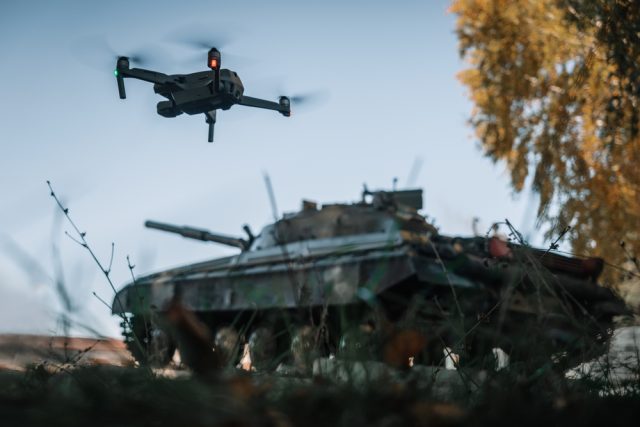
In the account of Ukraine’s counter-offensive at Oleksandrivka, the most revealing detail is the order of arrival. First came the preparation of the battlefield, then the infantry advance, and finally the tanks, consolidating the ground already taken. In her report published in The Telegraph on 3 October, Verity Bowman describes an armoured deployment made possible by months of operations against the military system that had restricted its movement: Russian logistics, reconnaissance, artillery and drones. The threat had not disappeared. The conditions for confronting it had changed, locally.
This episode offers a starting point for examining the transformation of European defence without reducing it to a contest between old and new weapons. The question emerging from the testimonies gathered by the British newspaper is not simply whether the tank still has a future, but which other capabilities its use depends upon. That question also connects Ukraine’s experience with European defence planning: how to integrate traditional platforms, uncrewed systems and communications networks into a force capable of operating together.
The Tanks Return, but the War Has Changed
The Telegraph report contains an important qualification. The analysts interviewed do not describe a return to sweeping armoured advances across the front. In several instances, tanks provided firepower and protection for positions already taken by infantry. The area exposed to drone attacks had not been eliminated; in some sectors, it had become less dangerous. The newspaper also reports Ukrainian losses, avoiding the suggestion that adaptation has delivered a permanent solution to the vulnerability of heavy armour.
That distinction matters. A local result does not establish that the same combination can be reproduced everywhere, nor does it settle the question of armoured survivability. In this account, however, the tools that have transformed the battlefield have done more than obstruct the tank. Used alongside other capabilities, they have helped make its deployment possible again. The relationship between drones and crewed vehicles therefore appears more complicated than the straightforward replacement of one by the other.
A compatible interpretation had been advanced on 20 June by Hamish de Bretton-Gordon and James Holland, also writing in The Telegraph. They envisaged tanks adding new functions to their traditional roles: communications nodes, electronic warfare platforms and mobile support bases for drones. The electrical power available aboard these vehicles, they argued, could enable uses beyond direct combat. This was a possible direction of development, not a description of a configuration already widespread across European armies.
The connection between the two articles is therefore a hypothesis about transformation, rather than proof that the tank of the future has already appeared on the Ukrainian front. One outlines a potential technological evolution; the other describes an operational adaptation. What links them is the importance attached to the relationships between the different components of a force.
From Experience to Planning
This thinking has already entered British defence planning. The 2025 Strategic Defence Review envisages a “20-40-40” mix of crewed platforms, reusable uncrewed systems and consumables, including ammunition and one-way attack drones. This is not a division of expenditure, nor does it mean that drones alone would provide 80 per cent of capability. The document retains a role for armoured vehicles, placing their evolution within a more integrated force.
The same review proposes a digital network connecting sensors, decision-makers and weapons systems, explicitly informed by lessons from Ukraine. It also calls for integration to be assessed through asset availability, sustainability, NATO interoperability and the speed of decision-making. The conceptual shift is from possessing individual technologies to making them work together. These remain objectives and recommendations: the document does not certify that the transformation has been completed.
It is through these steps that battlefield experience can contribute to the writing of doctrine. An experience is observed, interpreted and translated into requirements, training and organisation. There is no automatic transfer from the success of a Ukrainian unit to the readiness of a European army.
The European Connection
At EU level, on 28 September the European Commission announced Member States’ endorsement of the first five European Defence Projects of Common Interest. Their scope includes drones and counter-drone systems, maritime and seabed defence, space, air and missile defence, and security along the eastern flank. Under the European Defence Industry Programme, EDIP, the Commission has allocated €325 million to support this category of projects. Endorsement allows them to move towards funding; it does not mean that the systems are operationally available.
The Defence Readiness Roadmap 2030, presented in October 2025, makes the connections between capabilities explicit. For the European Drone Defence Initiative and Eastern Flank Watch, it proposes combining surveillance, drones, countermeasures, electronic warfare and operational coordination, in cooperation with NATO and complementing its regional plans. The proposed structure includes capability coalitions with lead nations: a framework for cooperation among states, not a description of an already constituted European force.
Read alongside the Ukrainian accounts, these documents suggest a convergence in approach. They do not, by themselves, establish that European programmes have already absorbed every lesson of the conflict. They do, however, allow questions that can be tested: which systems will exchange information, which units will operate them, with what training, and under which shared procedures?
The industrial dimension belongs to the same problem. The roadmap links military preparedness to production at the required scale and speed, shorter delivery times and greater security of supply. It also envisages integrating Ukrainian industry and innovation into the European effort. These are stated objectives whose implementation remains to be measured.
The Network Extends Behind the Front
The announcement of European funding for drones introduces a related but distinct field. On 2 October, Euronews reported an additional €130 million for technologies intended to strengthen border security. The scheme covers drones, counter-drone systems and their integration into national surveillance networks. In the statements quoted, Commissioner Magnus Brunner also referred to the protection of critical infrastructure.
It would be misleading to add this funding to military programmes as though it supported the same mission. Border surveillance and high-intensity combat have different purposes and requirements. The connection concerns certain functions instead: detecting a threat, sharing information and coordinating a response. That is where this funding belongs in the argument—not simply because it contains the word “drone”.
RANE’s situation report of 2 October adds the question of infrastructure vulnerability. Drawing on reporting by The New York Times, it describes an alleged Russian plan, presented by Ukraine as intercepted intelligence, targeting electricity, heating and water supplies in Kyiv, Kharkiv and Odesa. That attribution must be preserved: the RANE brief does not independently establish the plan’s authenticity. In RANE’s assessment, attacks on electrical connections could also disrupt nuclear generation and municipal services, with extensive consequences for the population.
The comparison highlights two distinct but connected problems: enabling armed forces to operate and preserving the services on which the society sustaining them depends. It does not require conflating internal security with military defence, or suggesting that counter-drone systems can answer every threat.
The Gap Between a Programme and a Capability
An indication of this gap appears in the European Defence Agency’s statement of 30 September on the first Annual Defence Readiness Report. Its summary records progress but also identifies continuing shortfalls, distinguishing between spending, capabilities, industry and partnerships. The full report is intended for governments and is not public. Any assessment must therefore rest on the official statement, rather than a reading of the complete document.
Taken together, these sources describe a transformation under way. The Ukrainian reporting shows how a weapon’s employment can change when the system surrounding it changes. The British review translates similar reasoning into a force model. European programmes identify capabilities and industrial instruments through which to pursue integration. These are connected levels, but they are not interchangeable.
At Oleksandrivka, according to The Telegraph, tanks helped hold positions taken after preparation involving several other components of the force. That is the operational finding from which to begin, without turning it into a universal promise. Its relevance to European defence lies in the question it leaves open: not only which assets will be available, but under what conditions they can be employed together.