





 Subscribe


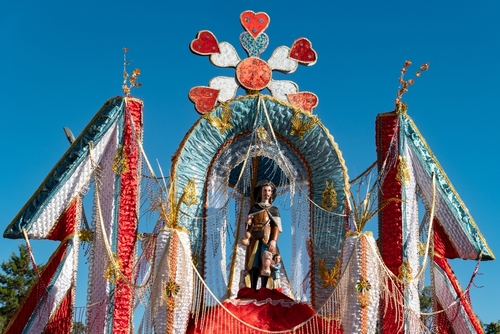
There is a Europe that does not appear in the official documents of Brussels, in international conferences or in major economic statistics. It is a Europe that is older and also surprisingly contemporary: the Europe of bell towers, marching bands, illuminated squares, processions, traditions passed down through generations, brotherhoods, tables laid for a feast, and recipes preserved within families as a form of memory. It is the Europe that, at least once a year, gathers again in its own square and recognises itself in a ritual that predates modern political borders and continues to survive within them.
From Italy to Spain, from Portugal to Greece, from Croatia to Poland, and through the Catholic regions of Austria and southern Germany, there exists a shared European sensibility that takes different but recognisable forms: the patron saint festival, the feast of a saint or, often, of the Virgin Mary, the procession, the religious celebration that also becomes the feast of a village, a town, a city, a community.
When that day arrives, the face of these places changes. The streets that throughout the year belong to everyday life acquire a different solemnity. Windows are decorated, façades are cleaned, and streets are crossed by arches of lights which, as evening falls, illuminate geometric patterns above the crowd. The bells ring longer and with a particular gravity, as though they wished to call not only those who are alive today, but also those who came before them. The scent of incense drifts out of the churches; in the squares, the murmur of the crowd mingles with the sound of the band; the voices of children intertwine with those of the elderly.
For a few hours, public space ceases to be merely a place of passage and becomes once again what it has been for centuries: the visible heart of a community.
The patron saint festival is not simply a folkloric spectacle, nor is it a tourist event to be watched from the outside. It is a communal ritual in which a population renews the story of itself. At its centre is the sacred: the solemn Mass, the prayers, the statue of the patron saint carried out of the church and entrusted to the hands of the men who will accompany it through the streets. The procession moves slowly, marked by the steps of the bearers and the music of the band. Balconies fill with people, the doors of houses remain open, some make the sign of the cross, while others watch in silence.
Sacred images pass along the same streets once walked by generations of grandparents and great-grandparents. In that moment, the past is not simply remembered: it physically returns to the present.
And when the festival belongs to a town facing the sea, the sea itself becomes part of the community’s civic and religious liturgy. The statue of the patron saint is placed aboard a boat, and a small fleet of fishing vessels, decorated for the occasion, follows it along the coast. The horns of the boats answer the bells on the shore; the water opens before the procession while people watch from the waterfront, the piers, the windows and the terraces. It is a profoundly Mediterranean image, but also a profoundly European one: the sea that for millennia has connected peoples, trade, languages and civilisations becomes, for one day, part of a community’s religious memory.
The same happens, in different forms, in many other regions of the continent. The saints, the music, the colours, the architecture and the way the streets are crossed may change, but what remains recognisable is the same spiritual structure: a community that leaves its private spaces, occupies public space and represents its own history within it.
In Spain, processions can transform entire neighbourhoods into settings of intense popular participation; in Poland, Marian devotion and great religious celebrations mobilise entire towns and cities; in Greece, festivals dedicated to patron saints are intertwined with the life of local communities; in Croatia and along the Adriatic, religious celebrations preserve the relationship between village, sea and devotion; in the Alpine regions of Austria and southern Germany, religious festivals are accompanied by bands, traditional costumes, processions and ancient communal customs.
These are not identical identities, and it would be a mistake to try to make them so. It is precisely their diversity that makes them European.
Europe, after all, was not born of uniformity. Its history is that of a civilisation capable of holding profound differences together through a common fabric. Long before modern states existed, European populations had built forms of belonging around places, patron saints, traditions, trades, devotions and shared memories. The patron saint festival is one of the most visible survivals of this ancient social architecture.
For this reason, it also says something important about Europe’s contemporary identity crisis. Europe’s problem does not consist only of its economic difficulties, its political divisions or the distance between institutions and citizens. There is also a quieter crisis of belonging: the difficulty of answering the question of what it means to feel part of a common history.
An identity cannot be built through rules, regulations, economic indicators or administrative formulas alone. Institutions can organise coexistence, but they cannot by themselves create the emotional attachment to places, people and memories that makes a community truly alive.
This is where the patron saint festival acquires a meaning that goes beyond the borders of any individual country. It shows that identity is not necessarily something that is proclaimed: it is something that is practised. It appears in the volunteer who prepares the decorations, in the brotherhood that safeguards a statue, in the musicians who rehearse for weeks, in the families who prepare traditional dishes, in the shopkeepers and elderly people who tell younger generations how the festival was celebrated when they were children.
It is present in the emigrant who returns precisely for those days, because they know that there is one moment each year when their hometown is not merely the place they left behind, but the place to which they still belong.
In this sense, the festival is also an extraordinary response to contemporary loneliness. In a society in which an increasing part of life takes place through screens, platforms and relationships mediated by technology, the festival demands presence. You have to be there physically. You have to walk together, stand in the same square, listen to the same music, wait for the procession to emerge, share the silence of a solemn moment and, only a few hours later, the joyful noise of the band and the crowd.
The community is no longer an abstract concept: it becomes a multitude of recognisable faces.
Even the simplest festival contains a form of civic education that often escapes the great political theories. A tradition survives because someone takes responsibility for passing it on. A child learns to recognise a melody because they have heard it in the streets; they learn the meaning of a procession because they have seen it alongside their grandparents; they learn the name of a dessert, a prayer, a gesture, a story because someone has handed these things down to them. Culture, before it is studied, is lived.
This is the deepest meaning of preservation. To preserve does not mean to embalm. A truly living tradition does not remain still: it changes its forms, uses new technologies, communicates through social media, welcomes visitors and opens itself to cultural tourism. But it can do so without losing its centre.
Modernity, then, does not necessarily have to become synonymous with the erasure of the past. It can also become the means through which a community makes what it has inherited visible once again.
Here we can also understand the connection between the patron saint festival and the principle of subsidiarity. Almost never does a celebration of this kind originate from above. The festival takes shape from below: through associations, parishes, brotherhoods, families, small businesses, volunteers, musicians and artisans. It is a concrete expression of that civil society, made up of intermediary bodies and spontaneous bonds, which has constituted one of Europe’s great historical strengths.
And perhaps this is precisely what Edmund Burke had in mind when he spoke of society as a bond between the living, the dead and those yet to be born. A community is not merely the sum of individuals present at a particular moment. It is continuity through time.
The patron saint festival makes this continuity almost tangible: the same statue that crosses a street today was carried along those same roads by men and women who have long since disappeared; the same melody played by the band was heard by previous generations; the same recipe contains gestures learned from mothers and grandmothers; the same square preserves the memory of those who gathered there before us.
And yet the European meaning of these traditions does not lie in each community closing itself within its own small local identity. On the contrary. A person who knows where they come from is often better able to understand what comes from elsewhere. Being rooted does not necessarily mean exclusion: it can be the condition for encounter.
Those who possess a symbolic home can invite someone else to enter it. Those who know their own history can listen to the history of others without feeling threatened by their existence. This is perhaps one of the most important lessons that popular festivals can offer Europe: unity does not require the erasure of differences, but rather allows differences to recognise themselves as part of a broader civilisation.
An authentically self-aware Europe could therefore rediscover its unity not only in capitals and common institutions, but also in the extraordinary variety of its squares. It could recognise that behind the procession of a small Italian town, the festival of a Spanish village, the celebration of a Polish patron saint or a religious feast in an Adriatic community, there lies the same human experience: the need to belong to something that precedes us and that, at least ideally, will continue after us.
When evening falls, the lights illuminate the façades of the houses and the square seems to turn into a theatre. The band plays its final march, people gather along the streets, the bells ring once again and the statue of the patron saint slowly returns towards the church. For a moment, the town seems to gather around what has held it together for generations.
Then the fireworks begin, the sky lights up and the crowd looks upwards. But when the last lights fade, what remains is not merely the spectacle. What remains is the awareness of having taken part in something that belongs to everyone and to no one individually, because it has been received from the past and entrusted to the future.
It is in moments such as these that Europe can remember that its identity is neither a recent invention nor simply an administrative project. It is a civilisation made of stone and bells, of seas and mountains, of saints and festivals, of different languages and intertwined memories; a civilisation that has learned, over the centuries, to transform differences into multiple forms of the same belonging.
If Europe truly wants to overcome its sense of uprootedness, perhaps it should begin listening again to what comes from its smallest communities. It should look less from the top down and more from the bottom up. It should observe what happens when a square fills with people, when a bell calls them together, when a band begins to play, when the lights come on and an entire community recognises something of itself in its symbols.
Because perhaps Europe, before being a political project, has been and still is a way of life. And that way of life, in its infinite local variations, continues to reveal itself whenever a people gathers in its own square, watches its patron saint pass by and, for a few hours, feels that it belongs not only to a place, but to a history that comes from far away and is worth passing on to those who will come after us.