





 Subscribe


One of the books that most influenced me as a young man was Aleksandr Solzhenitsyn’s The Gulag Archipelago, published in English in 1974–1975. In the 1970s, I often debated communism in Icelandic schools with Stalinists, Trotskyists and Maoists, who fulminated against Iceland’s long-standing defence alliance with the United States and assured us that the next time socialism was implemented, it would not fail. In 2009, I translated the Black Book of Communism into Icelandic. It was originally published in French in 1997, on the sixtieth anniversary of the Bolshevik Revolution, edited by the eminent historian Professor Stéphane Courtois. In 2012, I attended my first meeting of the Platform of European Memory and Conscience, established the year before following a resolution of the European Parliament on remembering the victims of European totalitarianism. At the Platform’s initiative, I wrote a book in 2017, Voices of the Victims: Notes Towards a Historiography of Anti-Communist Literature, published by the Brussels think tank New Direction.
Communism: Rejected in Most Countries, Transformed in Some
Many countries in Central and Eastern Europe rejected communism after being forced to adopt it following the Second World War, whereas in Belarus and Russia it transformed into a corrupt autocracy, run in Belarus by the former Soviet apparatchik Aleksandr Lukashenko and in Russia by the former KGB agent Vladimir Putin. Despite occasional friction, Belarus has essentially become Russia’s client state. Lukashenko has clung to power since 1994, organising sham elections every fourth year and occasional referenda. Neither the United States nor the European Union recognises him as Belarus’s legitimate president. Lukashenko severely restricts freedom of speech in his country and uses the ruthless secret service to harass his political opponents and critics, imprisoning many of them and driving others into exile. Lukashenko has resisted the extensive economic reforms that enabled significant economic growth in Europe’s other post-communist countries. As a consequence, Belarus remains quite poor.
Poczobut Receives the Platform Prize
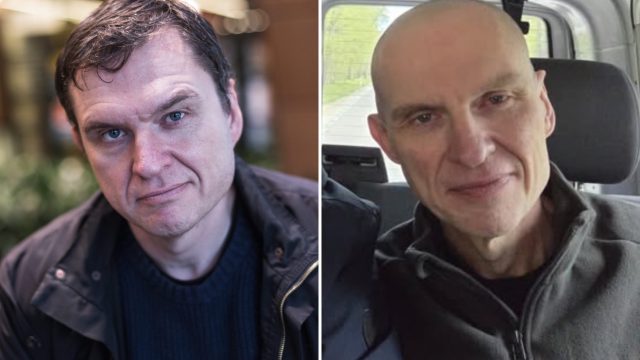
Each year, the Platform of European Memory and Conscience awards a Prize to someone who excels in advancing its mission. Former recipients include Russian historian Vladimir Kara-Murza, who was sentenced to 25 years in prison for protesting the 2022 invasion of Ukraine, and Ukrainian journalist Dmytro Khyliuk, who was kidnapped in his home village by the Russian invasion force. Both were released in prisoner exchanges soon after receiving the Prize. This year, the Platform Prize goes to the Polish-Belarusian dissident Andrzej Poczobut. Born in 1973, he graduated in law from Hrodna University in 1998 and became a journalist. He was first arrested in 2011 for participating in a protest against the sham presidential elections in December 2010. He was arrested again in 2011 and in 2012, allegedly for ‘libelling’ Lukashenko abroad. He was arrested again in 2021 and convicted for ‘damaging the national security of Belarus’ and ‘sowing discord’. One of his alleged crimes was recognising the Soviet invasion of Poland in 1939 as an act of aggression: in their Pact of 23 August 1939, Stalin and Hitler had divided Poland between them, with Hitler attacking on 1 September from the west and Stalin on 17 September from the east. Another charge against him was that he strove to honour the memory of anti-totalitarian heroes in and after the Second World War. Poczobut spent the next few years in a maximum-security penal colony, where conditions were harsh, as can be surmised from the two photos of him above, before and after his imprisonment.
Release and Return to Belarus
In late 2025, the European Parliament awarded Poczobut the Sakharov Prize for Freedom of Thought, which he shared with another political prisoner, Georgian journalist Mzia Amaglobeli. In April 2026, Poczobut was released to Poland in a prisoner exchange with Belarus, while Amaglobeli remains in prison. In an address to the European Parliament on 17 June 2026, Poczobut noted that Belarus still held 854 political prisoners, including 21 journalists. He made a brief return to Belarus in early September but vowed to return permanently and continue the fight for freedom. Hopefully, he will receive the Platform of European Memory and Conscience Prize next spring as a free person.