





 Subscribe


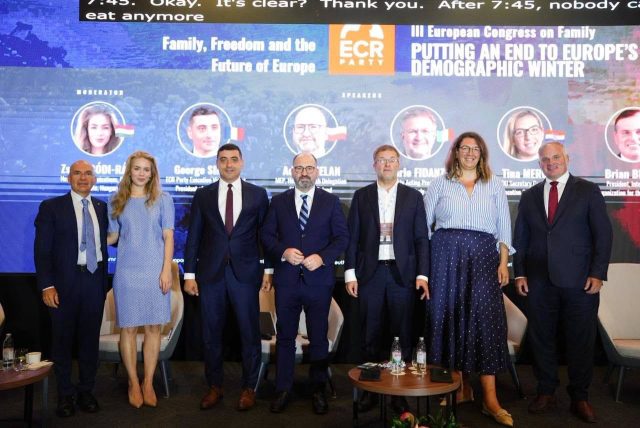
– Europe’s demographic crisis is not merely a matter of numbers. It is a cultural, economic and political crisis that concerns the continent’s very future. That was the message to emerge from the panel “Family, Freedom and the Future of Europe”, which concluded the afternoon session of the Third European Congress on Family, organised by the ECR Party in Dubrovnik. Political figures and representatives of international conservative organisations discussed birth rates, employment, housing, Christian identity and migration, comparing the experiences of Poland, Romania, Italy, Hungary and the United States.
The meeting was opened by Antonio Giordano, a member of the Italian Parliament and Secretary General of the ECR Party, who described the closing discussion as “certainly no less important” than the preceding panels and emphasised the international standing of its guests. The debate was moderated by Zsófia Bódi-Rácz, Head of Communications at the Danube Institute, a Budapest-based think tank. Her opening question defined the terms of the discussion: as birth rates decline, why does the European Union appear to rely upon migration rather than do more to support European families and citizens?
The first to respond was Adam Bielan, a Polish Member of the European Parliament, head of the Polish delegation in the European Parliament and a member of Law and Justice. “Europe is confronting not merely a demographic crisis, but a demographic and cultural crisis simultaneously,” he said. Bielan recalled the “500+” programme, later increased to “800+”, introduced by Poland’s conservative government to support families. In its initial phase, the measure helped increase births by 6 per cent. Money alone, however, is not enough, he acknowledged. Affordable housing, adequate wages and opportunities for young people are also required. Hence his defence of the personal income tax exemption for people under twenty-six and his criticism of the Green Deal and the Emissions Trading System: without industry, growth and employment, Bielan argued, there can be no effective demographic policy.
For Bielan, renewal must also be cultural. Christianity, he recalled, played a decisive role in Poland’s history and its resistance to communism. After 1989, however, the country was flooded with Western liberal ideas “in the worst possible way”, losing some of its traditional reference points. In his view, Karol Nawrocki’s presidential victory represents a sign of the return of conservative values.
George Simion, Executive Vice-President of the ECR Party and President of AUR, the Alliance for the Union of Romanians, shifted the focus towards political freedom and national sovereignty. According to the Romanian leader, Europe applies “a clear double standard” when judging conservative governments: the family policies of Poland’s Law and Justice government and Viktor Orbán’s government in Hungary were attacked together with the administrations that promoted them. “Why are they frightened of democracy, of returning to the ballot box and respecting the people’s vote?” he asked, denouncing pressure against sovereigntist parties.
On the relationship between birth rates and migration, Simion adopted the panel’s most uncompromising position: “We do not need any form of migration. We need to protect our children, our citizens, our civilisation and our Christian roots.” The AUR President distinguished Romanian emigrants, whom he described as integrated into their host countries and eager to return home, from illegal immigration, which “must be stopped”. He also credited the Meloni Government with making progress in combating irregular migration and identified 2029, the year of the next European elections, as the decisive opportunity to build a new continental majority.
Brian Brown, President of the International Organization for the Family, an international network committed to defending the natural family, offered a perspective from the United States. Brown challenged the argument that secularisation is an irreversible process, observing that the world’s most religious communities are also those having the most children. “If conservatives unite, we can respond to this situation together,” he said. For Brown, Europe and America belong to the same civilisation and cannot accept mass migration being presented as an automatic solution to declining birth rates.
His argument focused above all upon the meaning of freedom. Conservative liberty, he explained, exists within an ordered society and does not mean the absence of every limit. The state may therefore use taxation and other instruments to encourage choices that benefit the common good without dictating how many children citizens must have. “The family is a primordial institution. It precedes both the state and the market,” Brown said. It is within the family that values are transmitted, that people learn not everything offered by the market has equal worth and that the state is prevented from becoming absolute. “The state cannot replace a father or a mother.”
Tina Mercep, Secretary General and Executive Director of the International Democracy Union, a global organisation bringing together more than eighty centre-right parties from over sixty countries, contributed a comparative perspective. She cited Mongolia and Kazakhstan as countries where declining birth rates had been reversed in part by changing the public image of motherhood and parenthood. “The answer is culture, not merely cash,” she said. Showing that a woman can simultaneously be a mother and a member of Parliament, a moderator or a Prime Minister means restoring the social visibility of parenthood, Mercep argued.
Alongside culture, however, there is housing. A young couple living in a thirty-seven-square-metre apartment on the fifteenth floor is unlikely to be able to plan for a large family, Mercep observed. If demographic policies are to endure, the issue must also move out of the margins of social affairs ministries and become a permanent item on the agenda of heads of government: “Demography is an economic issue. It is a security issue. It is a defence issue.” In her closing message to young people, the Croatian official urged them not to conceal their Christian identity or allow the media and prevailing fashions to draw them away from the values in which they were raised.
The Italian perspective was presented by Carlo Fidanza, a Fratelli d’Italia Member of the European Parliament and Executive Vice-President of the ECR Party. Fidanza defended the stability of the Meloni Government and the measures introduced to support the birth rate and female employment, recalling that 1.3 million jobs have been created since the Government took office. Every additional job held by a woman, he argued, represents an element of freedom, because no woman should be forced to choose between motherhood and employment.
The results on birth rates, however, have not yet matched the scale of the investment. Fidanza’s conclusion was that the challenge is primarily cultural: “Family policy is not a cost; it is an investment. Every euro spent on family policy is an investment in the future of our civilisation.” European fiscal rules should therefore not treat expenditure supporting families as ordinary public spending. Migration, he added, can play a role only when it is “limited, regulated and based upon skills”, but it cannot become the alternative to a recovery in Europe’s birth rate.
In his second intervention, Fidanza connected demographic decline with deindustrialisation caused by excessive regulation and by Green Deal requirements imposed upon European companies while the market remains open to competitors that do not face the same constraints. Without economic growth and wages capable of providing security, young people postpone leaving the parental home and starting families. The Italian Government also intends to address this problem through a national plan to make more than 100,000 homes available at regulated prices, primarily for young people and families.
Fidanza also addressed foreign nationals’ access to welfare, criticising interpretations by European courts that make it difficult to introduce longer residence requirements. Resources, he argued, should give priority to citizens and to foreign nationals who are legally resident, integrated and committed to a stable future in the country. He consequently referred to the initiative promoted by Giorgia Meloni and Danish Prime Minister Mette Frederiksen to revise the interpretation of the European Convention on Human Rights in migration-related cases.
Mercep also returned to migration, citing British Conservative leader Kemi Badenoch’s position on its cultural dimension: a culture that accepts child marriage or violence against women, she observed, cannot be regarded as equivalent to one that rejects them.
Before the conclusion, Zsófia Bódi-Rácz invited Valeria, a young participant who had contributed to a research paper on the subject, onto the stage. Her question—how young people can be encouraged to have children without losing their traditions, way of life and family values—brought the discussion back to the generation that will live with the consequences of the demographic winter. The moderator concluded with the principle underpinning Hungarian family policy: “We want every desired child to be born”, and to build a Europe in which people once again desire to have children.
The Dubrovnik discussion offered no single formula. It did, however, establish a shared order of priorities: stable employment, affordable housing, favourable taxation, the defence of identity and policies capable of surviving changes of government. Above all, it rejected the idea that decline is inevitable or that Europe can simply replace the generations no longer being born through migration. For the conservatives gathered by the ECR, demographic renewal begins when the family is once again regarded not as a remnant of the past, but as the essential infrastructure of Europe’s future.