





 Subscribe


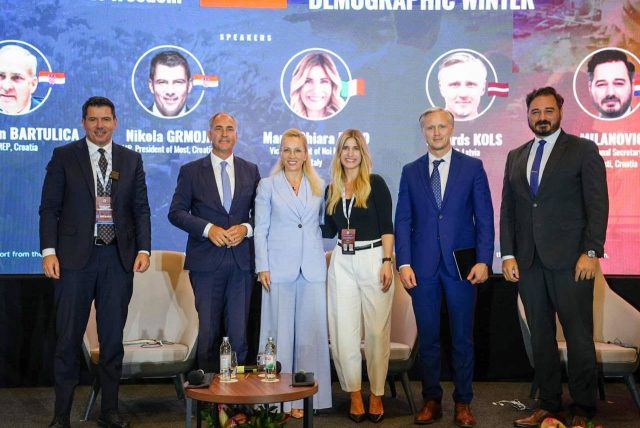
The family therefore entered the discussion not merely as the recipient of public support, but as a safeguard of liberty. Stephen Bartulica, a Croatian MEP in the ECR Group and a political philosopher by training, defended limited government, particularly in education. Parents, he argued, should be able to choose their children’s schools, including through a voucher system, and must retain responsibility for decisions concerning smartphones and social media. “When I discuss this subject, I refer to the natural family: a father, a mother and their children,” he said, recalling the referendum in which 67 per cent of Croatians voted in 2013 to define marriage in the Constitution as the union of one man and one woman.
His criticism extended beyond state intervention in education to European proposals restricting minors’ access to digital platforms. For Bartulica, such decisions belong first to parents. He also sees the desire to regulate social media as an attempt to control the spaces in which growing numbers of young people obtain information and encounter conservative parties. Protecting minors, he argued, must not become a pretext for taking authority away from families.
Rihards Kols, a Latvian MEP and Deputy Chairman of the National Alliance, challenged the very premise of unity. “The united centre-right at the service of freedom” is a reassuring phrase, he observed, but risks meaning nothing unless both centre-right and freedom are clearly defined. Political labels in Brussels change rapidly: the same ECR Group can be described as moderate, radical or far-right depending upon where commentators choose to place the political centre.
Kols therefore proposed replacing nominal affiliations with a concrete standard. “Freedom is not a static condition. Freedom is a practice.” Whenever legislators consider a directive, regulation or electoral promise, they should ask three questions: does it make citizens, businesses and families freer? Does it reduce excessive regulation or add another layer of control? Does it make the nation more resilient or more dependent? For Latvia, which borders Russia and invests almost 5 per cent of GDP in defence, sovereignty is not theoretical. “You cannot exercise freedom of speech, maintain free markets or enjoy family life if you cannot defend your sovereign borders.”
While Kols sought a common standard, Maria Chiara Fazio outlined a path towards cooperation. The Vice-President of Noi Moderati, responsible for relations with the European People’s Party, represented a party that governs Italy alongside Fratelli d’Italia and the Lega while belonging to a different political family in Brussels. Asked whether there was room to work together, she answered directly: “I see much more than an opportunity: I see a duty.”
For Fazio, demographic decline is no longer a temporary emergency but a structural condition requiring an ecosystem of policies. Cohesion funds for inland and remote areas, services for families, educational, sporting and cultural opportunities for children and greater attention to young people must form part of a strategy based upon subsidiarity. Cooperation among parties can begin with those practical objectives, while avoiding welfare policies that create dependency. She summarised the Italian approach in one sentence: “We will not use families to obtain votes. We will obtain votes in order to defend families.”
It was here that the panel revealed its most interesting tension. Nikola Grmoja, a Croatian MP and President of Most, rejected the idea that a coalition becomes credible by simply adding together polling percentages. Parties endure, he argued, when voters recognise “authenticity, sincerity and values that you actually live by rather than merely discuss”. The greatest danger to conservative and sovereigntist thought does not necessarily come from its opponents; it may arise internally when conduct contradicts proclaimed principles.
Grmoja said he was prepared to support any proposal that benefited families and contributed to a “stronger Christian Europe”, regardless of which party introduced it. He nevertheless rejected stable political cooperation with forces he regarded as centre-right in name alone. His criticism was directed above all towards Croatia’s EPP-affiliated HDZ, which he described as a clientelist party enabling the Left to grow stronger. In this view, unity cannot precede credibility: “For that truth to reach people, its messenger must be credible.”
Bartulica responded from his experience in the European Parliament, where the different groups of the Right struggle even to organise joint initiatives. That weakness, he argued, betrays voters’ expectations. “We serve you. We are not here for ourselves.” Politics, he added, is neither an exact science nor the road to Heaven. It requires prudence, a willingness to compromise and the ability not to turn personal conflicts into permanent obstacles.
The exchange between the two Croatian politicians became direct. Grmoja argued that Christian love does not require politicians to ignore betrayal or abandon caution when choosing allies. Bartulica replied that figures close to Most had participated in attacks against him during an election campaign, but urged the audience not to remain prisoners of past wounds. Beyond the personal dispute, their disagreement exposed the central problem facing Europe’s centre-right: unity may produce results, but cooperation without trust can destroy the very alternative it seeks to create.
Marko Milanović Litre, a former Croatian MP and International Secretary of the Croatian Sovereignists, returned the discussion to the cultural consequences of that choice. Answering a young Dutch participant’s question about the secularisation of younger generations, he described the family not as simple coexistence but as “a partnership” between mother and father. Making it desirable again requires sustained cultural work, showing the harm caused by the absence of either parent and transmitting, particularly in post-communist countries, the memory of the control authoritarian regimes exercised over society.
Kols reinforced the same point by recalling that Latvia was not merely a former Soviet republic, but an occupied country. Today’s twenty-year-olds were born after Latvia had joined both the European Union and NATO and possess no direct experience of communist rule. That historical distance, he warned, can be exploited by progressives. Yet just as many members of the hippie generation eventually formed families, he believes the young people of the twenty-first century may also rediscover their value.
The panel therefore produced no organisational formula for uniting Christian democrats, conservatives and sovereigntists. It did, however, clarify the conditions without which unity would be no more than an electoral cartel: a common standard of freedom, respect for subsidiarity, verifiable policies for families and a credible political class. Bartulica concluded by quoting Saint Teresa of Calcutta: “If you want to change the world, go home and love your family.” It was perhaps the most coherent conclusion to a discussion that began with European alliances and ended by recalling that political freedom begins before the state and before political parties.