


 Subscribe


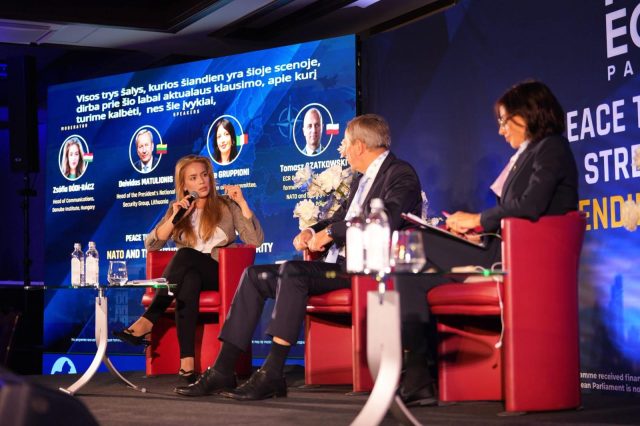
On October 25–25, Vilnius hosted the conference “Peace Through Strength: Defending Europe”, organised by the European Conservatives and Reformists Party. The two-day event saw intense debates, during which prominent officials, decision-makers and defence specialists from Italy, Poland, Lithuania, and other European countries discussed the massive challenges facing Europe in the new security landscape. The first panel of the conference, moderated by Zsófia Rácz, Head of Communications at the Danube Institute, featured high-level speakers from Lithuania, the host country, and Italy, legislators and experts alike, which addressed a highly significant, pressing, and challenging topic – “NATO and the Future of European Security”.
Not only does our continent need a strong alliance, but it also needs each member state to take responsibility. What should be the priorities of a stronger NATO, and what kinds of circumstances should justify invoking Article 5 of the North Atlantic Treaty? These powerful questions kicked off the ECR conference in Vilnius.
Deividas Matulionis, Senior Advisor to the President of Lithuania and Head of the National Security Group, drew attention to certain incidents, such as drone incursion or attempted arson, which fall more into the realm of “shadow” or “malign” activities and do not meet the necessary conditions to trigger Article 5. According to Mr. Matulionis, also former Lithuania’s Permanent Representative to NATO, it would be a major mistake to invoke Article 5 in less serious cases. “Sometimes we devalue Article 5”, he said. But when a member state is under attack, when the evidence is undeniable, there is no room for debates.
Italian parliamentarian Naike Gruppioni, member of the Foreign Affairs Committee in the Chamber of Deputies, spoke about the necessity for people to understand that defence spending is essential. According to the Italian lawmaker, defence expenditure is an investment, a vital one, and a source of significant opportunities for both citizens and businesses. Defending our own country means defending our freedom. Transparency and honesty are vital to prevent people from feeling manipulated and to remain confident that real solutions can be found. According to Mrs. Gruppioni, a strong supporter of strengthening European and Italian capabilities, it is “not just about purchasing weapons”, but the real challenge is “to turn resources into real capabilities”.
The Head of the Lithuanian President’s National Security Group emphasised that, within the EU new financial framework, one of the key decisions should be to increase the budget allocated to the defence and security industries. This is an investment not only in our defence and deterrence, but also in our economies and our jobs. Deividas Matulionis said he was “really grateful” that the Lithuanian government is spending an impressive figure on national defence – 5.38 percent of its GDP, but also 1.6 percent on other defence-related expenditures. Over 60% of that spending remains in the Republic of Lithuania, which is an admirable achievement.
Aurelijus Veryga, Chairman of the Lithuanian Farmers and Greens Union, strongly argued in favor of increasing defence spending, while stating that the countries on the eastern flank need more money so that their industries can remain competitive. Beyond all this, the real question, according to Mr. Veryga, should be: how much money should we spend to stay alive?
However, even though other countries are also making substantial efforts, Europeans must acknowledge this reality: our continent cannot defend itself and will need more years to achieve this goal. But, if there is “the political will to spend more money,” Europe will be on the right track.
According to Italian MP Naike Gruppioni, there is no collective defence outside of NATO, and Europe is required to assume “real responsibilities.” To put it another way, when you call for certain protection, you must commit to make the necessary contribution – whether it involves technology, infrastructure, or highly trained troops. The choice should not be between a stronger Europe and a stronger NATO, but rather to secure both. On the other hand, the Italian parliamentarian stated that she disagrees with fostering antagonism between the EU and the United States, as the transatlantic bond is – or should be – a “strategic choice” for Europeans.
This principle was also reinforced by Deividas Matulionis, former Lithuania’s Permanent Representative to NATO, who stated that North Atlantic Treaty Organization, with its 360-degree approach, is the only collective defence organization. The EU can act in a complementary manner, but it would be very dangerous to seek to substitute NATO. However, NATO’s European dimension should be further strengthened. “Europe should have ambition within NATO”, according to the Senior Advisor to the President of Lithuania. “Europe must carry more weight within NATO” – an opinion also shared by the Italian lawmaker, Naike Gruppioni.
Deividas Matulionis referred to the post-Cold War European defence system, which was based on three main pillars: the United States would continue to defend Europe, no matter what, economic cooperation would reduce conflicts, and no more large-scale military conflicts on our continent. All these fundamental concepts are now being questioned, said Mr. Matulionis.
Naike Gruppioni, member of the Foreign Affairs Committee in the Italian Chamber of Deputies, stated that she does not believe that Ukraine was “betrayed” by the current White House administration, which continues to maintain sanctions against the Kremlin, just as the European Union does. In fact, it is “simply rhetoric” — the truth is that Washington is the only one that can bring Moscow to the peace talks, while the EU clearly being sidelined in this such a lengthy process.
Lithuanian MEP Aurelijus Veryga spoke about the essential geostrategic role played by his country, which has demonstrated on numerous occasions that it is a reliable partner. According to Veryga, the Russian Federation will not be able to attack NATO states in a “conventional” manner, but it does – and will continue to do so – through hybrid means. Mr. Veryga mentioned Israel and Finland, countries that have fought extraordinarily at various stages in recent history – and continue to do so (Israel) – to preserve their sovereignty and freedom. Their lesson is that a society must remain alert and prepared for the unexpected during such troubled and dangerous times.
Regarding the Russian Federation, the panelists were asked when NATO should offer a stronger response to the Kremlin’s aggression. Deividas Matulionis replied that, on the one hand, the Russians’ objective is “psychological intimidation,” putting pressure on companies, and sowing distrust in the political system. According to Mr. Matulionis, concrete countermeasures are needed, even if sometimes they are covert operations. He mentioned several measures he would implement, namely restricting energy export capabilities, canceling tourist visas for Russian citizens, and trying to reach a European-level agreement on the use of frozen Russian assets.
When asked what NATO’s main objective should be for the next 5–10 years, Aurelijus Veryga replied that it should do “everything possible to stop Russia and to prevent future challenges from Russia”, the greatest threat of our times. While Italian MP Naike Gruppioni noted that a ceasefire would be a first step toward normalcy, Deividas Matulionis expressed his hope that, in the long term, Europe would become a major player on the global geopolitical stage.
To conclude the first panel of the ECR Party conference in Vilnius, moderator Zsófia Rácz pointed out that even though we still rely on the United States, this should not prevent European states to continue to fight for their own sovereignty as part of the North Atlantic Treaty Organization. The key is strong cooperation and the capacity to overcome the significant challenges that lie ahead.