





 Subscribe


For three decades after the fall of the Berlin Wall, “globalization” was the word that ended arguments. Borders softened, supply chains lengthened, and prosperity was understood to flow naturally from openness. Europe built much of its post-Cold War identity on this premise: a continent of trading nations, knitted together by the single market and connected to the wider world by an unshakeable faith that interdependence and peace were the same thing.
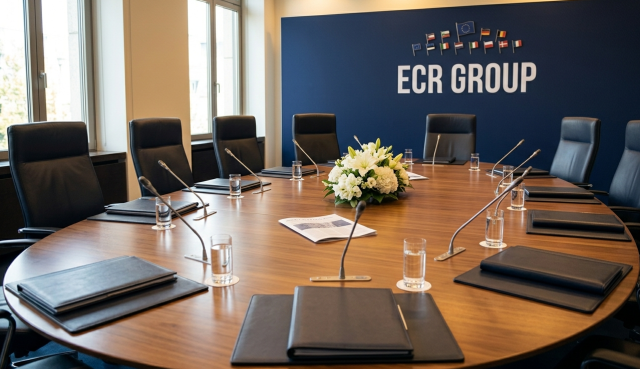
That premise no longer holds the same way and the ECR Group’s panel, “Defining European Economic Sovereignty in a Globalized World”, opens precisely where the comfortable consensus ends.
In the span of five years, Europe has lived through a pandemic that exposed the fragility of availability along the supply chains, a war on its eastern border that revealed the price of energy dependence on a hostile power, and an acceleration of technological competition between Washington and Beijing in which the European Union has often found itself a spectator rather than a player. The language of Brussels has adjusted with remarkable speed: “Open strategic autonomy”, “de-risking”, “economic security”, “critical raw materials”, “technological sovereignty”, terms barely audible a decade ago now structure entire legislative dossiers.
Antonio Rapisarda, the director of “Il Secolo d’Italia” and a speaker on Friday’s panel, has put the question of “Are we ready?” with characteristic directness at the Forum Machiavelli on defense earlier this year. And he answered for himself: “Europe is not. Globalization is crumbling, conflicts are multiplying, the United States is drifting away, and Italy and Europe risk becoming “vasi di coccio” (clay pots) caught between world powers”. The image is taken from Manzoni, and the warning behind it is old: the brittle vessel travelling among iron ones is the one that breaks. Rapisarda’s prescription is a European pillar within NATO, a strategic autonomy that does not rupture the Atlantic alliance, a formulation that has become the working doctrine of the Italian government and that will frame much of the panel’s debate.
A central task of the panel is definitional, and the distinction matters. Economic sovereignty, in the sense the ECR has consistently defended, does not mean self-sufficiency. It is not the resurrection of trade barriers, nor a retreat from the open commerce that made post-war European prosperity possible. It is, rather, the capacity of nations and of the Union acting on their behalf to make decisions in their own strategic interest without those decisions being foreclosed by dependencies they did not choose and cannot easily exit.
That is a narrower and more honest concept than the slogans suggest. It accepts that a continent of 450 million people will always trade extensively with the rest of the world and it insists only that trade should not be allowed to become a vector of coercion. The question the panel will press is how to operationalize that distinction, where the line between healthy interdependence and structural vulnerability actually falls, and who decides.
The most concrete recent test of that question is the European Union’s climate trajectory, and few have stated the ECR position on it more sharply than the Romanian AUR MEP Adrian Axinia, who joins the panel from Strasbourg. Ahead of the November 2025 mini-plenary on the 2040 emissions target, Axinia warned that a 90% reduction by 2040 amounts to “economic suicide”, that the Commission’s proposal puts European industry “on blocks”, and that the continent is watching its own deindustrialization accelerate at a moment when Germany and France are already in recession. His point is not a rejection of environmental responsibility. It is a refusal to treat competitiveness as a residual variable. Any future legislation, Axinia argues, must contain guarantees that European competitiveness is fully accounted for and that families are shielded from energy price shocks.
A second strand of the debate, less often heard in Brussels but unavoidable in capitals like Bucharest, concerns the relationship between sovereignty over economic policy and the survival of the national productive base. Eduard Koler, deputy in the Romanian Parliament for AUR and a speaker on Friday’s panel, has built much of his recent parliamentary work around precisely this question. Koler’s central observation is empirical: Romanian entrepreneurs keep the country’s economy alive, they produce the majority of profit, employ the majority of workers, and underwrite the consumption, the taxes and the salaries on which the state depends. His charge against the current government is that fiscal policy has turned against this base: VAT increased, property taxes increased, dividend tax raised to 16%, consumption suffocated, domestic capital decapitalized. Meanwhile, he argues, foreign capital benefits from arrangements that permit the legal export of profit, producing a double fiscal standard in which the Romanian business environment is pushed toward bankruptcy or the grey economy.
The sharper formulation came earlier this year: Romania, in Koler’s phrase, no longer functions as a market economy but as a system of “economic detention” in which the state supervises, controls, sanctions and confiscates. One may agree or disagree with the diagnosis. What it raises, for the purposes of this panel, is the question of whether economic sovereignty as a European concept can mean anything if national governments have already surrendered the fiscal architecture on which their own productive citizens depend.
Adela Mîrza, president of the “Alternativa Dreaptă” party and a member of the ECR Party’s governing council, brings to the panel a doctrinal frame that has, over more than a decade, sought to articulate a Romanian conservatism explicitly compatible with the open market. In her own formulation, the political project she leads draws simultaneously on Christian values and on the values of the modern capitalist economy, a synthesis closer to the founding spirit of the European centre-right than to the protectionist temptations now visible across the continent.
Mîrza has been consistent that the ECR family offers Romania a usable template for stable economic development. The meetings within the ECR, she has argued, are precisely about the kinds of European policies that can genuinely help Romania become a stable economy. From her professional vantage point in real estate and investment, she has also been one of the more pointed observers of Romania’s recent pro-cyclical fiscal turn: the simultaneous raising of VAT, the collapse in transaction volumes, and the contradictory arithmetic by which the state expects higher revenue from a contracting base. The panel will be the natural setting for her to connect that domestic observation to the wider European debate about how sovereignty over economic policy is meant to be exercised in practice.
Within this frame, the conversation on Friday’s panel is expected to engage several interlocking debates:
The first concerns industrial policy and competitiveness. Specifically, whether the Critical Raw Materials Act, the Chips Act and the Net-Zero Industry Act translate from targets into actual projects, and whether Europe’s regulatory instincts and competitiveness ambitions can be reconciled before the gap between them becomes structural.
The second concerns the single market itself. A genuine European economic sovereignty requires a single market that functions in services as well as in goods, in capital as well as in labor. The uncomfortable observation, repeated across recent reports, is that Europe has not yet completed the market it already has.
The third concerns the transatlantic relationship under conditions of strategic divergence. The United States has moved decisively toward industrial subsidy and selective protection and Europe must decide whether to follow, to compete, or to differentiate. Rapisarda’s framing, “European autonomy within the Atlantic alliance rather than against it”, will be one of the panel’s strongest debates.
The fourth concerns the question of “who governs”. Economic sovereignty exercised through the Union is, by definition, sovereignty pooled. The ECR’s distinctive contribution to this debate has been to insist that pooling must remain a means rather than an end and that the legitimacy of European action in this domain depends on its accountability to national parliaments and national publics.
The fifth, and perhaps the most demanding for the Romanian participants, concerns Central and Eastern Europe specifically. The region has emerged as one of the most dynamic growth engines on the continent. Any credible European economic sovereignty will be built with the East, or it will not be built at all.
The conversation organised by the ECR Group does not promise a single answer. It promises something more useful: a serious exchange, conducted in the political grammar of Eurorealism, among Italian, Romanian, Swedish, Icelandic voices that have already begun to articulate it in their own national debates. A continent that produced the idea of the open society, the rule of law, and the modern commercial republic cannot retreat into mercantilism without losing something of itself. But a continent that refuses to take its own security seriously will find that the world rearranges itself around its hesitations.