





 Subscribe


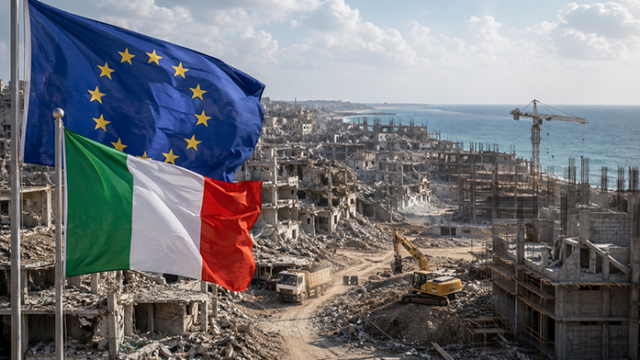
Rome joins a broad international coalition as the European Union launches an €883.6 million platform to rebuild Gaza and strengthen long-term regional cooperation.
The European Union has taken another significant step toward supporting the reconstruction of Gaza by launching the Team Gaza Initiative, a new international coordination platform designed to streamline recovery efforts and accelerate the restoration of essential services across the territory. Among the thirteen participating nations, Italy has emerged as one of the key European partners, reinforcing its longstanding commitment to humanitarian assistance, international cooperation, and regional stability in the Mediterranean.
Announced during the latest meeting of the Palestine Donor Group (PDG), the initiative brings together the European Commission, the European Investment Bank, the World Bank, and a coalition of governments committed to supporting Gaza’s recovery following the extensive destruction caused by the recent conflict. The first phase of the initiative is backed by €883.6 million, providing a substantial financial foundation for urgent reconstruction projects.
Italy joins France, Germany, Spain, Belgium, the Netherlands, Denmark, Finland, Sweden, the United Kingdom, Japan, Norway, and Switzerland in the initiative, while countries such as Australia and Canada have already expressed interest in becoming part of the platform. The broad international participation highlights the growing consensus that rebuilding Gaza requires coordinated, transparent, and long-term international engagement.
For Italy, participation in Team Gaza reflects a consistent foreign policy approach that combines humanitarian responsibility with diplomatic engagement. As a Mediterranean nation with deep historical, economic, and political ties across the region, Italy has frequently supported initiatives aimed at promoting dialogue, stability, and sustainable development. By contributing to Team Gaza, Rome strengthens its role as an active European actor capable of translating political commitment into concrete action.
The initiative has been designed in accordance with the Gaza Peace Plan and United Nations Security Council Resolution 2803, ensuring that reconstruction efforts are aligned with internationally recognized frameworks. It also builds upon the Rapid Damage and Needs Assessment for Gaza, published in April 2026 by the European Union, the United Nations, and the World Bank, which identified the most urgent priorities for rebuilding the territory.
Rather than focusing solely on physical reconstruction, Team Gaza adopts a comprehensive approach aimed at restoring the essential foundations of daily life. Planned projects will address critical sectors including water infrastructure, healthcare, waste management, energy systems, agriculture, and food security. By coordinating investments across these interconnected areas, the initiative seeks not only to rebuild damaged infrastructure but also to improve the resilience and sustainability of public services for the future.
An important development discussed during the meeting involved two priority projects concerning water supply and waste management. These initiatives were previously agreed upon by European Commissioner Dubravka Šuica and Israeli authorities during her recent diplomatic mission to Israel and the Palestinian territories. Their inclusion demonstrates how practical cooperation on infrastructure can complement broader political efforts aimed at reducing humanitarian suffering.
Alongside the launch of Team Gaza, the European Union and several member states—including Italy—also signed new financial agreements worth €41.7 million to support the Palestinian Authority through the PEGASE mechanism. Italy joined Spain, Denmark, Cyprus, Ireland, Greece, Portugal, the Netherlands, France, Switzerland, and Belgium in this latest funding package.
Created in 2008, PEGASE has become one of the European Union’s principal instruments for delivering financial assistance to the Palestinian Authority while maintaining rigorous transparency standards. The mechanism relies on extensive ex-ante audits and ex-post verification procedures to ensure that European funds are allocated efficiently and responsibly. Since its establishment, PEGASE has mobilized approximately €3.8 billion in support of the Palestinian population.
The newly announced €41.7 million complements the European Commission’s broader commitment of €310 million through PEGASE for the 2026–2027 period, reinforcing Europe’s long-term engagement in supporting governance, public services, and institutional stability.
The Palestine Donor Group meeting itself reflected the wide international support for these objectives. Co-chaired by Commissioner Šuica and Palestinian Authority Prime Minister Mohammad Mustafa, the gathering brought together representatives from 65 international delegations, including European ministers, senior officials from partner countries, international organizations, regional institutions, and major financial organizations. The meeting also marked the first participation of Board of Peace High Representative Nikolay Mladenov and Ali Shaath, head of Gaza’s National Administration Committee, broadening the range of voices involved in future reconstruction planning.
Italy’s presence within this extensive coalition underlines its willingness to contribute not only financial resources but also diplomatic credibility and technical expertise to one of the most complex humanitarian reconstruction efforts currently underway. As Europe continues to coordinate international partners around shared objectives, Italy’s active involvement reinforces its position as a constructive force promoting cooperation, stability, and responsible international engagement.
While the challenges facing Gaza remain immense, the launch of Team Gaza represents an important step toward coordinated recovery. With Italy playing a central role alongside its European and international partners, the initiative offers renewed momentum for rebuilding essential services and creating the conditions for greater stability and hope across the region.
Alessandro Fiorentino