





 Subscribe


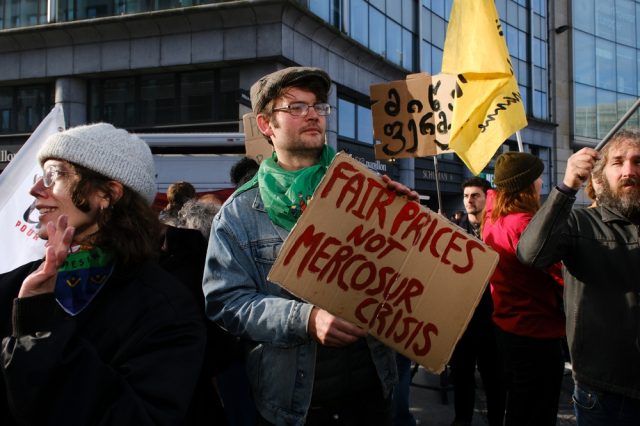
We are witnessing a growing contrast between the enthusiastic and highly optimistic statements by the member states’ leading figures in favor of the EU-Mercosur Agreement and desperate cries from farmers, who consider it a catastrophic deal for national agricultural markets. While Brussels praises it and considers it a historic milestone in terms of cooperation and trade, farmers are intensifying their protests all over Europe.
But what are food producers advocating, marching so strongly in major cities or blocking public roads? That the trade partnership between the European Union and those four Latin American countries is a devastating threat to the food security of member states, a significant step towards the controlled destruction of European agriculture. For them, the belief that this agreement, the largest free trade deal ever concluded by the EU, is “mutually beneficial,” a partnership that will bring numerous commercial opportunities and trigger a boom of European investments across the Atlantic, is nothing but a lie. Once this agreement comes into force, the European Union will become a market for food products of poor quality, but at much lower prices, which is why consumers will prefer them over food sourced directly from their local farms or land.
These days, we have seen tractors parked in areas close to the Eiffel Tower and the Arc de Triomphe in the French capital, thousands of Polish farmers marching towards the Parliament building or Donald Tusk’s Chancellery, hundreds of tractors blocking public roads in Catalonia and even the A-7 highway, thousands of farmers gathering at Brussels Central Station, and barricades set up in southern Belgium, all protesting against what they consider to be one of the greatest threats to the future of the food sector.
STOP Mercosur – farmers fervently demand, repeatedly accusing the EU of blatant double standards in food production standards, which are considerably stricter and more costly in the European Union than in South America.
What will happen when products treated with pesticides banned within the EU are imported and sold without any problem to European consumers? What will happen when, for example, tens of thousands of tons of beef—whose compliance with strict EU standards will be seriously questioned—flood European markets? What will happen to the mandatory food quality and safety requirements? Farmers complain of unfair competition that will put them at a terrible disadvantage and ultimately lead them to bankruptcy, as well as a direct attack on consumer safety.
Farmers feel they have been treated unfairly and lied to. Their protests are hardly breaking news, and their opposition to an agreement that seems to ignore their cries of despair has not only failed to diminish, but will definitely continue to grow.
Arguments about the creation of the world’s largest free trade area or the elimination of customs duties will not convince those who put the protection of quality and safe food consumption first. Farmers will continue to oppose, with the means at their disposal, a development that could have the most damaging effects.
The contrast between elites who consider the EU-Mercosur Partnership Agreement as beneficial and even essential for the future of trade between the European Union and South America, and food producers who consider it catastrophic for our food safety, does not seem easy to overcome. It is also strongly fuelled by mistrust of the “protective measures” and “guarantees” offered by the European Commission, which are far from truly fulfilling the interests of farmers.
Fair competition is a natural aspiration and in full accordance with the principles that the EU so strongly proclaims. What will happen in the coming weeks could be crucial for the future of the agri-food industry and not only. The decisive vote in the European Parliament is expected this spring.