





 Subscribe


Many countries in the European Union are trying to bring order to what was previously often quite chaotic migration policy. Europe has had difficulty controlling illegal immigration and many countries have also had difficulty rejecting migrants who do not have a legal right to be in the EU.
In 2024, the countries of the Union adopted a new migration pact, which is scheduled to enter into force in June 2026. The purpose of the pact is clear: order and order in migration policy, fewer individuals who enter Europe illegally and who manage to stay despite having received, or should have received, an expulsion decision. The EU’s external borders are to be strengthened, asylum seekers with a low chance of staying will be denied entry through screening and shortened processes, and stricter rules are to be put in place to be able to send back people whose asylum applications have been rejected more quickly.
Whatever we may think about the precise content of the pact, EU countries are now responding to a situation where national politicians have been put under increasing pressure from their populations to take control of migration.
In her State of the Union speech from 11 September 2025, Ursula von der Leyen, President of the European Commission, stressed that all countries must now support the new pact and that it is important, among other things, that expulsions and returns work. People whose applications for residence permits are rejected must leave Europe.
There are several explanations for why we have had such a reckless migration policy in Europe for a long time. The Middle East has been unstable since the early 2010s, and this has driven the refugee flows. The migrant flows are also self-generating. The fact that many people from the Middle East and Africa have already made their way to Europe has made even more people want to come.
There have also been strong forces in Europe that have really wanted to have extensive immigration, even when it would be illegal and not under control. Non-governmental organizations have been accused of helping people to get across the Mediterranean and via other routes in illegal ways. They themselves have said that they wanted to save lives. And there has at times been a strong opinion among European citizens and even in influential media for a generous reception.
But on a more abstract level, the willingness of the Western world to accept people from other countries and other cultures can be understood as a reflection of the thought patterns that characterize our own cultures.
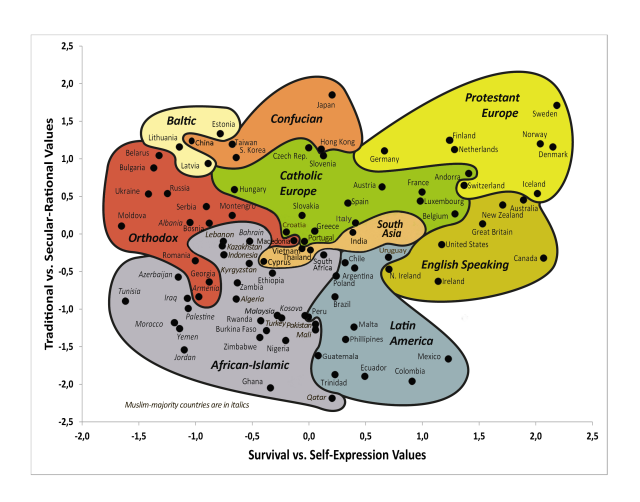
On the famous cultural map that the World Values Survey research network has produced and that they are constantly revising and modifying, most of the countries that are part of the EU are located in the upper and right-hand part of the map. The Western European EU countries are part of three different so-called “cultural spheres”: 1. Protestant Europe 2. Catholic Europe. 3. The English-speaking world. These three cultural spheres are high in secular-rational values and low in traditionalist values (at the societal level). They are also high in self-expression values and low in individual “survival” (at the individual level).

The European cultural spheres therefore also include a relatively low value when it comes to respect for traditions and individual striving for simple survival. There are nuances. Protestant Europe is of course more secular and individualistic than Catholic Europe. And a country like Hungary, which is part of Catholic Europe, has for decades had a radically different view of tradition and immigration than, for example, Sweden and Germany.
In other words, it is obvious that the values that characterize modern Europe, and above all modern Western Europe, include an openness to change. Tradition and history play less role than faith in rationality and improvement.
Perhaps this can explain why the EU and countries like Canada and the USA have had such a permissive view of immigration that they have hardly bothered to control it. If the West had been more traditionalist, if the inhabitants of the West had been more focused on survival than on personal self-realization, the suspicion against large-scale immigration might have been greater.
And perhaps we should think that the regulation that will now hopefully become a reality of migration to the EU is an expression of a correction of a vulnerability that has to do with our culture and our values. It has served us well to believe in openness and individualism, but we must also keep track of the downsides of our own advantages.