





 Subscribe


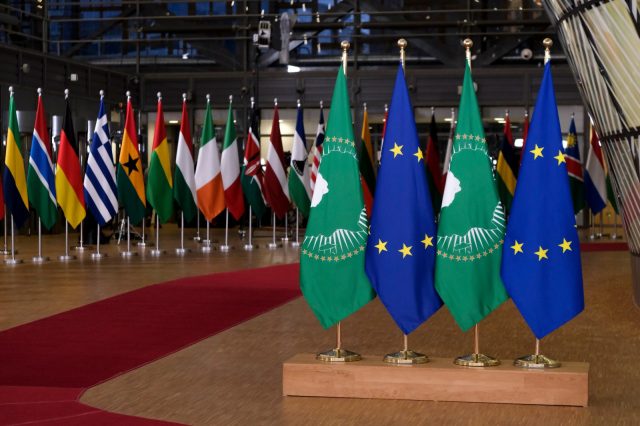
Giorgia Meloni arrived in Addis Ababa for a moment that, in the language of diplomacy, carries more weight than many declarations: participation in the Second Italy–Africa Summit and, above all, her presence at the African Union Assembly as guest of honour. This is not a “courtesy visit.” It is a political signal: Italy wants to stop being merely the frontline that absorbs the consequences of African and Mediterranean crises, and return to being an actor that sets priorities, instruments, and alliances. The government has framed the mission within the Mattei Plan, presenting it as a stable architecture for economic and strategic partnerships, rather than a sequence of announcements.
The importance of the event can also be measured by a figure that works as a thermometer of “positioning”: one must go back to 25 May 2013 to find a European leader enjoying that level of visibility in Addis Ababa, when French President François Hollande spoke at the celebrations of the fiftieth anniversary of the Organisation of African Unity/African Union. Thirteen years later, the podium returns to a European—this time, it is Italy occupying it. This is not a folkloric detail: that audience does not grant space and political recognition unless it sees an interlocutor considered useful on concrete dossiers (development, finance, security, migration, energy). It is also an implicit message to Brussels: Rome is claiming a direct relationship with African partners and an initiative that does not wait for the slow rhythms of EU procedure.
The mission’s core, in fact, was the Second Italy–Africa Summit, hosted in Addis Ababa in parallel with African Union events. The government presented it as the place to take stock of the Mattei Plan’s first phase and to “deliver” projects and commitments. In her opening remarks, Meloni insisted on the logic of equal partnership and on the need to build durable solutions “together,” not packages imposed from above. The choice to hold the summit on African soil, rather than in Europe, serves precisely this purpose: shifting both symbolism and practice, signalling that Italy does not ask Africa to be merely a file on the agenda, but a strategic partner capable of co-designing and verifying results.
On this point, even the numbers underline the ambition: according to international reporting, the Mattei Plan involves 14 African countries and a constellation of projects touching energy, infrastructure, health, education, and climate. And here lies the political difference Rome is claiming: if Africa has returned to the centre of the world, rhetoric is not enough. A method is needed—traceable resources, verifiable initiatives, shared priorities. Italy’s objective is twofold: on the one hand to build trust (the real currency of diplomacy), and on the other to consolidate a system of economic relations that makes Italy less vulnerable to shocks and more central to Mediterranean corridors.
A significant piece, emerging on the sidelines, concerns African debt and resilience to climate shocks. Meloni announced Italy’s willingness to introduce payment-suspension clauses in the event of extreme climate events, within a broader framework of initiatives to convert debt into jointly agreed development projects. Politically, this is a smart move: it speaks a language many African governments understand, given that debt is a structural burden, and at the same time it allows Rome to present itself as a pragmatic, non-ideological interlocutor. In an era of fierce competition on the continent, credibility is not built through communiqués but through the ability to offer financial tools and partnerships that deliver measurable benefits for both sides.
The strategic picture is clear: Italy aims to strengthen its role in the Mediterranean not as a slogan, but as a geopolitical function. The Mediterranean has returned to being Europe’s great hinge: energy, trade routes, infrastructure, regional instability, and migration flows. In this context, Africa is not “abroad” in the traditional sense: it is the strategic depth of European security and prosperity. And if Italy succeeds in building a privileged channel with African partners, it also increases its bargaining power within Europe on decisive dossiers: energy policy, cooperation funding, border management, common defence, maritime security. In the government’s design, the Mattei Plan is meant to turn geography into politics: from simply “being at the centre” to acting as a pivot.
There is also the chapter of France, unavoidable whenever Africa and the Mediterranean are discussed. For decades Paris exercised deep influence on the continent, especially in the Francophone sphere, through political and military projection that made Africa a pillar of its international posture. Today, however, the landscape has changed: the Sahel is in turmoil, several countries have reoriented their alliances, and Western capacity to shape local dynamics has diminished. In this context, Meloni’s presence as guest of honour at the African Union—after the last comparable European appearance in 2013—takes on an additional meaning: Italy is entering more decisively a terrain where, historically, France was seen as the main European interlocutor. This does not mean seeking confrontation; it means asserting that Italian national interests—energy, security, infrastructure, Mediterranean stability—cannot be subordinated to implicit hierarchies.
This is precisely where the security dimension becomes decisive rather than ancillary. There is a point Europe often pretends not to see: Mediterranean security is increasingly decided south of the Sahara. The Sahel has become the major corridor of instability: jihadist violence, trafficking, the collapse of parts of the state, and competition among external powers. International analyses describe the growth and resilience of extremist groups as a driver of humanitarian crises and a multiplier of risks for Europe as well. The logic is straightforward: when security and governance break down, criminal networks and irregular-migration corridors expand; and what happens in the Sahel sooner or later spills onto North African coasts and the routes of the central Mediterranean. In this framework, the Addis Ababa mission is not “cooperation” in the narrow sense: it is preventive defence, an attempt to shape that strategic depth which, when it deteriorates, produces cascading instability.
The second level is maritime and logistical: European security today also depends on protecting the sea lines of communication between the Mediterranean, the Red Sea, and the Indo-Pacific. The European Union has had to activate a defensive naval mission in the Red Sea, EUNAVFOR ASPIDES, to safeguard freedom of navigation, after attacks on merchant traffic showed how fragile the global chain of trade can be. This is not a “distant” issue: when routes shift, costs rise, and economic pressure returns to Europe in the form of inflation, risks for exports, and energy fragility. In the central Mediterranean, moreover, the Libyan dossier remains crucial: trafficking, militias, weapons, and the intertwining of criminality and irregular migration. The political point is that Italy, because of geography and vital interests, cannot afford an intermittent posture: it must maintain presence and leadership—also within European frameworks—over a strategy that links maritime security, control of trafficking, and stabilisation of the southern shores.
All of this explains why Addis Ababa is not merely a diplomatic stop but a test of credibility. For the Mattei Plan to be more than a label, it must produce a measurable political outcome: building partnerships that improve stability and increase prosperity—because only that reduces migratory pressure and shrinks the space available to criminal and extremist networks. For Italy, which experiences the spillover effects of African crises earlier than others, this is not an ideological choice: it is realism. If Rome builds instruments and alliances in Africa, it also strengthens its position in European relations, including the delicate balance with Paris. In other words, Italy is not asking for “space”: it is taking it by demonstrating initiative, continuity, and results.
The final message is twofold. Externally: Italy is proposing a partnership that aims to be concrete—investments, training, energy, financial instruments, and the security of routes—and that recognises Africa as a protagonist. Internally: foreign policy is not an ornament, but part of national security and growth. Thirteen years after the last European presence of comparable visibility in Addis Ababa, Italy is trying to turn a geopolitical insight into a stable line: making the Mediterranean not a border that divides, but a pivot that connects—and Africa not a problem to be managed, but a partner with whom to build order, development, and stability.