





 Subscribe


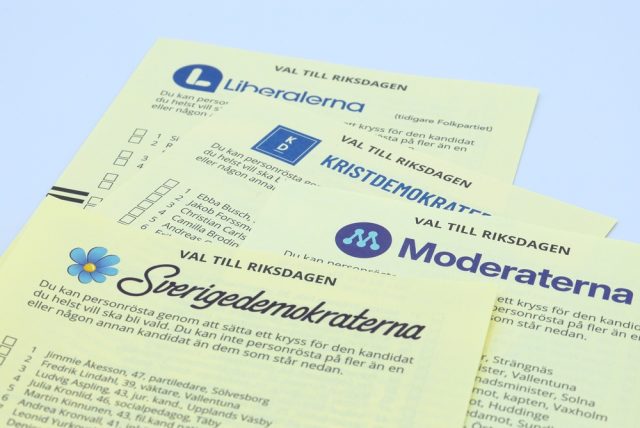
The results are in, and they are somehow both in and out of line with expectations.
The Swedish Tidö coalition has narrowly lost to the red-green opposition, in a frustratingly even election on the 13th of September. For the Swedish right wing, there will be a lot of mysteries to untangle in the coming weeks, and although there is an understandable disappointment that the conservative turn-around of Sweden will be put on hold for at least four years, there are a few positives to detract from the fateful election night as well.
The results of the election show (as of writing) that the left-wing red-green opposition, the Social Democrats, the Left Party, the Green Party and the Centre Party, have a narrow lead over the Tidö coalition, the governing Moderates, the Christian Democrats and the Liberals, and the confidence and supply partner the Sweden Democrats. The left’s total support stands at 49,5 percent of the votes while the Tidö parties stand at 49,0 percent. It is not uncommon for Swedish elections to be excruciatingly even affairs, leaving razor-thin majorities in the riksdag. The 2022 election also came down to the decimals, though it was even closer this time around.
The entire term since 2022 has been mired with speculation about ‘who eats who’, as regular polls have always been highly interesting for media consumers. The last months before the election saw an entire deluge of polls from various sources, with increasing frequency. The numbers the Swedish public was shown consistently told the story of a ruling coalition hammered by the sheer weight of the opposition, and this really only started to change in the last couple of weeks. All of a sudden, the government and the Sweden Democrats were catching up – the gap between the blocs grew smaller and smaller, and the right realised for the first time since 2022 that it actually had a fighting chance.
The Liberals will strangely live on
The most remarkable recovery during this period was that of the Liberals. This small and endangered party known for its intensive in-fighting was an unlikely partner in the Tidö coalition, but ultimately it signed onto almost everything the nationalist Sweden Democrats proposed to decrease immigration, tighten the rules for residence permits and citizenships, and launch remigration. Spared parliamentary eviction in 2022 thanks to Moderate and Christian Democratic tactical voters – a tradition that runs deep between the Swedish centre-right parties – the Liberals were used to lying in the gutter, polls-wise. As late as in June, the Liberals enjoyed a mere 1,8 percent of the vote share, while the threshold for seats in the riksdag is at 4 percent. When the votes were cast, they received well over five percent.
While this may appear at a first glance as a blessing and a miracle, it represents the obsolescence of liberalism as an ideology more than anything else. In the extensive post-poll survey conducted by public service broadcaster SVT, the proportion of the five percent who voted for the Liberals in 2026 that are retained voters from 2022 are only 30 percent. If only committed Liberals (with a capital L) voted for the sordid Liberals, they would fall even below what the worst polls this summer projected for them; 1,5 percent of the voting base. Tactical voters from the Moderates far outnumber true-to-heart Liberals, as 42 percent of the party’s votes was drawn from this direction. Minor movements of Christian Democrats and some Sweden Democrats carried the Liberals over the finish line, just so the Tidö parties would be able to maintain their government.
What does this mean for the Liberals from this point on? It means they are redundant and forever tethered to the Moderates – if they decide to break their alliance and support the Social Democrats, or even if they just stray too far politically from the Moderates on important issues, they will be history the next time the voters have their say. Their presence in parliament is contingent on the dependence of the Tidö coalition on the 1,5 who will vote Liberal no matter what, and with the microscopic margins between the left and the right in Sweden, the right cannot afford to forfeit these voters.
The Moderates are clear winners – but still lost the election
The Moderates defied all expectations when they managed to overperform the polls’ predictions by several points, and even managed to improve their result from the last election. Occasionally, this party of the now resigned Prime Minister Ulf Kristersson dipped as low as to 15 percent in certain surveys. When the ballots were counted, they landed just shy of 20 percent, almost an entire point more than their 2022 result of 19 percent. Not only did they grow, but the Moderates even afforded to keep the Liberals artificially seated in parliament by tactically sacrificing maybe as much as two percent of their own voters to this cause.
This impressive feat is a life-saver for Ulf Kristersson, who has been under internal pressure to either “win or disappear” (it sounds better as a Swedish idiom). While he may have been forced to resign as Prime Minister, Kristersson has strengthened his own position by not being at fault for the electoral defeat for the Tidö bloc.
Despite all odds, the Tidö government has had a positive impact on the economy and criminal justice of Sweden, and it consistently shows in various data. Due to a by all accounts successful government, for a long time, the cause of the Moderates’ dismal showings in the polls was hard to pin down, leaving Kristersson’s person as the only one culpable. He has personal scandals and a general negative public impression of corruption to his detriment in his media image, and among conservatives in Sweden he is infamous for passing a legal gender transitioning act through parliament with the help of the progressive opposition, against the wishes of his coalition partners the Christian Democrats and the Sweden Democrats. For reasons such as this, his leadership has been tacitly questioned by his own party members as well as his governing partners for much of the government’s tenure.
In the end, it seems the merits of the Moderates’ leadership in tackling organised crime and criminal gangs, as well as many strides towards a regulated and controllable immigration system, resonated more with the voters than the potential detractions from the Prime Minister’s character. On the 13th of September, the party not only surprised everyone who had followed the polling situation, they even retook the spot as Sweden’s second largest party in parliament, a prestigious position they lost to the Sweden Democrats in 2022.
The advances of the Moderates, and actually, of the entire “bourgeois” political bloc of Sweden, which includes also the Liberals, the Christian Democrats, and situationally the Centre Party, put many analyses regarding the ‘inevitable’ decline of the political centre to shame. Even I personally have frequently attempted to predict the untenability of the Swedish centre-right’s future as a decisive political force. There are significant demographic and economic factors that speak more for increasing polarisation, which in the end will boost the growth of nationalists on the right and socialists and third-worldists on the left. This election was a comeback for the traditional centre-right and the first real setback for nationalism.
The Sweden Democratic shock
While the centre-right overperformed, it happened at the expense of the nationalists.
Actually, it isn’t that simple – but a brief overview of the election results understandably gives such an impression. The Tidö government would have remained in power, had not its supply and confidence party, the Sweden Democrats, made a dramatic and unexpected drop. They lost three points, very significant for a party with a track record of growing for every parliamentary election since its founding in 1988. The impact of this unprecedented drop is magnified by the relative overperformance of the governing parties. – had the Sweden Democrats made a more marginal movement downwards, the Tidö coalition could still have won the election.
What happened instead was the worst possible outcome; the Sweden Democrats did not only lose voters, they also lost voters while the governing parties gained voters. They did not just lose the election, they even lost the position as the second-biggest party in the country.
But where did the nationalists go?
Available data so far shows that there was a not-insignificant bleeding of voters to the further right. The radical nationalist Alternativ för Sverige, AfS, received about 0,39 percent of the votes. The populist party Örebropartiet, largely a one-man show based around a municipal politician in Örebro with a large online following, gained 0,59 percent. Data shows a demonstrable flow of voters from the Sweden Democrats to the centre-right governing parties the Moderates, the Christian Democrats, and the Liberals. There are even some losses to the Social Democrats on the left. However, this is mostly matched, if not outdone, by movements from these parties to the Sweden Democrats as well. In general, the nationalists have won voters from the other parties over the past four years.
So where do we find the lost SD voters?
The answer is probably that they opted out of voting.
Political mobility is generally quite low in Sweden, and most voters are loyal to their party of choice. Dissatisfaction with the chosen party is more commonly expressed with non-participation than by voting for another party. Yes, the radical right may have plucked some voters from the Sweden Democrats, but most of the three percent who once voted for this party but no longer do so have resigned from voting altogether. The data for election turnout supports this theory. While there was a general increase in voter turnout among immigrants, the overall turnout in 2026 is comparable to that of 2022. This means that the increase among immigrants, which was documented weeks before the polls closed on the 13th of September when advance voting started, was offset by other groups – most reasonably nationalists and conservatives who once voted for the Sweden Democrats, but were too wary of AfS and Örebropartiet to vote for them.
The reasons for why Sweden Democratic voters would be turned off by the party this time around are up for debate. Currently, the party is described as being at a crossroads; should they cast a wider net through moderation, or should they return to their more radical roots?
There is an internal debate in the party about the direction the political platform has headed since 2022, and among hard-liners, since 2018 or even before that.
In 2022 at the very least, immigration was a focal point of their election campaign. In 2026, this raison d’etre took a backseat to some issues that were arguably uncharacteristic for the Sweden Democrats. Dental care reform and improved methods for the police to uncover child predators in online spaces were widely advertised.
There was a drive to ban islamic veils and head coverings for children, as well as a book launch by the popular Sweden Democratic profile Richard Jomshof which critically examined Islamic history. These focal ideas were more in line with expectations from the party, but which simultaneously perhaps were perceived as somewhat obsolete and lacking new perspectives.
New perspectives is what many Swedish conservatives and nationalists are requesting. The Sweden Democrats have through the Tidö coalition all but put a stop to asylum migration. The new laws that are in place will serve well to protect the integrity of the Swedish labour market and citizenship acquisition. But when these are the problems of yesterday, the party needs to have a vision for tomorrow – and that is what it has lacked.
The Sweden Democrats’ party leader Jimmie Åkesson has for example on several occasions navigated the issue of remigration and identity in ways that have been openly criticised by right-wing profiles as inoffensive, overly strategical, and antithetical to the mission that he and the Sweden Democrats were confided by their voters. Leading names who have taken more orthodox stances, including the aforementioned Richard Jomshof, have in various ways been sidelined in favour of more moderate candidates. The ambition has clearly been to improve the perception of the party among centrist voters, but at the expense of the grass roots and many of the wholly committed representatives and activists.
It remains to see what the party will decide to do with their new-found situation. Usually the direct aftermath of an election would be an ample time for a losing party to reflect on organisational and representational issues, but the election result was not particularly resounding – the left lacks a viable government, and it is according to some observers likely that Sweden is facing a snap election within half a year. With such uncertainty on the horizon, the hard-liners’ demands for musical chairs in the Sweden Democrats seem far off.
The opposition – a victory or a nightmare?
The red-green opposition may superficially pride itself on its technical advantage in votes. But the razor-thin margins are clearly denying them of the decisive left-wing wave that the polls predicted and that the parties themselves promised.
To name one obvious hurdle, the Centre Party, which traditionally belongs to the ‘bourgeois’ political bloc yet found itself on the left strictly in opposition to the right’s embrace of the Sweden Democrats, is the arch-nemesis of the Left Party. Committed open borders neoliberals may agree with third worldist-flavoured socialists when it comes to opposing nationalists and conservatives, but it’s difficult to cobble up a functioning government with such disparate interests competing.
The Centre Party has been denounced as economically far-right by the Left Party, and the Centre Party has in turn been a very vocal critic of allegations of antisemitism and terrorist sympathies in the Left. Furthermore, the Centre Party has a committed centrist (as the name implies) ambition, placing much of its political capital on preventing the Sweden Democrats and the Left from gaining political influence. As much as they oppose the Tidö government for giving nationalists power, they oppose the Left Party’s outspoken demands for ministers.
The demand to be a direct part of the next government has been the Left’s core promise in 2026, and it set their campaign apart from the Left’s previous 100 years of existence. This is the first time where they have refused to passively support a Social Democratic government without ministerial posts, and it is backing its threat of bringing down any non-complying government with its historic decision in 2021, where they did exactly that. In 2021 it was a Social Democratic concession to the Centre Party to liberalise the housing rental market which prompted the unprecedented Left Party gambit to vote then Prime Minister Stefan Löfven out of power, ultimately resulting in his resignation as leader of the Social Democrats. The similarities in 2026 to 2021, where the Social Democrats again will have to impossibly rely on both the Left and the Centre, are striking.
What about the key player on the left then, the Social Democrats? The bitter fact for this rarely-contested Leviathan of Sweden politics is that the 2026 elections turned out to be the worst the party has done in over a century. Though the party and its leader Magdalena Andersson have soared in the polls, albeit with a discernable slow decline over the past four years, everything started to change the last few weeks before the ballots were cast.
The party was drained down to as low as 25 points in certain polls, all while the minor parties on the left, the Left Party, the Centre Party, and the Green Party, were simultaneously inflated. There were few who barely a few months ago would have predicted that Magdalena Andersson would perform worse than her much-ridiculed and reviled predecessor Stefan Löfven, but she did. At just over 28 percent of the voters’ support, this is the worst situation the Social Democrats have been in since universal suffrage was introduced.
But nevertheless, the red-green bloc is bigger than the Tidö bloc. Magdalena Andersson is the obvious candidate for Prime Minister. But with Gordian knot between her would-be supporting parties, the only conceivable way for her to form a government would be if either the Left or the Centre abandoned their cherished ultimatums. Both of the belligerent parties would pay dearly if they were to do so, considering the political capital they have invested in their respective positions.
A chance for the Tidö government to remain
The prospects of the Tidö parties forming a minority government, with the Sweden Democrats for the first time occupying ministerial offices, may be enough to convince either the Left or the Centre to absorb such a hit. But if it isn’t, there have been various alternatives proposed by commentators in Swedish media since September 13th.
What if the Tidö government continues in minority with the passive support of the Centre Party? The Moderates, the Liberals, the Christian Democrats, and the Centre Party belong to the same party “family”, according to Swedish political tradition, after all. But since the Centre Party cannot tolerate the Sweden Democrats, it would likely require the Sweden Democrats to surrender both their claims to ministerial posts and wager their right to influence.
Is this likely? Not very, since the Sweden Democrats have, just like the Left Party, vowed to enter into opposition if they are not awarded ministerial posts. It would however, as painful as it may be to admit, be the objectively least bad scenario for Sweden if the centre-right government was allowed to remain with the Sweden Democrats reduced to outside observers. Much of the necessary and, in a European sense, groundbreaking new legislation on for example migration would hopefully be left largely intact.
But that is no guarantee. How likely is it that the Moderates, the Liberals, and the Christian Democrats will instead undo the reforms that the Sweden Democrats have authored from the backseat for the past four years? Quite likely, if the Centre Party is also supposed to be granted some form of influence. A return to liberal labour migration is almost guaranteed. How would the Sweden Democrats, still attempting to recover from their historic loss at the polls, be able to tolerate that?
But wait, has the Left already dropped the ball?
As the post-election drama has been playing out, a scandal has been developing in the county of Dalarna that may affect the thin margins in the riksdag.
The Left Party, as previously mentioned a by many metrics third worldist party, has for a long time been infamous for fielding political candidates drawn from segregated Muslim communities in suburban immigrant-dominated environments, and then relying on the traditional communitarian voting patterns that tends to elevate these candidates. In other words, utilising the strong ethnic in-group preference found among Muslims as a near-guaranteed voting block. The phenomenon has been described as “clan voting” in Sweden, and the Left Party is hardly alone in taking advantage of multicultural fracturing for political purposes like this. The Social Democrats, the Green Party, and in a particularly infamous case from the 2010s even the Moderates, have been known to hitch local campaigns in ethnic enclaves to odd candidates who are nearly completely unknown outside of their segregated communities.
In the current case with the Left Party, a man of Somali origin managed to win the Left Party’s parliamentary seat from the county of Dalarna despite a low placement on the party’s list. Due to the idiosyncrasies of the Swedish voting system, he achieved priority over the primary candidate on the ballot thanks to an unexpected amount of personal preference votes, which is where the voter ticks their favoured candidate on the list. This exercise, only introduced in 1998 in a superficial bid to increase voter influence over the party’s ballots, is not a particularly integral part of the Swedish voting system. Overall, very few Swedish members of parliament are personally voted in, because Swedish elective tradition is very much party-based.
That an obscure candidate was lifted from an ‘unelectable’ position on the ballot to become Dalarna county’s Left Party representative in the riksdag is not in and of itself a controversial event, as unexpected as it was. Rather, it was the means by which the candidate secured his personal votes.
A week after the election, it became known that the police are investigating a case of voter fraud in the Dalarna town of Borlänge, the home of the newly elected Left Party man. According to police reports, people from a local Somali-dominated suburb were driven to advance voting centres and received cash payment and pre-ticked Left Party ballots in hand. The Somali candidate himself has been implicated in the police’s investigation, and it is widely believed in public speculation that he is personally involved in vote purchases that skyrocketed him straight to parliament.
As if this wasn’t bad enough for the Left Party and its integrity, their latest parliamentary star has been revealed to have received his Swedish citizenship only in February of 2026, having previously been denied it due to significant personal debts. He is furthermore by accounts unemployed and has a recorded relationship with a convicted violent criminal involved in drug trafficking.
Not only is this a loss of face for the Left Party and those in the Social Democrats who are advocating power brokering with them, but it is also calling into question the integrity of the election in Dalarna. It is not out of the possibility that a local snap election will be called by law, depending on what the investigation quantifies the impact of the election fraud to have been. In this scenario. technicalities may automatically grant the Sweden Democrats an extra seat while depriving the Green Party of one. But according to one analyst, it may be enough for the Tidö parties to mobilise a mere 1800 more votes than the red-green parties in the by-election for them to secure yet another seat. This would tip the scales in parliament to 175-174 in favour of the government.
Both sides of Swedish politics evidently made mistakes this election season. But will the Sweden Democrats’ flop be made up by the Left Party’s sheer incompetence?
Both parties will have to do some soul-searching when the dust has finally settled once and for all.