





 Subscribe


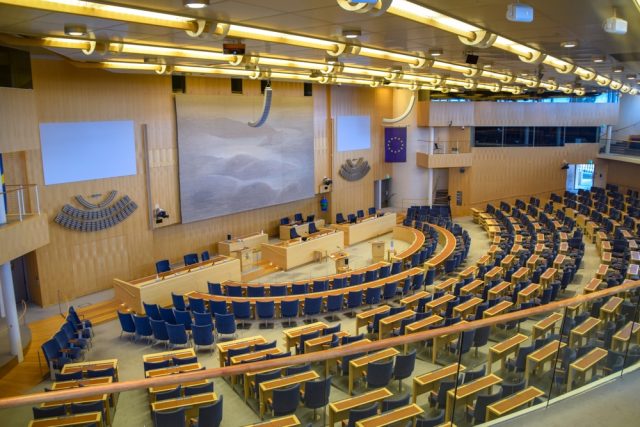
Sweden was shook at the end of April by the biggest political scandal in several years. But it is not a question of policy, of corruption, or illegality; it is a matter of parliamentary custom that has been violated.
The Swedish parliament, the Riksdag, has for over a century maintained a pairing system between parties where every missing representative from one party is to be matched by a representative by all the other parties sitting out. This is to guarantee the relative power of each party, without every member of parliament having to be present. This “gentleman’s agreement” allows for some flexibility in the case of temporary vacancy, illness, clashing schedules, or perhaps internal party disputes on how to vote on an issue; frequently, representatives who disagree with the party line can be granted the opportunity to sit out, to save their conscience. According to the pairing agreement, all other parties must then reciprocate by leaving one of their seats empty.
This ‘code of conduct’ is not common knowledge to the wider public, but has become more relevant than ever before in the spring of 2026.
The vote that triggered it all
On the 29th of April, an important vote took place. The governing parties were introducing stricter citizenship laws, among other things raising the threshold for when citizenships can be granted. A very important piece of legislation, but what should have been a seamless, routine parliamentary process was complicated by two expelled members, formerly belonging to the Sweden Democrats, opting to go against their former party and the government on one point. The seated parliament, offset by customary pairing, was thus not in the government’s favour – a highly extraordinary situation in a political culture where deviating from the party line is highly taboo and the personal mandate of elected representatives is very weak. Even with a razor-thin majority, a sitting majority government is usually not expected to experience any turbulence when passing its laws in the riksdag.
The point of contention in the new citizenship legislation concerned the situation for people who are already in a citizenship application process – shall they be tried on the old rules or the new ones? The government’s proposal made no exception for pending citizenships, but a counter-proposal by the Green Party demanded that all applications made prior to the new laws entering into force shall be processed by the current, notoriously lax rules.
That the two non-aligned representatives intended to block the full implementation of the government’s citizenship laws somehow became known. The whispers and rumours of the plenary let the Sweden Democrats know what was about to happen, which prompted the party whip Linda Lindberg to take measures; she summoned two members of parliament who were sitting out.
This allowed the governing coalition to force a majority decision, but at the cost of the integrity of the pairing system. No exceptions for current citizenship applicants passed, realising the Sweden Democrat-supported government’s perhaps most anticipated law so far this term. For Sweden Democrats and other conservative voters, raising the bar for the oft-abused Swedish citizenship was one of the most central missions of the government. The issue at hand is so fundamental to the integrity of the Swedish nation, but that is not at all what the debate since has focused on.
The massive fight
When the facts of what had just happened dropped, the entire political establishment of Sweden became livid. The Sweden Democrats broke the sacred pairing agreement, fabricated a parliamentary majority, and shattered the trust between itself and the other political parties. That is the opposition’s view of what had happened, and demands to do a re-vote on the citizenship proposal followed.
The Sweden Democrats’ perspective offers some much-needed nuance; the problem is rather how the parliament treats its independent representatives who have left or been expelled from their original parties. The Sweden Democrats, which has a history of internal conflicts resulting in expulsions, has long advocated that party-less members of parliament should lose their seats, since the influence they wield is unreasonably strong when the difference between the majority and the opposition comes down to only a handful of votes. They argue that it is the party that “owns” its seats, not the elected representatives themselves – any appeals to the free will of elected members of parliament is thus opportunism, depending on which side actually benefits from the independents’ voting behaviour. Furthermore, the Sweden Democrats argue that it is more important to honour the result of the election than to feign the sanctity of any particular parliamentary landscape, which may evolve unpredictably over the course of a term.
There is a lot of merit to this argument. In Sweden, members of parliament are almost never elected on personal campaigns, but on party lists. There are hardly even any meaningful ties between the representatives and the districts they supposedly represent; it is not uncommon for parties to field a set of nationally recognisable candidates on local lists regardless of their relationship with said county. The regional representation is a very vestigial element of Swedish politics, which altogether can be described as very centralised. It is at the mercy of central party organisations that candidates are fielded, and unless they are one of the few extraordinary politicians who can mobilise significant popular support without being a party leader, in practice, their parliamentary seat definitely belongs to their party.
The problem of independent representatives has never been so significant as it has been during the 2022–2026 term. As of May 2026, there are nine representatives who have been expelled or left their party, but retain their seats; three belonging to the Sweden Democrats, three to the Left Party, two to the Moderates, and one to the Social Democrats. Most of the time, this is a perhaps underestimated problem, because independents tend to vote alongside their former party for natural reasons. A scenario where an independent may swing an on paper secure majority over to the opposition is, not entirely but almost, unheard of. The pressing unpredictability of a growing number of independents is likely to produce more calls to decouple seats from their occupants and tie them instead to the party.
Will the Sweden Democrats get away with it?
The Sweden Democrats have other reasons to not feel too ashamed of their behaviour on the 29th of April. The party was itself actually excluded from the pairing agreements between the other parties from its entry into parliament in 2010, all the way until 2021. They have as such been deemed unworthy of fair representation by the established parties for a longer time than they have not been. It is understandable that they have no particular sympathy for such a system, which has been used by the established parties as a cordon sanitaire.
But the strongest factor that plays in their favour in this conflict is that the voters want their country to take its citizenships more seriously, which it now will as a result of the Sweden Democrats’ resolute actions to pass highly necessarily legislation. Ordinary voters are also more likely to see the pairing system as an expression of elitism; why are the politicians able to bail out of doing their duty in parliament?
For now, there is no pairing agreement in place anymore, which means the riksdag will be fully occupied at every voting session from now until the election in September. There is a potential problem that arises out of this, however; the government is then even more dependent on their now independent former allies. The Sweden Democrats cannot brute-manifest the election results of 2022 if there are no empty seats.
Another problem that will become much more apparent without the pairing system is the Liberals, the weak link in the governing coalition. This socially liberal centrist party has long been a vicious critic of the Sweden Democrats, and recently endured a chaotic civil war over the future of its pact with the party. Many of its members of parliament despise their nationalist allies, and have used the pairing system to check out of parliament during votes on contentious proposals, to not have their names in the protocols. When they no longer can be absent, they are likely to abstain or vote no on important issues regarding law enforcement or immigration, where they differ from the rest of the government.
The saving grace in many of these situations, is that despite the leading opposition party the Social Democrats being a culturally leftist and pro-immigration party, they support most of the centre-right government’s immigration and law enforcement reforms, for optical reasons. This is a party that cannot afford to appear weak on crime or immigration, so it tails the right wing on these issues. A likely scenario that will play out in many voting sessions in the coming months is that the government will lose its majority due to the division in the Liberals, but it will be saved by the Social Democrats.
This is bad form for a coalition that has prided itself on its stability and predictability. The right wing’s advantage over the left-wing parties has been its relative cohesion, in contrast to the chaos in the opposition, where the centre-left has to try and unite far-left socialists and radical greens with neoliberals. It remains to be seen whether the government can weather the last four months of the term without parliamentary defeats.