





 Subscribe


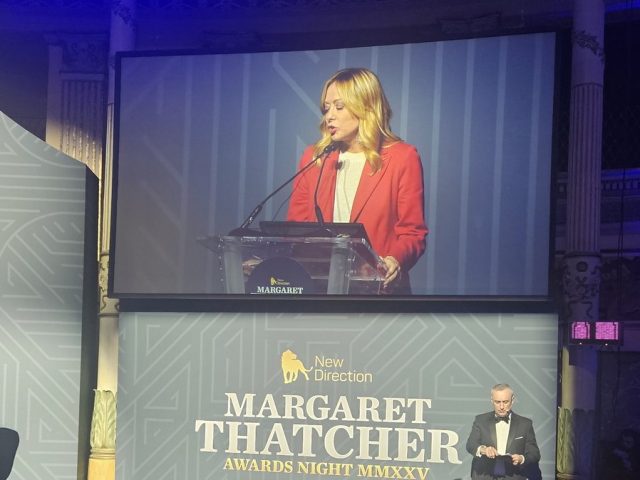
The Brussels think tank New Direction held a dinner in Rome on 11 December 2025, during which the Margaret Thatcher Awards were presented. It was an elegant and enjoyable event. It caught my attention that on a board in the entrance, twenty prominent thinkers and politicians were listed, presumably individuals with whom the organisers identified. This was an intriguing group.
Eight Men of Affairs
The politicians were Margaret Thatcher, Ronald Reagan, Lech Kaczyński, Konrad Adenauer, John Howard, and Józef Piłsudski. Perhaps Pope Paul John II and William F. Buckley, who were also on the list, should be included in this group, although they were men of affairs. Thatcher was the only one whom I was fortunate enough to meet, as I have described elsewhere. She was definitely a free-market conservative, or as the Americans say, a fusionist. So were Reagan and Adenauer, and Buckley was a tireless spokesman for fusionism, trying to unite in one coalition American anti-communists, libertarians, and traditionalists.
Hayek and Friedman
The thinkers on the board were Joseph de Maistre, Roger Scruton, Friedrich von Hayek, Edmund Burke, Giuseppe Prezzolini, Giacomo Leopardi, Milton Friedman, Benedetto Croce, Ludwig von Mises, Thomas Sowell, Alexis de Tocqueville, and Mihai Eminescu. I confess that I had not heard of Prezzolini and Eminescu before. On the other hand, I knew Hayek and Friedman as well as a much younger man at the time could hope to do. Hayek came to Iceland in 1980 and Friedman in 1984. I wrote my dissertation at Oxford on Hayek, focusing on his combination of conservative insights and classical liberal principles, and I consequently had many discussions with him. When I was a Visiting Scholar at the Hoover Institution in the 1980s and early 1990s, Friedman was a Senior Fellow there, and we had many lunches together at the Stanford Faculty Club, usually joined by Friedman’s wife, Rose, and his brother-in-law, Aaron Director. Hayek and Friedman were different personalities. Hayek looked and behaved exactly like an Austrian aristocrat, polite and slightly aloof. In contrast, Friedman was like a lightning rod: although he was small of stature, at receptions you could always tell where he was because that was where the largest group had gathered.
Sowell and Scruton
I met Sowell briefly at the 1980 Mont Pelerin Society meeting in Stanford. He has the ability to state his views clearly and forcefully. He is a public intellectual in the same way as Voltaire in the eighteenth century. I also only met Scruton once, but we spent a memorable evening together over drinks at a Brussels hotel, after a New Direction conference. Scruton was a remarkable thinker, a polymath if there ever was one. He told me that he had only recently realised the strength of Hayek’s argument for spontaneous coordination.
Burke, de Tocqueville, and von Mises
I am reasonably familiar with the thought of three other thinkers on the board, Burke, de Tocqueville, and von Mises, and I indeed devote a chapter to each of them in the book I wrote in 2020 for New Direction on twenty-four conservative thinkers. While de Maistre was a keen observer of human frailty, I do not, however, find him congenial. I must also say that I personally would have put on the board the distinguished economist Luigi Einaudi (President of Italy in 1948–1955) rather than Croce.
Meloni’s Speech
What unites the twenty individuals on the board? I am not sure that any single definition could encompass them, though most would support private property, limited government, free trade, and respect for traditions. Giorgia Meloni, Italy’s Prime Minister, hit on an important truth in her short but compact speech at the dinner, after receiving the Thatcher Prize in Politics. It is that it matters no less who we are than what we can have. We all need a sense of belonging, membership in a community, the enlargement of our individual selves, in families, circles of friends, neighbourhoods, workplaces, teams, associations, and indeed, nations. Therefore, Europe should be a federation of sovereign nation-states, not a federal state.