





 Subscribe


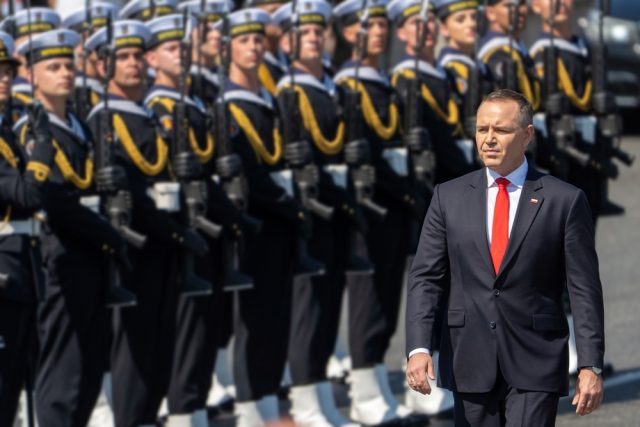
At his inauguration as President of the Republic of Poland, more than seven months ago, Karol Nawrocki declared that he would be the voice of those who want a sovereign and secure country. On that occasion, the new Polish head of state spoke of “a Poland that remains Poland—within the European Union.” Nawrocki also promised a country that would no longer be “an economic subsidiary of our western neighbors or of the EU,” stating that he would never accept “the EU taking away Poland’s competences.” A clear and strategic vision of a sovereign Poland, one that is not dependent on decisions beyond its control. Of course, Nawrocki’s perspective was not met with applause by so-called pro-Europeans in government, for whom the sun rises and sets in Brussels.
From August 2025 to the present day, Nawrocki and Tusk’s cohabitation can be summed up by the clash that erupts whenever a major decision is made, with the split between the national-conservative president and the centrist prime minister continuing to widen. These days, it’s all about the Security Action for Europe (SAFE) bill, with the two figures dominating Polish politics once again finding themselves on diametrically opposed sides—no surprise here!
President Nawrocki’s announcement that he would veto the law regarding the €43.7 billion loan granted to Poland for “strengthening defense capabilities” sparked outrage among key government figures. From Prime Minister Tusk to Foreign Minister Radosław Sikorski, the reactions were furious: Nawrocki is “lacking in patriotism,” “a liar and a coward,” “a traitor.” Pretty harsh insults to throw at a head of state who promised, from the very beginning of his term, that he would put his country and its people first.
Nawrocki’s arguments were no different from the view he had expressed from day one: the SAFE mechanism is a huge loan over a long period—45 years—with interest nearly as high as the loan amount itself. The true beneficiaries of this program will not be the Polish people, but rather the financial institutions that will collect the enormous interest, arms manufacturers in certain Western countries, and Brussels of course, which could make the disbursement of the loan conditional on certain political outcomes, a far from new tactic. President Nawrocki’s message was clear: “Poland’s security cannot depend on decisions taken elsewhere,” specifying that he would never sign a law “that strikes at our sovereignty, independence, and economic and military security.”
Vetoing SAFE is by no means an indication that Nawrocki does not want his country to enhance its military capabilities. On the contrary. The Polish President is the foremost advocate of a strong and well-equipped national armed force, an essential pillar of regional security, but not under the conditions imposed by Brussels or anyone else, but in accordance with the will of the Polish people. “On its own terms.” And not just when it comes to investments in the national defense industry, but in all economic sectors.
In fact, Karol Nawrocki is acting in accordance with his long-term vision and the promises he made to his people: to staunchly defend national interests by unequivocally opposing any decision that could be a burden on Polish society and its people.
Instead of a loan of nearly 44 billion euros (actually, close to double because of the interest) that would enslave Poland for generations to come, President Nawrocki supports Polish SAFE 0% (i.e., 0% interest), a mechanism whereby the military industry would be financed through gold reserves and funds belonging to the National Bank. A 100% Polish mechanism.
“Polish SAFE 0% means zero dependence and 100% sovereignty,” according to Karol Nawrocki.
This is the key to the president’s initiative, firmly supported by the Law and Justice party. The Polish defense sector cannot be left at the disposal of Germany or other foreign powers, so that future generations of Poles will not be forced to pay tens of billions of euros to Brussels for a project whose benefits to Poland are unknown, but which will undoubtedly benefit other forces, whether state, political, or economic.
And what if Polish SAFE 0% paves the way for other countries to say “no” to this kind of servitude?