





 Subscribe


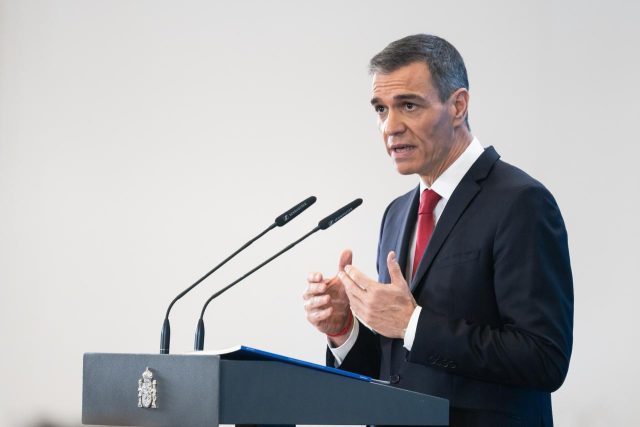
There is an almost comical scene unfolding in European politics: while a large part of the Italian left continues to point to Pedro Sánchez’s Spain as a model of humanity and “progressive” migration management, Sánchez himself is embracing – with remarkable pragmatism – a path that leads straight to Giorgia Meloni.
And this is not about subtle nuances. It is about strategy.
The Meloni model: CPRs and Albania
To understand the political short circuit, one must begin with what the left has spent months attacking: the so-called “Albania model.”
CPRs (Centres for Repatriation) are facilities where irregular migrants who have already received an expulsion order are held while awaiting deportation. They are not reception centres, but operational tools meant to enforce a basic principle: those who do not have the right to stay must be returned.
Meloni’s political breakthrough was to move part of this mechanism outside Italian territory, through an agreement with Albania:
- transferring irregular migrants to centres managed by Italy but located in Albania;
- rapidly processing asylum claims;
- accelerating deportations for those who do not qualify for protection.
The model is built around two key objectives:
- deterring departures, by making illegal journeys pointless;
- reducing domestic pressure, by externalising part of the migration management system.
Not surprisingly, despite months of outrage and criticism, this framework has begun to receive attention – and even cautious support – at the European level. An opinion by the Advocate General of the European Court of Justice suggested that the system can be compatible with EU law, provided fundamental rights are guaranteed.
Sánchez and the “discovery” of reality
And now we arrive in Spain.
The socialist government of Sánchez – celebrated for years as the moral alternative to Europe’s supposedly “hardline” governments – has launched cooperation with Mauritania that follows the exact same principle: managing migration flows outside European borders.
Specifically:
- agreements with African countries to stop migrants before departure;
- joint patrols and operational management on Mauritanian territory;
- creation of detention and processing centres;
- rapid returns for those who do not have the right to remain.
The objective is explicit: to stop routes toward the Canary Islands directly in Africa.
Translated into plain political language: externalisation of borders, precisely what Italy attempted with Albania.
The similarities: more than anyone wants to admit
The similarities between the two systems are obvious:
- Externalisation: both move migration management outside the EU (Albania for Italy, Mauritania for Spain).
- Deterrence: both aim to discourage irregular departures.
- Fast-track processing: rapid distinction between those entitled to protection and those who are not.
- Centrality of deportations: the entire system revolves around making expulsions effective.
There is one technical difference:
- Italy transfers migrants who have already arrived in Europe;
- Spain intervenes earlier, in transit countries.
But the political logic is exactly the same: control, selection, deterrence.
In some respects, the Spanish approach may even be tougher: detention facilities in Africa combined with immediate deportations.
The paradox of the European – and especially Italian – left
This is where the real political contradiction emerges.
For months, the Italian left has pushed a simplistic narrative:
- Meloni equals closure, cruelty and violations of human rights;
- Sánchez equals openness, solidarity and the “correct” European approach.
The problem is that reality tends to be less ideological.
When migration flows increase, when routes become unmanageable, when public opinion demands control, even progressive governments end up doing what works.
And what works today is exactly what the European right has been arguing for years:
- agreements with third countries;
- external border management;
- effective deportations.
The difference, increasingly, is rhetorical rather than substantial.
Is Sánchez still a model for left?
At this point, the obvious question must be asked.
If Pedro Sánchez is adopting tools that look remarkably similar to Giorgia Meloni’s, then:
- is the Meloni model really so outrageous?
- or was the real problem never the policy itself, but rather who proposed it?
And above all:
will the Italian left continue to present Sánchez as the example to follow?
Because one of two things must now be true:
- either Sánchez has stopped being a model;
- or, more simply, the model was right from the very beginning – it just happened to come from the “wrong” side of politics.