





 Subscribe


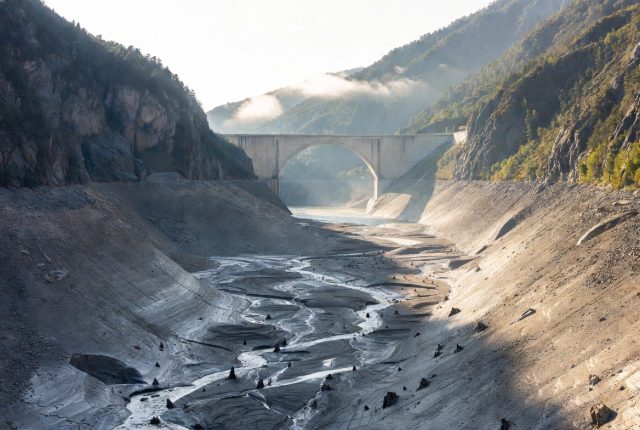
A network of foreign-funded environmental organizations has set its sights on Romania’s dams, with budgets running into the tens of millions of euros and at least eight structures already on the target list. The campaign arrives at the worst possible moment: barely a hundred kilometers from Bucharest, the controlled draining of a single major reservoir has left tens of thousands of people without drinking water for six months. Romania does not need to imagine what happens when you interfere with a dam. It is living it.
The driving force is a coalition called “Dam Removal Europe”, coordinated by WWF Netherlands and backed by the Open Rivers Programme. Its new regional project, “Expanding dam dismantling: an implementation plan for Southeast Europe”, opens with a budget of €1.2 million, and its premise is that Romania and the Balkans have “fallen behind” the rest of the continent in pulling barriers out of rivers. Activists have reportedly already flagged eight Romanian dams, with four inventoried for demolition across 2024 and 2025. The wider EU ambition, written into the bloc’s biodiversity targets, is 25,000 kilometers of barrier-free rivers by 2030.
The national water authority, Apele Române, insists there is no European order to demolish strategic dams, and that the much-quoted “1.2 million barriers” figure refers overwhelmingly to small, obsolete weirs rather than to giants like Porțile de Fier, Bicaz, Vidraru or Paltinu. That is true on paper. In practice, the danger in Romania has never been a demolition order from Brussels. The danger is the courtroom. The dam at Răstolița stands 90% finished and has never produced a single kilowatt/hour, frozen for decades by legal challenges from environmental groups. You do not have to dynamite a dam to neutralize it. You only have to litigate it until the money runs out.
In August 2025, Hidroelectrica began the first complete drawdown in Vidraru’s roughly 60-year history. Not an NGO action, but a planned €188 million modernization of one of the country’s most important hydropower complexes. It was meticulous, authorized, and accompanied by years of permits. And it still went badly for the people living below the dam. By November 2025, the water supplied to Curtea de Argeș and the neighboring communes of Valea Danului, Valea Iașului and Băiculești (together around 40,000 residents) was declared no longer potable. The controlled discharges had pushed turbidity in the raw water far beyond what the treatment station at Cerbureni, built back in 1973 and designed for clear water, could handle. Public-health inspectors then found dangerous bacteria like clostridium and intestinal enterococci in the system, and a state of alert was declared. Six months on, the crisis has not ended. Residents queue at springs and at the roughly 20 water containers the town has set out, prices for bottled water have jumped, and a technical report reportedly found that the station’s filtered-water basins had not been cleaned or disinfected in around two decades. The mayor’s own summary was stark: nobody knew what was coming once they started letting the water out of the lake.
This is the crucial point, and it is one no fact-check can wave away. Vidraru was a controlled operation run by the operator itself, with environmental permits and a fixed timetable and it still severed clean water for 40,000 people for half a year. Now imagine the logic of the dam-removal movement applied permanently: barriers taken out for good, reservoirs emptied not for maintenance but on principle, the buffer between a river’s moods and the towns below it simply gone.
Romania is following a path Spain walked years ago. Spain became Europe’s champion of dam removal, dismantling 108 barriers in 2021, another 133 in 2022, and well over 200 obsolete dams and weirs in total. A record celebrated as ecological progress. Then, in October 2024, the DANA storm system drowned the Valencia region and killed more than 200 people in some of the deadliest flash floods the country has ever seen. A furious national argument followed: had a culture that treated dams as villains and championed “wild” rivers quietly downgraded the unglamorous work that barriers do: slowing water, buying time, protecting towns?
Spanish fact-checkers and water officials reject any direct causal link, arguing the demolished structures were minor weirs incapable of regulating a flood of that scale. They may be right about those specific barriers. But the deeper lesson survives: a continent that has decided, as a matter of ideology, that dams are obstacles will tilt every close call toward removal and water does not negotiate with ideology. Dams, as Romanian engineers keep repeating, do two vital jobs at once: they generate power and they hold back disaster.
Romania now stands exactly where Spain once stood, but with a fresher wound. It is a country that has already forfeited hundreds of millions in EU recovery funds for failing to rehabilitate its dams, that has watched Răstolița rust for a generation, and that is, at this very moment, hauling drinking water by the container to 40,000 people because one reservoir was lowered under controlled conditions.