





 Subscribe


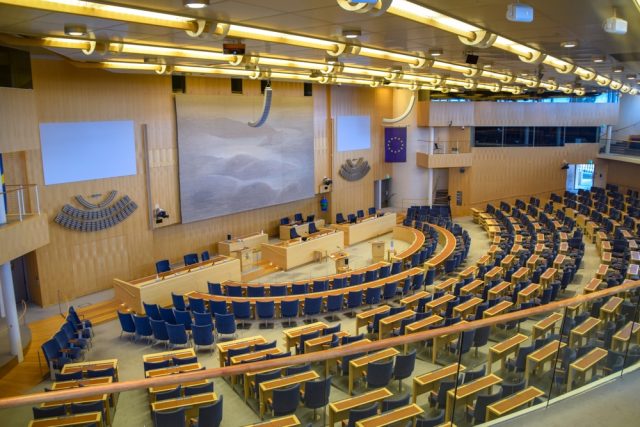
Is the centre-right Swedish government preparing itself for an electoral defeat this autumn?
The so-called Tidö government, named after the historical castle where the three centre-right parties the Moderates, the Christian Democrats, and the Liberals formed their ruling coalition with the nationalist Sweden Democrats in 2022, has been a remarkable feat for Swedish politics. This typically progressive and socially liberal country managed to carry through reforms on criminal justice, immigration, public service media, and taxation that would have been unthinkable merely five years ago.
That is not to say that the reforms themselves are always that ambitious or necessarily in true conservative or nationalist taste. But they are a break from the leftist politics of the Social Democrats, which used the radical Green Party and the Centre Party to advance an in hind-sight very harmful progressive agenda that put the needs of the Swedish people second to that of the green transition, of foreign nationals, and of the bureaucrats of the European Union.
Despite – or admittedly, perhaps due to? – the fast pace of popular and highly necessary reforms, the governing parties have not been rewarded by the voters. On the contrary, they have been penalised to the extent that the Liberals, which only narrowly survived the last election, are now unlikely to meet the four percent threshold to retain their seats in the riksdag come September 13th.
For much of the term, the governing parties have not had reason to fear their inherent polling disadvantage. The four parties combined have without exception been polling lower than the opposition “red-green” parties, but the assurance has been that wider gaps have been closed in the months preceding an election in the past, such as in 2010, when the left snatched defeat from the jaws of victory.
But here we are, mere months before the election. As of writing this, it is just over three months until the Swedish people will cast their votes. Meanwhile, the polls show an alarming situation for Tidö – the gap is as wide as ten points, which is more than ever recorded since 2022. As a conservative, it is painful to realise that there comes a point when the optimistic determinism that the right wing is skilled at picking up the pace in the polls when it really matters, may just be simple naïvety.
There are a few telltale signs that the government may be bracing for the worst.
A gamble with public transport
In late May, the four Tidö parties announced their big public transport programme, which halves the ticket cost for buses, trains, trams, and subways starting in July and lasting throughout November. The official motive is to offset the increased cost of living experienced by the households, and in particular those who are dependent on public transport. Bus lines and much of the railway passenger transport in Sweden are operated by regional governments, which may voluntarily apply for subsidies if they want to halve their ticket costs, is the idea. In total, the predicted shortfall for the government due to this programme amounts to seven billion SEK, or 700 million euros.
Sweden has a relatively low and stable national debt, which may incentivise projects like this. There is room to invest in the well-being of households with potentially borrowed money, is the argument. The same rationale has been used to motivate rising defense expenditures and expansion of nuclear power.
These schemes, and the public transport subsidies alike, have been criticised by the Social Democrats for being reckless spending. The Social Democratic leader, Magdalena Andersson, has made her name as a responsible financial manager, owing to her time as minister of finance before becoming party leader, which makes this a fairly strong angle of attack. It is also uncharacteristic of the “bourgeois” parties of Sweden, the Moderates in particular, to commit to such an expensive public programme, which weakens the credibility of it.
To many critical observers, the public transport gambit has thus been shrugged off as a cheap attempt to buy the voters. They argue that this is out of line with Swedish political tradition, where ideology has often weighed heavier than material promises, and that the voters will see through it.
If one analyses the public transport bill strategically however, it may be weaponised by the Tidö parties. It is up to each Swedish regional government to apply for the subsidies that will enable them to lower ticket prices. Out of prestige and political grandstanding, left-wing ruled regional administrations and municipalities are likely to decline the opportunity. Thus the cost for the government is lower, and they have instead proven a rhetorical point; the left wing is too proud to grant the right wing the benefit of the doubt, even when it also benefits their own population. In theory, it is the Tidö parties that will have the communicative upper hand on this issue, which may win them some voters.
Another strategic analysis of the programme is that it is effectively a tacit resignation. The right wing knows that it is governing on borrowed time, and while this uncharacteristic play may win them some voters in accordance with the scenario described above, the main function of it is to plant a headache for the next government. Already the Green Party, which is likely to be a part of the next Social Democratic-led coalition, is pledging to make the subsidies for cheaper public transport permanent. Are the ‘fiscally responsible’ Social Democrats going to scrap a popular programme for the most needy, just because it is expensive? The ulterior motive here may be to make the ‘inevitable’ transition of power uncomfortable for the left, which already has massive problems building a credible coalition.
An earlier investment by the government, where the value-added tax on food items was halved from 12 percent to 6 percent, may be viewed in the same light. This adjustment took effect in April, and is set to last until October – conveniently just after the election.
The problem for the governing parties is that they have yet to be rewarded for their easings.
The potential of recovery in opposition
It is a bitter pill to surrender power and being relegated to opposition. Especially if the ambition from the start was to get a second term to cement all the important reforms of the first term, and taking additional steps in the conservative direction.
But it may also be a learning experience for the right, in particular for the Sweden Democrats. This is the nationalist party that has been marginalised from power and dialogue with the established parties for the entirety of its existence, until around 2021. Due to this rhetorically advantageous position, they have never lost vote shares from one election to another. An exception occurred in 2024, when the party shrank in the European Parliamentary elections, but this was at the time considered exactly that, an exception. While there is nothing to indicate that the Sweden Democrats won’t reach their 2022 levels in the 2026 election, there is unfortunately nothing that indicates a growth either.
Being ousted from power can be a good teacher. This is the time for the party to consider where it lost the good will of the voters that it had in 2022, and to sharpen its tools for the next election. Concerning the above scenarios, it is likely that the left wing will have a very hard time ruling Sweden, if costs of living will continue to play a part in Swedish politics the next few years. Additionally, cobbling together a durable coalition that can actually agree on reforms appears to be an almost insurmountable challenge itself for the Social Democrats. In other words, it is not necessarily so that much of the Tidö legacy will be erased so easily by the socialists, the greens, and the neoliberals. That is why there are assured voices on the right who warn of a snap election if the Tidö parties cannot secure a majority in September. That is an agreeable conclusion.
Against this backdrop, it is perhaps understandable for the long term that the government is implicitly conceding defeat – a tactical retreat, if one may. The battle may be lost, but the war carries on.