





 Subscribe


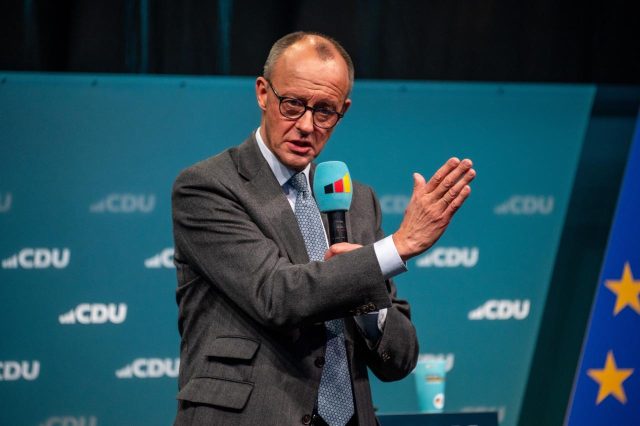
On July 28 the German Chancellor Friedrich Merz met the Taoiseach Micheal Martin to implore him to support Germany’s budget cutting and emergent Brussels-sceptic pivot. In Martin’s press statement that day he began by expressing “the solidarity of the Irish people with the victims of the horrific attack on the Pride parade in Berlin at the weekend. The European Union is a community of values…”. While justifiably condemned by leaders across the bloc, the attack is just one tragedy in a series of migrant-related criminal incidents that has been normalised in European society — a trend which Martin’s government has spent years attempting to suppress information about in Ireland. This hubris, of a pro-migration leader such as Martin commenting on a migrant attack to a CDU leader rapidly shifting rightwards on migration policy, is illustrative of the meeting which took place.
The Taoiseach might try to position himself as an honest-broker during Ireland’s Council Presidency, and claim to listen carefully to Chancellor Merz’s concerns, but that could not be further from the truth. Martin’s meeting with the unpopular Chancellor was a diplomatic embarrassment. Instead of addressing Merz’s primary concern — that the European Commission is adding far too many civil servants, spending far too much, and that the upcoming Multiannual Financial Framework for 2028 to 2034 is set to be negotiated during Ireland’s Council Presidency.
Rather, the Irish government has been embroiled in media fanfare and faux concern over one activist Daniel Tatlow-Devally and concerns that he is being held in poor conditions. The Taoiseach said that he raised the issue directly with the German Chancellor, and the Minister for Foreign Affairs Helen McEntee has confirmed her Department has done the same. This comes amidst Irish media depicting Tatlow-Devally as the victim of a show trial and leftist politicians alleging he is being treated inhumane. The irony is completely lost on Ireland’s political class that this sort of behaviour is an international embarrassment. To act as if Germany — a fellow EU member state and a wealthy developed nation — is treating an Irish prisoner to unnecessarily harsh treatment is a major blight on German-Irish relations precisely because Irish politicians are acting as if the German justice system is uncivilised and unfair.
Not to mention the fact that Tatlow-Devally is a member of the media-styled “Ulm 5” and is currently on trial in Stuttgart after being arrested by police last year for damaging an office owned by a firm which is known to supply weapon systems to Israel. He is said to be a member of Palestine Action, which is listed as a criminal organisation in both Britain and Germany. So ludicrous is the Irish political system, that government TD Barry Ward visited the accused Irish citizen with a number of left-wing opposition TDs and concurred with their description that Tatlow-Devally is being put on a show trial.
Unfortunately, Merz attempted to flatter the Taoiseach by stating his confidence that Martin would come to a realistic proposition during Ireland’s Council Presidency. Martin has been known to be anything but realistic in his domestic policy agenda. The Taoiseach, like his colleagues, is prone to diplomatic gaffes and a remarkable lack of situational awareness. For that reason, it is no surprise that Martin moralised over Israel with the German Chancellor. What is even more odd is the question: what did he even expect Merz to say in response? Germany, owing to its dark twentieth century history, has a special relationship with Israel that all children in Irish secondary schools would be aware of through our history curriculum. Yet the Taoiseach, a former headmaster and teacher, thought that this was an appropriate thing to say? Do the Irish political class expect the German Chancellor to fall on his sword and state his judiciary is not independent of the nation’s politics? That would be absurd, but here we are regardless.
Merz’s meeting with the Taoiseach was not merely a disaster in political terms, it was also laughably badly organised. Ireland’s budget for the European Council Presidency is set at almost €300 million — meanwhile Cyprus’ budget this year for their Council Presidency ran just under €100 million. One would expect that Dublin paying such a large amount of money would be conducive towards a well organised logistical programme — but absolutely not!
Amidst an Irish summer heat in the mid 20 degrees celsius, the Taoiseach was unable to understand his German counterpart’s speech to the Irish and international press. Why? Becaus his translation headset was not working, neither did it work for journalists in attendance at the press conference. As such, the public were left thinking: what was the point of this meeting at all? Our Taoiseach, to the best of public knowledge, speaks no other languages than English and Irish. So is he, as a so-called “good European” really qualified to lead Ireland’s Council Presidency in a period where European cooperation has been more important than ever? The answer is obviously no. But that will not stop unqualified morons like Ireland’s headmaster Martin from pretending as if they are suitable to lead the country’s European policy.
It is seriously concerning that Ireland’s Taoiseach does not speak a lick of the language spoken by the German Chancellor. Especially during such a period with international profile and attention on Ireland. We are to lead the Council of the European Union. While continental political figures have learnt English, French or German to facilitate their communication with other leaders, that the head of state for the Irish Republic to be utterly negligent of any skill in a major European Union language like German is a disgrace. Especially when one considers the deep historical and cultural ties between German and Ireland that date centuries prior to Irish independence or indeed even German unification under Bismarck.
It is a disgrace and it shows the masquerade of the Irish political class on full display. Though they might pretend to be European in their outlook, they lack the personal commitment or knowledge to back up their claim, including on degrees as basic as linguistic competencies.
What is even more despicable, is that Ireland’s betrayal of Merz’s reasonable European budgetary cuts comes amidst the Aughinish Alumina scandal. Germany under Merz has called for private discussions, and yet such an olive branch by a major EU member state has been refused in the name of protecting Irish citizens who are rightfully before trial over alleged crimes they have committed. One might hope that Europe will learn its lesson after this Council Presidency session that Ireland’s political leaders are utterly useless and incapable of exercising their own political power.
It is a dark stain on Ireland’s diplomatic reputation within the European Union that the country’s logistics for scheduling a meeting with a foreign leader are so poor that the translation headsets do not work. It is even worse that slovenly politicians like Martin are in charge of a sovereign state’s political administration. Regardless, it is unfortunately very transparent to all involved that the Republic of Ireland is incapable of engaging in basic diplomatic courtesies between governmental leadership without lecturing them on their supposed moral failures. The day which such a trend dies may be far off in the horizon, but it truly cannot come soon enough. At this stage, it is in the national interests of the Irish Republic to hold a general election that might end the political centre’ grip on political life in the country.