





 Subscribe


Iceland was settled from western Norway between 874 and 930, but soon the Icelanders became a separate nation, establishing a Commonwealth. Nevertheless, Norway and Iceland were close, and in 1262 the Icelanders reluctantly pledged allegiance to King Haakon the Old of Norway. More than a century later, the Norwegian crown passed to the Danish king, and thereafter both Norway and Iceland were governed from Copenhagen. It is still a mystery that, when Denmark had to cede Norway to the Swedish king in 1814, Iceland, long a Norwegian tributary, remained under Danish rule. This was probably because Sweden had no interest in this remote island, while the United Kingdom wanted leeway for the Royal Navy in the North Atlantic, easier to obtain from Denmark than from Sweden. But in 1905, the Norwegians established their own kingdom under a Danish prince who adopted the ancient Norwegian name Haakon. He was a respected and popular king, and a dramatic film, The King’s Choice, was made about his refusal to accept the demands of the Nazis after their invasion in April 1940.
A Warm and Down-to-Earth King
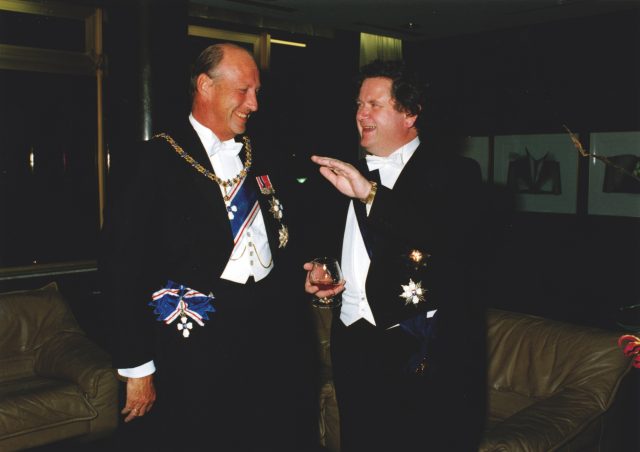
In 1918, Iceland became a sovereign kingdom in a personal union with Denmark. In a diary he kept as King of Iceland, Danish King Christian X—King Haakon’s brother—occasionally, but needlessly, worried that the Norwegians would try to reach out to the Icelanders, bypassing the Danes. During the Second World War, King Haakon and his son, Crown Prince Olav, lived in England, while Olav’s wife, Princess Märtha of Sweden, and their three children took refuge in the United States, where Märtha became a close friend of President Franklin D. Roosevelt. A romantic television series, Atlantic Crossing, was made about her exile. Crown Prince Olav came to Iceland in 1947, bringing a statue of Snorri Sturluson, the Icelandic chronicler who wrote Norway’s history. When Haakon VII passed away in 1957, he became King Olav V. His son, and Haakon’s grandson, succeeded him in 1991 as King Harold V. He was, like his father, a great friend of Iceland. He got on well with Iceland’s longest-serving prime minister, Davíd Oddsson (see the photo above). King Harold was warm and down-to-earth, an avid sportsman with a keen sense of humour, yet dignified in manner, as befits a king, and well aware of his duties as head of state. He passed away on 28 August, and his older sister Astrid only two weeks later.
Monarchy: Glory Without Power
Some say a monarchy is an irrational institution. But it has one point in its favour: it works. The seven European countries with the strongest traditions of liberty under the law are all monarchies: Norway, Sweden, Denmark, the Netherlands, Belgium, Luxembourg, and Great Britain. In these countries, the monarchy signifies historical continuity. Perhaps it is no less rational to be chosen by history than by the voters. Another argument for monarchy in a representative democracy is that it separates power from glory. Power rests with the elected representatives of the people, whereas glory belongs to the monarch and their family. Thus, politicians are less easily tempted to develop exalted ideas about themselves than in republics. They are informally held in check. Moreover, a monarchy provides a third level of veneration, alongside the ability to make money, worshipped in the free market, and the ability to gain votes, amply rewarded in politics. A country with a flourishing civil society is full of everyday heroes, civic leaders, volunteers and good samaritans, who deserve to be honoured. For them, it is much more impressive to receive recognition in the monarch’s palace, imbued with history, than to meet fleetingly with a glib demagogue. Perhaps the most important role of a monarch is to act as the leader and spokesman of civil society, above the clamour of merchants and politicians. King Harold performed this role very well.