





 Subscribe


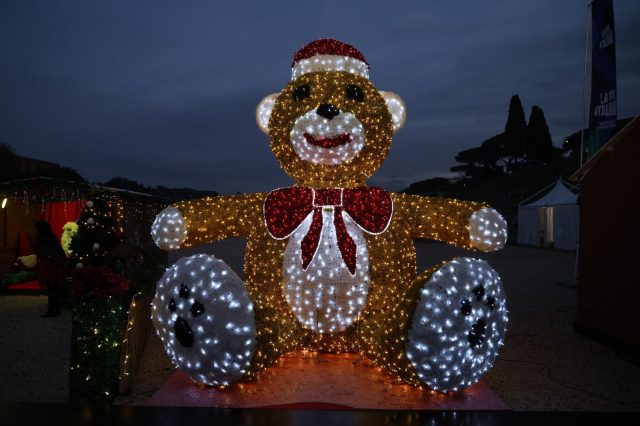
There is a moment, arriving at the gardens of Castel Sant’Angelo, when Atreju stops being “an event” and becomes simply a place. You do not need to know who is speaking on the main stage, nor carry the programme in your pocket. You just follow the current: families hauling skates and backpacks, small groups of teenagers warming their hands around a hot drink, older couples who have come “to see what it’s like,” tourists who stumble into a Christmas village in the very centre of Rome as if it were a seasonal surprise.
The scene works because access is the first statement of intent: free entry, no badges, no invitation-only threshold to cross. And in a country where politics often becomes a fenced enclosure (or a television studio), here they attempt something else: a constructed square, but one you can walk through without having to declare allegiance. Atreju 2025—running from 6 to 14 December—was presented explicitly as a large Christmas village in the heart of the city: market stalls, local products, and an ice-skating rink designed for adults and children alike. The first impact is not ideological; it is logistical and sensory. Lights and wood, the smell of food, queues that move without tension, a kind of informal order that makes the space feel liveable.
The rink becomes the emotional centre—not because it is spectacular, but because it is familiar. It is a simple gesture: if you want, you can stay without listening to anyone. If you want, you can pass through, buy a small gift, spend half an hour and leave. It is a very concrete way of saying: this is not only for those who already belong. And that is where Atreju’s “recipe” becomes clear: it does not try to persuade you with a speech first; it offers you an atmosphere. Before asking what you think, it asks whether you want to remain.
This year, the result is measurable: 105,000 people passed through Atreju. That figure alone explains why the 2025 edition has been described as record-breaking. It is extraordinary not only because of the number, but because of what it implies: 105,000 in the centre of Rome means constant footfall, a mixed audience, and curiosity that is not necessarily partisan. In practical terms, it means the event managed to be “city” before it was “party.”
And yet, while the village draws you in with ordinary things, the pulse of the political gathering is always there in the background: microphones being tested, stage lights coming on, staff moving briskly between areas, volunteers escorting guests. The architecture is that of a major public event, but the language is that of somewhere that wants to feel domestic. It is not a minor detail; it is the difference between a rally and a civic appointment. Atreju tries to make identity function less like a wall and more like a house with an open door.
The opening day made this especially visible: ribbon-cutting, the rink inaugurated with children performing before the more institutional greetings. Even that sequence sends a message. Not “look how impressive we are,” but “look how normal it is to be here.” And indeed Atreju lives in that grey zone that is the secret of its durability: it does not renounce politics, but it sets politics inside a setting where people arrive for a thousand different reasons, and many have nothing to do with panels.
Off to the side, the market: small purchases, Italian products, the practical logic of the “useful gift” rather than the political gadget. In front, the slow pace typical of Christmas spaces—an atmosphere that softens everything, including tone. And then there is plain curiosity: people who might not vote for Fratelli d’Italia, but still allow themselves to look, listen for a few minutes, form an impression. That, too, is part of the recipe: not to demand alignment, but to encourage proximity.
Seen from within, the most striking outcome is less political than social: Atreju is a demonstration of organisation and public staging. An event that has reached its 26th edition behaves, in length and centrality, like a fixture of the Roman calendar, not a cameo appearance. In other words, it is not simply an event that “occupies” a space; it is a space that tries to become an event—an environment where people can circulate, linger, return.
And here the political passage becomes unavoidable, though it does not need to be shouted. Atreju is also the way Fratelli d’Italia tries to turn identity into public space—to suggest that the Italian right is not only leadership and votes, but a community capable of organising, welcoming, and holding things together. In an era when politics tends to seal itself behind barriers or exist only on screens, bringing 105,000 people into an open, walkable venue is a cultural move before it is an electoral one: a claim that politics can still be lived as presence, not only consumed as content.
This is the deeper logic of “making even outsiders feel at home.” It is not a promise of neutrality; it is the decision to challenge the idea that politics must always be only conflict and separation. Atreju becomes a place where identity tries not to turn into hostility: it invites, hosts, lets people circulate. And in an Italy where public squares are often either heavily policed or emptied out, the simple possibility of “entering and staying” is already, by itself, a message.