





 Subscribe


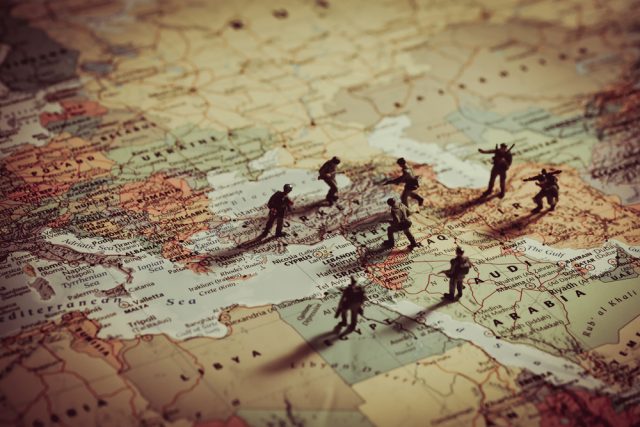
For years, Europe has cultivated a reassuring illusion: that crises could remain confined within their geographical boundaries. Ukraine to the east. The Middle East to the south. The Gulf far away, Ukrainian cities closer but still circumscribed.
Today, that illusion no longer holds.
When missiles and drones strike targets in Iran and the Levant, the question is not just about regional stability. It is about Kiev. It is about Warsaw. It is about Western military supplies. It is about the price of energy that fuels European economies. Ultimately, it is about the security of the continent.
Several European observers have expressed concern that an escalation in the Middle East could reduce US attention and resources for Ukraine at a time when Kyiv continues to depend crucially on Western support. This is not an ideological assessment, but a logistical one: interceptors, air defense systems, and advanced ammunition are not infinite resources.
At the same time, the structural link between Moscow and Tehran—particularly in the field of drones and military cooperation—has made it clear that the Ukrainian conflict and the Iranian crisis are not isolated issues. The Russian-Iranian axis is not a minor detail: it is part of the operational architecture of the ongoing war in Eastern Europe.
The result is an invisible but real front connecting the Persian Gulf to the Ukrainian plains.
The Moscow-Tehran axis: a concrete military hub
Cooperation between Russia and Iran is not diplomatic rhetoric. It is technology, production, and industrial capacity.
The use of Iranian-designed drones in the Ukrainian theater has been widely documented and represents one of the tools Moscow has used to compensate for its conventional vulnerabilities. In a conflict that has turned into a war of attrition, the availability of low-cost, highly replicable systems has significant strategic weight.
This means that any weakening or destabilization of Iran has a potential impact on Russia’s war effort. But it also means the opposite: if Iran is under pressure, Moscow may be pushed to strengthen other channels of cooperation, seeking compensation elsewhere.
Europe cannot afford to view these developments as isolated or purely symbolic events. Contemporary wars are industrial wars. And industrial wars are won—or lost—on the ability to produce, adapt, and resupply.
If the Moscow-Tehran axis cracks, the operational balance on the Ukrainian front may change. But if the West has to redistribute resources across multiple fronts simultaneously, European resilience will also be put to the test.
The American question: finite capabilities, European responsibilities
Another key element concerns the sustainability of Western support.
According to analyses reported in the international press, any expansion of US involvement in the Middle East risks affecting the availability of systems and ammunition destined for Ukraine. The consumption of interceptors and air defense missiles is not abstract: every battery deployed in one theater is unavailable in another.
This is not a question of questioning the Atlantic alliance. On the contrary. Precisely because the Alliance remains the pillar of European security, it is necessary to recognize a basic fact: no power can indefinitely sustain a simultaneous commitment to multiple high-intensity crises without recalibrating priorities and resources.
The real question, then, is not whether Washington will remain committed. The question is: is Europe ready to shoulder a greater share of responsibility?
For decades, the continent has been able to count on almost automatic strategic cover. Today, the scenario is more complex: the Pacific, the Middle East, and Eastern Europe are interconnected theaters where military capabilities are intertwined.
In this context, to continue to think that European security can be entirely delegated is to ignore the systemic nature of contemporary crises.
The Gulf as a European vulnerability
If the military node connects Tehran to Kiev, the energy node connects the Gulf to European capitals.
Any escalation in the Middle East immediately translates into volatility in the energy markets. Tensions in the Persian Gulf, threats to shipping, and official Iranian statements directed at Western countries have already caused financial turmoil and price fluctuations. This is not a temporary detail: it is a geopolitical constant.
For Europe, energy is not just an economic issue. It is a matter of political stability.
Higher prices mean:
- persistent inflation
- pressure on public budgets
- social unrest
- reduced fiscal margins for strategic investments
And, ultimately, less capacity to sustain a prolonged effort on the eastern front.
In recent years, the European Union has embarked on a laborious diversification of energy supplies. However, structural dependence on developments in the Middle East has not been eliminated. In a scenario of prolonged conflict, the security of maritime routes also becomes a determining factor once again.
The lesson is simple but often ignored: there is no military security without energy security.
European industrial fragility
The most sensitive issue, however, concerns industrial capacity.
The war in Ukraine has shown that Europe was not prepared for a high-intensity conflict in its neighborhood. Ammunition stocks proved insufficient. Production times proved to be long. The defense supply chain remains fragmented along often uncoordinated national lines.
At a time when the United States may need to redistribute resources across multiple theaters, this fragility becomes a strategic risk.
This is not a call for bureaucratic centralization or ideological slogans. It is a matter of primary responsibility for states.
The conservative European political tradition—as expressed in the principles of the Reykjavík Declaration—focuses on the democratic sovereignty of nations, the exercise of power at the most effective level, and the direct accountability of governments to their citizens.
Applied to security, this principle implies a concrete fact: defense cannot be outsourced.
Cooperation between European states is necessary. But such cooperation must strengthen national capabilities, not replace them with structures that lack real operational readiness.
The Iranian crisis, viewed in parallel with the war in Ukraine, shows that Europe is engaged in global competition in which industrial production, logistical resilience, and rapid decision-making matter as much as – if not more than – political declarations.
A strategic choice for Europe
At this point, the crossroads is clear.
Europe can choose to continue to react to crises as separate events, trusting in the US’s ability to sustain multiple fronts simultaneously. It can limit itself to managing the emergency, chasing every new escalation with partial and belated measures. Or it can draw a more lucid conclusion. The Iranian crisis is not a peripheral incident. It is a test. A test of Europe’s ability to understand that security is systemic. That theatres overlap. That supplies are not infinite. That energy is a geopolitical weapon. That industrial production is deterrence.
It is not a question of choosing between interventionism and neutralism. It is a question of choosing between dependence and responsibility.
Responsibility means:
- strengthening national defense capabilities
- coordinating European industrial efforts
- investing in energy resilience
- taking on a more solid role within the Atlantic Alliance
Not against the United States, but together with the United States. Not to replace NATO, but to make it more balanced.
If Moscow and Tehran have shown that geopolitical axes can extend beyond regional borders, Europe must show that it understands the nature of the times in which it lives. The axis between Moscow and Tehran, the pressure on Western supplies, and European energy vulnerability are not separate pieces of a distant mosaic. They are parts of the same strategic equation. Europe can continue to consider itself a “post-historical” actor, protected from dynamics unfolding elsewhere. Or it can recognize that the world has returned to being competitive, industrial, and geopolitical. Security is not an abstract concept. It is productive capacity. It is credible deterrence. It is decision-making autonomy. It is national responsibility exercised in cooperation with reliable allies. If the Iranian crisis has a lesson for Europe, it is this: there are no distant fronts when you depend on the choices of others.
The real front line is not drawn on a map. It is drawn in the political will of a continent that must decide whether to remain dependent on external balances or return to being the protagonist of its own security.