





 Subscribe


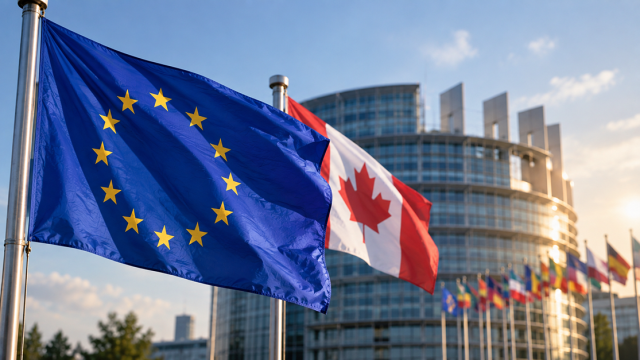
Von der Leyen’s State of the Union outlines a more assertive EU, combining tighter rules for technology, climate resilience and defence with an unprecedented proposal to make Canada the bloc’s first “associate member”
Europe’s answer to an increasingly unstable international order may be neither isolation nor dependence, but a more ambitious form of strategic autonomy. That was the central thread running through European Commission President Ursula von der Leyen’s State of the Union address in Strasbourg on Wednesday, as she outlined initiatives ranging from artificial intelligence and children’s access to social media to climate adaptation, security and a potentially historic new relationship with Canada.
The speech portrayed a European Union seeking greater control over the forces reshaping its economy and security. Technology was perhaps the clearest example. Rather than framing artificial intelligence simply as a competition to develop the most powerful models, von der Leyen argued that Europe should concentrate on extracting economic and social value from AI while retaining human control.
The Commission president pointed to fields such as healthcare, manufacturing and agriculture as areas where Europe could turn AI into a competitive advantage. Her emphasis, however, was on augmentation rather than replacement: machines should enhance human decision-making instead of removing people from it. She called for AI that generates greater value with lower costs and energy consumption, while preserving what she described as “human agency.”
That approach also explains Brussels’ determination to regulate the technology. The EU’s AI Act remains at the heart of its framework, but von der Leyen now wants greater international cooperation on the risks posed by increasingly capable systems. Canada and the United Kingdom were identified as potential partners in developing common approaches to AI safety and model evaluation.
The same philosophy — innovation combined with safeguards — underpins one of the most politically significant proposals in the speech: tougher restrictions on social media use by minors.
Under the plan presented in Strasbourg, children younger than 13 would be prevented from having social-media accounts. Those aged between 13 and 15 would have access only through restricted accounts under parental supervision, while platforms would have additional obligations to provide safer environments for users between 15 and 18. The proposal follows months of debate over addictive platform design, age verification and the exposure of children to harmful content.
Von der Leyen’s agenda extended well beyond the digital economy. After another exceptionally hot European summer, the Commission is proposing a European Heatwave Plan alongside a Climate Insurance Alliance. The latter is intended to address a growing vulnerability: only around a quarter of catastrophe losses in Europe are currently covered by private insurance, leaving governments increasingly exposed when extreme weather causes major damage.
Security, meanwhile, is becoming another field in which Brussels wants greater European coordination. Von der Leyen announced plans for a European security strategy inspired in part by NATO’s consultation mechanism, under which allies can convene when a member believes its security or territorial integrity is threatened.
Yet the most unconventional proposal concerned a country outside Europe.
With Canadian Prime Minister Mark Carney attending the Strasbourg session as guest of honour, von der Leyen proposed making Canada the EU’s first “associate member”. The precise institutional meaning of that status remains to be defined, but the political direction is clear: Brussels and Ottawa are exploring a relationship substantially deeper than a conventional trade partnership.
The proposal builds on already extensive EU-Canada cooperation, including CETA and expanding defence ties, but could eventually encompass technology, security and other strategic areas. It also reflects a broader effort by both sides to strengthen cooperation among democracies at a time of growing geopolitical and economic uncertainty.
China represents another side of that strategy. Von der Leyen signalled that dialogue with Beijing would continue, while warning that Europe expects tangible progress toward a more balanced economic relationship and is prepared to use its available trade instruments.
Taken together, the initiatives reveal an EU attempting to redefine what European sovereignty means. It is no longer primarily a question of internal integration. Brussels increasingly sees independence as the capacity to regulate transformative technologies, protect citizens, withstand climate shocks, strengthen collective security and build partnerships beyond Europe.
Von der Leyen’s Strasbourg message was therefore less a catalogue of individual policies than an argument about power: in a more confrontational world, the EU intends to reduce its vulnerabilities without abandoning cooperation — and to demonstrate that European integration can extend its influence far beyond Europe itself.
Alessandro Fiorentino