





 Subscribe


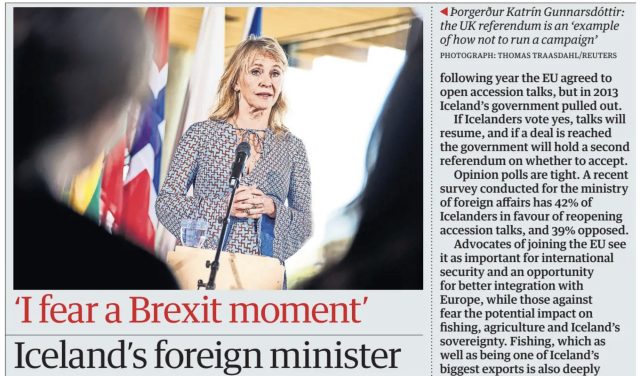
On 29 August 2026, in just three months, Icelandic voters will decide whether to renew Iceland’s 2009 application for EU membership, shelved in 2013. The debate is intensifying. The current foreign minister, Thorgerdur K. Gunnarsdóttir, leads the pro-EU centre-left Reform Party, and she has not concealed her strategy: to exploit a potential rift between the United States and Europe to resume the application process.
Farage’s Playbook?
On 27 May, in an interview with The Guardian, Thorgerdur comments on the debate (in Icelandic, family names are rarely used; Gunnarsdóttir is used only to indicate that she is the daughter of Gunnar). She says that some (unnamed) political parties are spreading misinformation about the EU in the same way that Brexit supporters did before the 2016 British referendum on membership. She adds that they seem to be using the playbook of Nigel Farage’s Reform Party.
Iceland Would Pay a Lot
It is, in fact, Thorgerdur herself who is spreading misinformation abroad. Those Icelanders who do not want to renew the membership application come from both the left and the right and have no connection to the British Reform Party. They are not arguing that the EU is a monster. Indeed, some European countries may gain more than they would lose from membership, especially the poorer ones. But Iceland is a wealthy country by gross domestic product (GDP) per capita. She would pay much more into the EU funds than she would receive.
An Impending Financial Crisis in the EU
The opponents of EU membership worry that the numbers now being mentioned about net transfers to Brussels, €400–500 per Icelander, are too low. The EU faces a financial crisis: many member states have accumulated unsustainable debts; most have significant unfunded pension obligations; the countries seeking admission at present are mostly poor; and European countries will have to spend much more on defence than before. Iceland has none of those problems. Her public finances are sound; she has the world’s strongest pension system; and since 1951, she has had a defence treaty with the United States, which guarantees her security.
The Icelandic Fisheries
Opponents of EU membership point out that equal access to fishing grounds for all member nations is part of the EU’s basic, non-negotiable legal framework, the acquis communautaire. The rule on relative stability in local fisheries is not part of this framework and can be changed at any time by a majority vote in the Council of Ministers (in which landlocked countries with no fisheries can participate). Irish fishermen found this out in December 2025, when their share of the total allowable catch in Irish waters was drastically cut by the EU. Iceland, however, enjoys profitable and sustainable fisheries, which account for much of her prosperity. Thorgerdur misleads the public when she suggests that permanent, not temporary, exemptions may be granted from the principle of equal access to fishing grounds, contrary to what is stated in EU documents and by EU spokesmen.
Iceland Already Has Access to the European Market
If Iceland joins the EU, she would lose not only control of her fisheries, but also the opportunity to enter into free trade agreements with other countries. Moreover, through her membership in the European Economic Area (EEA), with Norway, Liechtenstein, and, for most purposes, Switzerland, she already has access to the internal European market. There is, therefore, no urgent economic need for membership. Opponents of EU membership also point out that the EU has changed significantly since Iceland applied for membership in 2009. The rules for admitting new countries have become stricter, and the oldest democracy in Europe, Great Britain, has left. They add that it is premature to speak of a rift between Europe and the United States. Rhetoric should not be mistaken for reality.
These considerations are all relevant and do not come from any playbook of the British Reform Party.