





 Subscribe


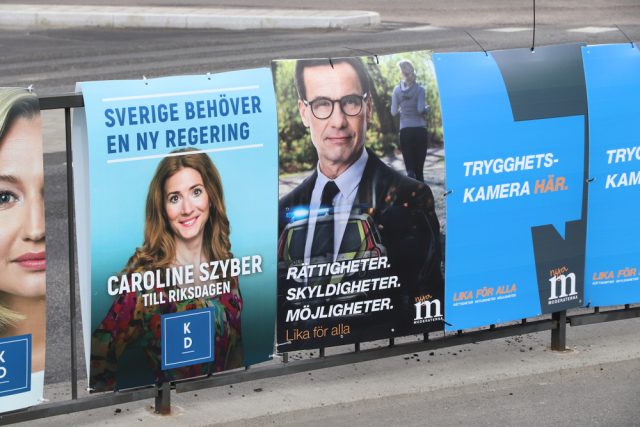
On September 13, Sweden goes to the polls. Every four years, Swedes elect their representatives to the national parliament.
Four years ago, in 2022, a new right-wing coalition won a narrow victory over the united left. This new coalition comprised three traditional right-wing parties, each with roots—in varying ways—in liberalism and conservatism. However, the election victory was effectively secured by the right-wing nationalist party, the Sweden Democrats. While the three traditional right-wing parties actually lost some ground in the election, the Sweden Democrats gained more than three percentage points, thereby clinching the victory for the right.
The 2026 election campaign is likewise defined by a divide between four parties on the right and four on the left. However, the left-wing bloc is not as tightly knit this time as the bloc on the right; the liberal Centre Party is struggling to find common ground with the old communist party, the Left Party.
The Centre Party—which has its roots in the old Farmers’ League—declared about a decade ago that it would never cooperate with the right-wing nationalist Sweden Democrats. Consequently, it eventually became inevitable for the party to join the left-wing bloc, even though its economic policies could best be described as neoliberal.
However, since the party appointed a new leader, Elisabeth Thand-Ringqvist, about a year ago, the tone has sharpened—even toward the party on the far left. Politicians from the Centre Party and the Left Party—who would both form part of the governing coalition should the Left win the election—now openly trade insults on television. This does not reflect well on the left-wing bloc.
But roughly four weeks before the election, as the campaign kicked into high gear, a new theme emerged in the debate.
The left-wing bloc is leading in the opinion polls—and by a wide margin. While the Left appears poised to win in September, it is far from certain how they would assemble a government.
It is against this backdrop that the Centre Party is attempting to revive an idea it has championed for years: that the centrist parties should form a government to avoid becoming dependent on either the Sweden Democrats—situated at the far right of the political spectrum—or the Left Party, which represents the extreme left.
Several scenarios are conceivable here. Depending on the election results, Sweden could see a government comprising the Social Democrats, the Centre Party, and the two conservative parties—the Christian Democrats and the Moderates. Alternatively, fewer of these parties might serve in the government itself, while a broader range of parties supports the administration and participates in budget negotiations.
Some argue that the small Green Party ought to be able to join a broad centrist coalition. However, whenever the issue has been discussed, it has become clear that they are perceived as too radically left-wing. Ebba Busch, leader of the Christian Democrats—who has often hinted at a willingness to cooperate across the traditional bloc divide—states that she absolutely does not want to work with the Green Party. And the lack of affection is clearly mutual.
In all likelihood, there will be no centrist government. Either the right wins—in which case Swedes know what they are getting: continued cooperation between the traditional right-wing parties and the Sweden Democrats—or the left wins, meaning the four parties in that bloc will eventually find a way to cooperate.
Yet the fact that the possibility of forming a centrist government in Sweden is now being discussed for the first time in a long while suggests that opposition to the socially conservative and nationalist Sweden Democrats is no longer sufficient to forge a united front. It was precisely the reluctance to grant any influence to the Sweden Democrats that enabled the Centre Party—formerly the Farmers’ League—to shift to the political left.
That reluctance remains strong; the Centre Party seems unwilling to touch the Sweden Democrats with a ten-foot pole. But now, an unwillingness to cooperate with a former communist party is also becoming apparent. In the long run, it appears Sweden is heading in the same direction as many other European countries: toward a situation where three political blocs—right, center, and left—must share power, despite finding it very difficult to work with one another.