





 Subscribe


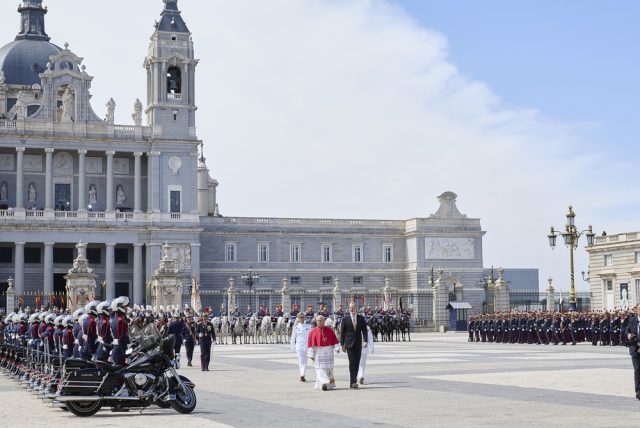
When the Pope visited Spain this month, much attention focused on the official ceremonies, the diplomatic symbolism and the crowds that gathered to welcome him. Yet the visit carried a significance that transcended protocol. It reminded the world that Spain remains a Catholic nation. It reminded the Pope himself that Spain remains a Catholic nation. And, perhaps most importantly, it reminded many Spaniards of that very same truth.
For decades, a dominant narrative has suggested that Spain had become decisively post-Christian—a country whose Catholic heritage belonged to museums, history books and tourist brochures rather than living public life. The images of the past days challenged that assumption.
The enthusiasm that greeted the Holy Father was not merely institutional courtesy or cultural nostalgia. It reflected a people who still recognise Catholicism as an essential component of their national identity. One need not ignore Spain’s growing secularisation to acknowledge that its deepest civilisational instincts remain profoundly shaped by Christianity.
Perhaps the most striking aspect of the visit was the Pope’s own reaction. Observers could not fail to notice moments of visible emotion as he encountered the warmth and affection of ordinary Spaniards. In a Europe so often portrayed as indifferent—or even hostile—to religious expression, Spain offered a different picture: one of sincere welcome, living faith and enduring attachment to the See of Peter.
Yet the Pope’s journey did more than inspire admiration. It left virtually no one indifferent. Believers and non-believers alike followed his speeches with unusual attention, recognising that he was addressing not merely Catholics but the moral challenges facing Spanish society as a whole.
His address before the Congress of Deputies was particularly significant. For many observers, it inevitably evoked the celebrated speech delivered by Pope Benedict XVI to the German Bundestag in 2011: an appeal to recover the ethical and philosophical foundations upon which democratic politics must ultimately rest. Rather than offering partisan prescriptions, the Pope invited legislators to rediscover enduring principles capable of guiding public life beyond the shifting winds of ideology and electoral calculation.
Nor did he shy away from difficult questions. On migration—a subject that continues to divide European societies—he articulated a vision that sought to reconcile two principles too often portrayed as irreconcilable: subsidiarity and solidarity. The legitimate duty of states to guarantee security, preserve public order and exercise effective control over their borders need not contradict the humanitarian obligation to recognise the dignity of every human person and to assist those genuinely in need. Sound migration policy, his remarks suggested, requires both prudence and compassion rather than sacrificing one to the other.
The symbolism of concluding his Spanish journey in the Canary Islands gave particular force to that message. Few places illustrate the complexities of contemporary migration more vividly. For years, the archipelago has stood on the front line of irregular migration routes into Europe, bearing enormous humanitarian, logistical and political pressures. By ending his visit there, the Pope transformed abstract principles into concrete reality, demonstrating that solidarity cannot exist without responsibility and that responsibility loses its moral legitimacy when detached from human dignity.
Equally striking was his willingness to reaffirm the Church’s defence of the sanctity of life in all its stages. He spoke clearly in favour of protecting human life from conception, reiterating the Church’s opposition to abortion while insisting that every unborn child possesses inherent dignity independent of circumstance or utility. At the other end of life, he warned against the growing normalisation of euthanasia and assisted suicide, arguing that a compassionate society accompanies those who suffer rather than facilitating their death. Whether one agrees with these positions or not, few could accuse the Pope of avoiding moral controversy or hiding the Catholic Social Thought behind the veil of political correctness. He was crystal clear on the Church’s position on these very heated debates.
Madrid, in particular, deserves recognition. The logistical organisation of the visit was exemplary, demonstrating an impressive capacity to coordinate an event of enormous complexity without sacrificing accessibility or solemnity. Even more remarkable was the popular fervour. Streets filled not simply with spectators but with pilgrims, families and young people whose presence testified that public expressions of faith still resonate deeply within Spanish society.
The Catalan leg of the journey carried its own symbolism. At Montserrat, the Pope encountered one of the spiritual jewels of Europe, where the monastery’s Escolania—the oldest boys’ choir in continuous existence on the continent—once again demonstrated the power of sacred music to elevate worship beyond politics or ideology. The centuries-old tradition of Gregorian chant and liturgical excellence remains one of Christianity’s most extraordinary cultural inheritances.
Equally unforgettable was the celebration at the Sagrada Familia. In an inaugural ceremony bathed in an extraordinary display of light and colour, Gaudí’s masterpiece showed that technological sophistication and profound reverence are not enemies but allies when ordered towards beauty. The carefully orchestrated visual effects did not distract from the sacred; they illuminated it. In an age often tempted to oppose innovation and tradition, the basilica offered a compelling counterexample: technology, architecture and artistic creativity can serve transcendence rather than replace it.
This lesson extends beyond liturgy. Europe frequently debates competitiveness, digital transformation and technological leadership while neglecting the cultural foundations that give meaning to such progress. Innovation detached from beauty and truth risks becoming sterile. The Sagrada Familia demonstrated that the most advanced techniques can be placed at the service of something timeless. A powerful reminder that ought to be applied elsewhere, starting with the EU’s foundational principles in these times of geopolitical, societal and economic turmoil.
More broadly, the Pope’s visit invited Spain to recover a clearer understanding of itself. The nation’s universities, legal traditions, artistic achievements, charitable institutions and global historical legacy were profoundly shaped by Catholic thought. The School of Salamanca helped lay the intellectual foundations of international law and human dignity, including the legitimacy of the use of force or to wage war. Spanish missionaries and scholars carried not merely political influence but a vision of the person rooted in Christian anthropology.
These are not merely historical curiosities. They remain part of the moral architecture upon which modern Spain stands.
Whether the enthusiasm witnessed during the papal visit marks the beginning of a broader religious renewal is impossible to know, though it seems that way among the Spanish youth —this being a trend across the West in general. But it undeniably exposed the inadequacy of describing Spain simply as another secular European state detached from its past.
For a few remarkable days, the world was reminded that Spain’s Catholic identity is not an archaeological relic but a living reality. The Pope was reminded of it too, visibly moved by the affection with which he was received.
And perhaps the greatest surprise of all was that many Spaniards seemed to rediscover the same truth for themselves. After years in which it was fashionable to downplay or even deny the country’s spiritual inheritance, they found themselves acknowledging something that had been hidden in plain sight: Spain is, despite everything, still a Catholic nation.