





 Subscribe


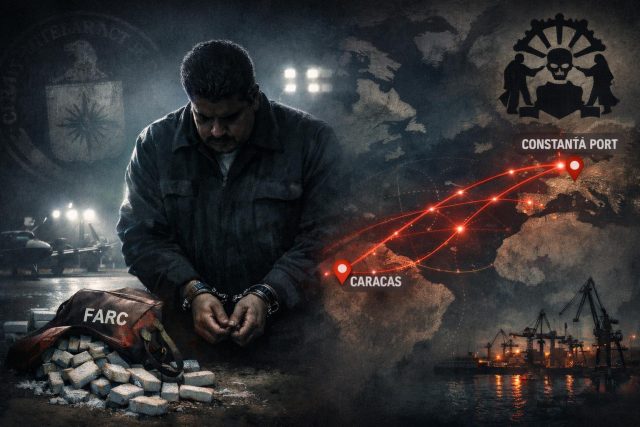
The January 2026 arrest of Nicolás Maduro reveals a state supported cocaine empire with tentacles reaching Europe’s ports. Echoes of Manuel Noriega’s fall demand scrutiny of secrets buried under “national security” pretexts. Maduro’s indictment shows that Venezuelan institutions are being systematically turned into infrastructure for drug trafficking. Many people don’t believe these accusations, but looking closely at what has happened in the Flores family and in other cases in Latin America makes the accusations seem more likely to be true.
The most important question is “Why were some of the charges against Maduro dropped?”
How does “national security” factor in this trial?
In November 2015, Cilia Flores’ nephews, Efraín Antonio Campo Flores and Franqui Francisco Flores de Freitas, were apprehended in Haiti attempting to transport 800 kilograms of cocaine with FARC (Revolutionary Armed Forces of Colombia) supply coordination. The significance extended beyond ordinary trafficking. These men operated with institutional authorization, planning to use Simón Bolívar International Airport while receiving protection from military authorities. Prosecutors documented that profits were designated to fund Cilia Flores’ campaign for the Venezuelan National Assembly scheduled for December 2015.
The trial concluded in November 2016 with convictions in December 2017 delivering eighteen-year sentences. Rather than distancing herself, Cilia Flores denounced the arrests as “kidnapping”, revealing the regime’s fundamental inversion: drug trafficking by state authorities constituted legitimate state exercise rather than criminal enterprise.
Flores herself emerged as the trafficking apparatus’ architect. Federal prosecutors documented that she accepted bribes of reportedly $100,000 per cocaine shipment in exchange for arranging meetings between major traffickers and Venezuela’s anti-drug director, Néstor Reverol Torres. The Orwellian inversion merits emphasis: the official anti-drug enforcement office became, under Flores’ mediation, a mechanism for facilitating smuggling. Substantial portions of these proceeds cycled back into regime political projects, directly linking the regime’s survival to narcotics revenue.
Maduro’s personal indictment reveals far more comprehensive trafficking than the nephew case alone. His operation began during his tenure as Foreign Minister (2006-2008) when he allegedly sold authentic Venezuelan diplomatic passports to identified traffickers. When these traffickers needed to move cocaine profits from Mexico back to Venezuela, Maduro would notify Venezuelan embassies of fictitious “diplomatic missions,” allowing planes laden with tens of millions in cash to bypass customs inspection.
After assuming the presidency in 2013, Maduro expanded operations exponentially. Federal indictments allege he coordinated the annual shipment of approximately 250 tons of cocaine into the United States. A volume comparable to established cartels. The operational architecture employed military resources systematically: flights originated from Venezuelan military airbases, FARC supplied cocaine from safe haven within Venezuelan territory, military and coast guard vessels provided maritime routes through the Caribbean, and military intelligence identified interdiction risks in advance, allowing traffickers to adjust routes accordingly.
Rather than single leadership, what emerged was what prosecutors termed a “patronage system and culture of corruption”: loose networks binding senior military officers, intelligence officials, and regime-connected civilians through direct profit participation in trafficking. This system proved remarkably resilient because participants understood they benefited directly from cocaine revenues while maintaining plausible deniability regarding their involvement.
The Maduro regime’s partnership with dissident FARC factions proved mutually beneficial: Venezuela provided sanctuary, military equipment, and logistical support; FARC supplied cocaine at wholesale rates and conducted dangerous cultivation and production work. By the late 2000s, this arrangement institutionalized completely. Flights departed Venezuelan military facilities carrying multi-ton shipments. Prosecutors documented single shipments exceeding 5.5 tons and FARC operatives offering imprisoned members’ storage facilities on Aragua State beaches for cocaine awaiting shipment. These were not discrete operations by rogue officers but systematic state-level cooperation coordinated from regime authority’s upper reaches.
Please note that Nicolas Maduro’s capture occurred precisely thirty-six years after Manuel Noriega’s removal from Panama. This is why this story demands historical context in order to better understand Maduro’s significance. From the 1950s, Manuel Noriega served as valued intelligence asset providing regional counterintelligence. The CIA compensated him financially and overlooked increasingly brazen trafficking. In the early 1980s, Noriega struck a direct deal with Pablo Escobar’s Medellín Cartel: cocaine transiting Tocumen Airport received protection for $1,000 per kilogram reaching the United States.
In December 1989, President George H.W. Bush ordered Operation Just Cause, invading Panama and capturing Noriega for trial on drug trafficking, money laundering, and racketeering charges. He received a forty-year sentence. Yet what remains extraordinary is what the trial systematically excluded: Noriega’s CIA relationship, documented payments (approximately $322,000 officially, though attorneys argued $11 million), CIA knowledge of his trafficking, and CIA efforts maintaining the relationship despite mounting narcotics evidence.
This suppression of evidence served critical institutional function: it prevented establishing that the CIA maintained relationships with international drug traffickers. Basically, the trial changed the way people saw Noriega from a rogue actor to someone who worked within institutions that allowed and sometimes benefited from his actions.
During the Nicaraguan civil war in the 1980s, the CIA helped the Contra rebels by turning a blind eye to cocaine trafficking. DEA agent Celerino Castillo said that cocaine was being stored at CIA’s Ilopango Air Force Base in El Salvador for shipment to the US. Instead of looking into it, the DEA dropped the investigation and kicked Castillo out. In Costa Rica, CIA agent John Hull worked with Miami drug dealer George Morales to move cocaine. In exchange for protection, Morales gave Hull money to support the Contras. This pattern created an institutional memory: anti-communist goals were more important than drug enforcement goals. The CIA could say that protecting traffickers was a necessary cost of its goals during the Cold War.
Recent events and statements confirm that the CIA had active intelligence sources within Venezuela’s government, meaning individuals close enough to Maduro’s circle to provide precise operational intelligence enabling his capture. These sources would possess comprehensive knowledge of trafficking apparatus structure, military and intelligence coordination mechanisms, foreign intelligence partnerships, and potentially American intelligence operatives’ involvement in operations benefiting from Venezuelan narcotics.
Yet this knowledge will remain classified. If Maduro possesses information implicating American intelligence operatives or former operatives in drug trafficking, that information will almost certainly be excluded from trial on national security grounds. This mirrors Noriega precedent perfectly: the public record will show Maduro as independent drug trafficker rather than political figure whose state apparatus intersected with American intelligence operations.
Romania’s emergence as Latin American cocaine’s critical transit point establishes where these networks directly impact European security. Constanța port received eighty-four percent of Romania’s 2009 cocaine seizures, including a single 1.3-ton interception. Cocaine moves from Venezuelan production through Caribbean routes, entering Constanța, then distributes through Romanian organized crime networks coordinating with Italian ‘Ndrangheta – the Calabrian mafia organization controlling approximately eighty percent of Europe’s cocaine supply. Romania’s drug epidemic represents not merely domestic criminality but integration into continental trafficking systems originating in Caracas.
In conclusion, Maduro’s knowledge of Venezuelan trafficking networks and international conspirators could reveal a vast transcontinental drug infrastructure. It is still unclear how much of this information will be revealed during the trial.