





 Subscribe


If there is any principle on which all serious students of the economy agree, it is free trade. The division of labour between individuals and countries increases the total product, because people then do what they are best at, and both they and others benefit. We should, however, not ignore the persistent opposition to free trade. Protectionism is not some personal whim of United States President Donald Trump. It has been the rule rather than the exception in US history, and it enjoys strong support elsewhere. It cannot be just dismissed with disdain. Instead, it should be understood and met with what I would call the AAs: Arguments and Alliances.
The Support for Protectionism
Two facts explain the political appeal of protectionism. The first one is the uneven distribution of benefits and losses from free trade. The benefits are dispersed, while the losses are concentrated. The benefits—lower prices and tougher competition—only become visible in the long run, and are enjoyed by the whole population, meaning that the benefit to each citizen is not great at any given time. The losses from free trade, such as the disappearance of unproductive jobs, are, however, clearly visible in the short term. Moreover, the losses affect only a small segment of the population, which is therefore well aware of them. The whole population enjoys lower prices of food, if it is freely traded, but only food producers, the farmers, benefit from being protected from competition abroad. Those who perceive themselves to be losers from free trade have an incentive to organise political support for protectionism. Special interests speak loudly to politicians, while the public interest is often to them only a faint whisper. All politics is local, long-time leader of the US House of Representatives Tip O’Neill once exclaimed.
Plausible, but Fallacious Arguments
The second fact explaining the support for protectionism is that many arguments for it seem plausible at first glance, even if they are fallacious. It is said that free trade entails both winners and losers. But its benefits far outweigh the costs, and the losers will only be losers in the short term. It may be true that not all boats are lifted by a rising tide, but it is equally true that no boat is lifted in a stagnant swamp. It is said that jobs have to be protected. But many more jobs are created by increased productivity than are lost due to free trade. It is said that wages have to be protected from undercutting in low-wage countries. But again, the creation of wealth through entrepreneurship and innovation in competitive international markets will increase demand for labour and thus raise wages. It is said that infant industries have to be protected. But when does the infant become an adult who no longer needs protection from competition abroad?
Arguments and Alliances
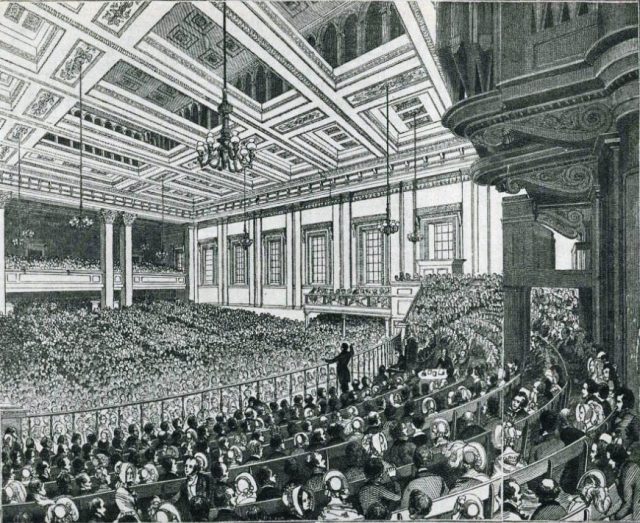
Of course, if the United States and the European Union embrace protectionism, they are big enough that they can nonetheless enjoy most benefits of the division of labour and free trade, as trade would mainly be between the fifty member states of the US and between the twenty-seven member states of the EU, two enormous markets. But for most other countries, protectionism would lead to small yards and high fences. How can this be avoided? Partly by arguments, I would submit. Protectionism must be, and can be, refuted, while the opportunities created by free trade should be forcefully presented. This is done cogently in a recent anthology, Free Trade in the Twenty-First Century, edited by Lord Daniel Hannan and Max Rangeley. Partly, I would submit, protectionism could also be overcome by free-trade alliances, not only by pressure groups but also by societies of idealists, such as Richard Cobden’s Anti-Corn Law League, whose meeting in 1846 at Exeter Hall in London is depicted above.