





 Subscribe


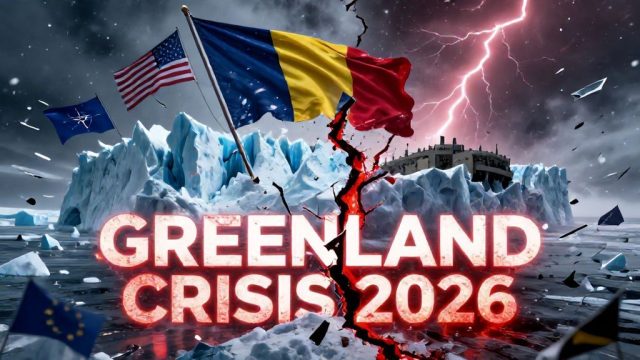
When the Trump administration openly floated the military takeover of Greenland in January 2026, it caused one of NATO’s biggest existential crises since the alliance’s origins. Some European politicians including Romania’s recently-appointed defense minister Radu Miruta found themselves issuing statements exposing a deep-seated misunderstanding of NATO’s collective defense mechanisms. That Romania might deploy troops to Greenland on the basis of Article 5 to take on the United States is not only the most egregious geopolitical mistake of the century but the beginning of a chain of strategic miscalculations that would be devastating for the Romanian national interest.
Let’s start with the simplest and most irrefutable issue: Romania has absolutely no Arctic military capacity at all. This is no small gap, it’s a chasm. Romania doesn’t have a single icebreaker. This means the nation’s entire naval strategy is oriented to the Black Sea with its patrol vessels and coastal defense systems designed for regional, rather than Arctic operations. Romanian forces going to Greenland would require securing supplies through hostile Arctic waters, and conducting operations in an area for which the Romanian military has zero capabilities, zero infrastructure, and zero specialized equipment.
Romania is strongly pro-American and pro-NATO: 89 percent of Romanians think it is in their national interest to stay in both NATO and the European Union. Even more striking is Romania’s view of the United States. In a 2025 poll, 65 percent expressed a favorable view compared to just 31 percent unfavorable, making Romania one of only two European countries (together with Poland) with a genuinely strong pro-US sentiment.
One of the cornerstones of Romania’s defense architecture is its partnership with the United States. This is not metaphorical or aspirational but is firmly embedded in the building blocks of the country’s military and defense apparatus.
There are three U.S. military bases that are strategically and ideologically the basis that underpins NATO’s eastern flank defense.
The Mihail Kogălniceanu Air Base is the U.S. primary air force hub in the region in the Black Sea port of Constanța.
Romania also operates the Aegis Ashore Ballistic Missile Defense system at Deveselu, a fundamental element of NATO’s missile defense structure.
Câmpia Turzii Air Base is a second major facility for allied air operations and training.
Strategic defense agreements that allow the U.S. forces to operate on Romanian territory, training Romanian soldiers, conducting joint drills and maintenance of these bases are the bedrock of Romania’s national security policy. If Romania should send troops to Greenland to take on the United States on the island, all of these agreements would become instantly void. The U.S. would withdraw from all three bases, pull all personnel, cease all joint training operations and end all military procurement relations. Romania’s developing defense industry, which had only just begun to build local capabilities in drone production and ammunition making through these partnerships, would end overnight. The strategic isolation would be total and disastrous.
Romanian Defence Minister Radu Miruta’s discourse relating to Greenland has pointed to dangerous confusion about how NATO’s Article 5 actually works.
Article 5 of the North Atlantic Treaty reads: “The Parties agree that an armed attack against one or more of them in Europe or North America shall be considered an attack against them all.” Article 5 was invoked exactly once in NATO’s history: after the September 11, 2001 terrorist attacks on the United States. It was called in when an outside power attacked a NATO member, not when NATO members collided with each other. It is also the reason that the treaty mechanism does not serve as a tool to force NATO members to battle one another as a collective against another NATO member. The consensus among scholars is clear: Article 5 is intended for external threats, not conflicts within the alliance itself.
Instead of implying that Article 5 might be invoked on NATO members, or that Romania could deploy Arctic military forces, Miruta should have highlighted what Romania can actually do, that is to support diplomatic solutions, and defend the Black Sea region and eastern European security, which, actually, is Romania’s sphere of relevant capabilities and strategic interest.
Romania cannot and could not rationally take action on Greenland by military means against the US. That’s strategic suicide, a policy so ideologically alienated from Romania’s actual military capabilities and vital interests that it could stand up to some of the worst geopolitical miscalculations in modern European history.
The most important lesson to emerge from this Greenland crisis comes down to really simple things: NATO works because America has committed to defending Europe. Once this status quo is questioned, as the Trump administration argues, European countries should decide between principled protest and survival instinct. For Romania, there is no question about which should be placed first.