





 Subscribe


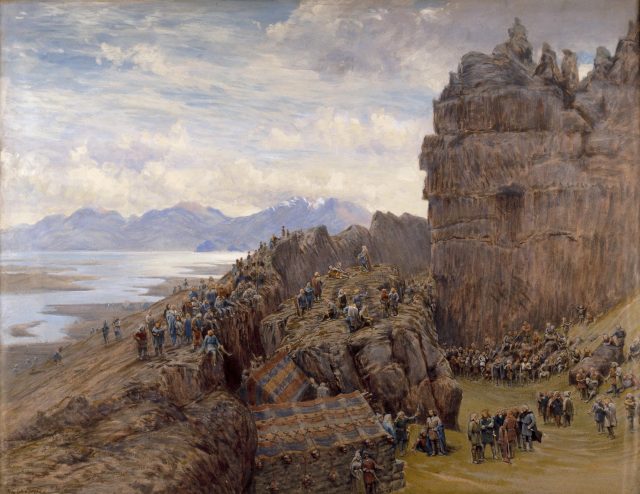
Practice precedes theory, and the Icelanders practised liberty long before they wrote about it. Iceland was settled between 874 and 930 by Norwegians, many of whom refused to accept the rule of the first Norwegian king, Harold Fairhair, who deprived his subjects of their ancient liberties and declared all land to be his property. In 930, the Icelanders established the Commonwealth, which was governed not by a king but by a popular assembly, the Althing, which met for two weeks every summer at Thingvellir (shown above in a painting by W.G. Collingwood) to resolve legal disputes and revise the law. The only official of the Commonwealth was the lawspeaker, who was supposed to recite one-third of the law each year over a period of three years. The country was divided into 39 chieftainships that served as private protection agencies. Each farmer could choose between the chieftains in his region.
The King’s Friends, Not Subjects
In the 1120s, the priest Ari the Learned Thorgilsson wrote a short history of Iceland, in which he described the conflict between heathens and Christians at the Althing in the summer of 1000. The lawspeaker, Thorgeir from Brightlake, was appointed as arbitrator. Although he was a heathen, he decided that from then on, the Icelanders should be Christians. In his speech to the assembly, he emphasised that Iceland was an exception among the Nordic countries, with no king taxing his subjects and waging war on other kings. The same theme appeared in the account by chronicler Snorri Sturluson of a meeting of the Althing in 1024. An emissary of King Olav the Fat of Norway tried to persuade the Icelanders to become the king’s subjects. In a famous speech, the farmer Einar from Thvera said that King Olav the Fat might be a good king, but that kings turned out differently; some were good, and others were bad, so it was best not to have a king. The Icelanders should be the king’s friends, not his subjects.
Calls for Independence
Snorri Sturluson, who wrote this account in the 1220s, was undoubtedly sharing his personal view. At the time, King Haakon the Old of Norway was attempting, like his predecessor two centuries earlier, to persuade the Icelanders to become his subjects. In Snorri’s works, two ancient Germanic principles were clearly expressed: government by consent and the right of rebellion. Understandably, King Haakon did not like this, and he had Snorri killed in 1241. The Icelanders finally yielded in 1262 to a combination of promises and threats from King Haakon and agreed to a covenant under which they became the king’s subjects while keeping their laws. Iceland was a dependency of the Norwegian king and later the Danish king for the next six centuries. However, in 1848, the historian Jon Sigurdsson called for Iceland’s independence. He was influenced by the British ideas of liberty, articulated by John Locke and Adam Smith, as well as by the Icelandic sagas, poems, and chronicles.
Three Defenders of Liberty under the Law
After the Icelanders gained full economic freedom through a constitution in 1874, the economy began to grow, and fisheries replaced agriculture as the country’s primary economic sector. The two most prominent defenders of economic freedom in the twentieth century were Jon Thorlaksson and Olafur Bjornsson. An engineer by training, Jon became a politician and leader of the conservative-liberal Independence Party, which was by far Iceland’s largest political party. He was influenced by Swedish economic liberal Gustav Cassel, but also often invoked the ancient Icelandic tradition of liberty. Olafur was a professor of economics at the University of Iceland and also a member of parliament for the Independence Party. He had been a socialist in his youth but changed his views after reading the works of Ludwig von Mises and Friedrich A. von Hayek. Law professor Sigurdur Lindal also wrote extensively about the Icelandic Commonwealth and the political ideas of Snorri Sturluson, highlighting the Icelandic tradition of liberty. This tradition is also embodied in some institutions, such as the sustainable and profitable system of individual transferable quotas in the fisheries.