





 Subscribe


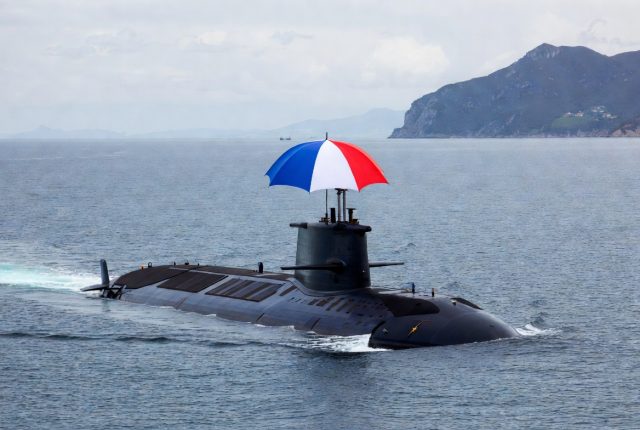
We have seen something both bold and profoundly unsettling in a French president taking the stage aboard a nuclear-armed submarine to declare that Europe must arm itself for a new era. That is precisely what Emmanuel Macron did on March 2, 2026, as he spoke from the Île Longue naval base near Brest ordering an expansion of France’s nuclear warhead stockpile and proposing a plan of what he calls “forward deterrence” for the continent.
It’s the biggest change in French nuclear policy in three decades and Macron has been promoting this idea since at least 2020, when NATO’s Secretary-General Jens Stoltenberg came out and flatly rejected it. In those days, nearly no one cared. Today, with Donald Trump once again in the White House and the promise of increased safety for the United States increasingly contingent, the mood changed drastically. Eight European countries, Germany, Poland, the Netherlands, Belgium, Greece, Sweden, Denmark, and the UK, have been said to be negotiating with France about what Macron refers to as an “advanced deterrence” programme, which could include French nuclear-capable aircraft being stationed on the continent. But there’s a catch baked right into that proposal: it is France’s unilateral decision-making power about when and if to use its weapons.
That is to say, some European countries may one day host French nuclear assets and join joint exercises, and contribute conventional forces to a shared deterrence framework, but the finger on the trigger lingers in Paris. This is not a European arsenal. It is a French one, extended conditionally to select neighbors. This is what critics have denounced itself, in precisely what it looks like, the slow streamlining of European defense under the French leadership, the covert federalization of defense in terms of European powers, with Paris as the unchallenged nuclear patron.
Russia’s Foreign Ministry did not spare a single word, accusing Macron of “nuclear blackmail.” Few places demonstrate precisely what the internal tension that has accompanied Macron’s offer looks like with more force than Poland. Prime Minister Donald Tusk, who leads the current centre-left government, swiftly confirmed that Warsaw was entering talks with Paris over joining the advanced deterrence programme. President Karol Nawrocki, a close ally of Donald Trump and ideologically opposed to Tusk, is said not to know about the talks with France before they became public. His International Policy Office cast significant doubt on France’s ability to supply a credible nuclear umbrella, stating unequivocally that only the United States has real deterrence capabilities.
Matteo Salvini, Italy’s Deputy Prime Minister, called Macron a “madman” and refused to entertain any thoughts that Europe could have an army at the command of the French. “We don’t support the idea of a European army under the command of a madman like Macron, who talks about nuclear war,” Salvini said in Milan. Prime Minister Giorgia Meloni, on the other hand, is more measured and has drawn closer to the proposition that European troops should not be sent into military conflict areas, and Italy has always made clear that the Non-Proliferation Treaty is the bedrock of international legal order in the global nuclear arena.
Romania’s context is uniquely complicated, and it is more than political. Romania signed the Nuclear Non-Proliferation Treaty (NPT) on July 1, 1968, and ratified it on January 30, 1970. Under the NPT (now comprising 191 state parties and extending indefinitely since 1995), Romania is explicitly barred from having, producing or hosting nuclear weapons on its own soil. This is also codified in Article 11 of Romania’s own Constitution: any international treaty that has been ratified by the Romanian Parliament becomes a national law. That implies neither the President, nor the Supreme Defence Council (CSAT), nor Parliament can legally authorize the installation of French nuclear warheads on Romanian soil without first denouncing the NPT, which goes against NATO itself reaffirming its non-proliferation commitments at the Warsaw Summit in 2016, and amending the Constitution. These are not bureaucratic red tape, they are legally binding barriers. And beyond the rule of law, a geopolitical backdrop is unmissable. Romania has a neighbor with a war already in progress. The immediate fact is, and beyond question, that any nuclear weapon deployed on Romanian territory, French or not, would be treated with the same urgency by Russia as a direct strategic threat, greatly increasing the state’s risk as a prospective first-strike target.
That risk is not theoretical. It is the sort of calculus that has been at the forefront of East European security thinking since 1991. France and Germany set up a senior command nuclear steering committee early in March 2026, signaling that this conversation is no longer hypothetical. France and the UK separately agreed in 2025 to coordinate their nuclear arsenals. The question of whether this becomes meaningful strategic autonomy or at the very least a highly bureaucratic exercise in French prestige is one that Europe’s smaller nations now face, frequently due to intense political pressure. Macron’s vision may be sincere. The threat environment is real. But a nuclear umbrella sewn together by French ambition, German anxiety and the reluctant assent of countries bound in their legal system by decades-old treaties is a fragile thing and the “price tag” for countries like Romania to claim it may far outweigh the safety it offers.