





 Subscribe


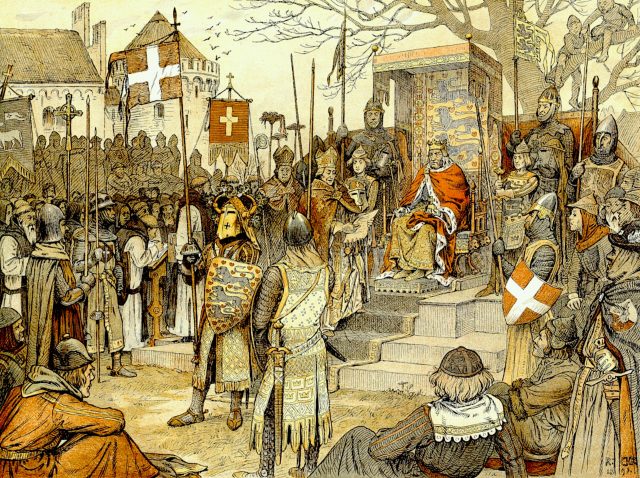
In a 1694 diatribe against the Danes, the English Whig Thomas Molesworth, who had briefly served as the British Ambassador to Denmark, nevertheless praised his former hosts on one count: their law was just, brief, and clear. Indeed, one factor behind the Nordic countries’ success is a strong legal tradition. In Denmark, it was articulated as early as 1241, when King Valdemar II (depicted above) proclaimed the Law of Jutland, whose preamble begins: ‘With law the land shall be built’. According to the preamble, the king gives the law, but only if the land accepts it; the law must be based on customs; and the king cannot change it without popular consent. These principles, which can be traced back to the self-government of the Germanic tribes, were reaffirmed in the first royal Nordic charter, issued in 1282 (67 years after the English Magna Carta). Even under absolutism in Denmark, from 1660 to 1848, the king was expected to stand above special interests, listen to his subjects, and resolve their conflicts as a judge, not as a general: this was to be an ‘opinion-guided monarchy’.
Lost Outside, Regained Inside
The Danish legal tradition somewhat restrained the kings, even as the state long engaged in both futile military adventures and counter-productive mercantilism. In the late eighteenth century, cautious reformers gained power. They were influenced by Adam Smith, whose Wealth of Nations appeared in Danish already in 1779–1780. Monopoly trade with Iceland and Northern Norway was abolished in 1787, and serfdom in 1788. Through extensive agricultural reforms, most Danish farmers became owners-occupiers. Paradoxically, what probably contributed most to Denmark’s transformation into today’s free and cohesive society was the loss of Norway in 1814 and of Schleswig in 1864. The Danes abandoned dreams of military conquests, taking the advice of the poet Hans Peter Holst instead: ‘What is lost outside, should be regained inside.’ Agriculture and industry prospered. The independent farmers cultivated their land and cooperated freely in farmers’ collectives. Denmark was one of the few European countries in the late nineteenth century to maintain free trade.
Grundtvig: Liberty and National Sovereignty
The most eloquent representative of Danish national renewal in the nineteenth century was the poet Nikolai F. S. Grundtvig. Inspired by what he saw as the heroic Nordic past and by contemporary English political practice, he was a committed supporter of private property, free trade, and national sovereignty. A delegate to the Danish Constituent Assembly in 1848–1849, he argued that the Danes should return to their ancient legal tradition, expressed in the preamble to the Law of Jutland, rather than import the ideas of French revolutionaries. The opinion-guided monarchy should be replaced by an opinion-guided democracy which required the freedom of expression, freedom for Loki as well as for Thor. (Loki was a heathen rogue god, whereas Thor was a heroic god.) Although Grundtvig was a nationalist, he rejected all attempts by one nation to subdue others. Therefore, he held that the Danes, in their disputes with the Germans over Schleswig, should claim only that part of it that wished to become part of Denmark. Although Grundtvig was one of the few Danes at the time to hold this view, it was put to a vote in a 1920 plebiscite, after which Schleswig was divided between Denmark and Germany in accordance with the population’s wishes.
Denmark and Estonia: An Illuminating Contrast
Denmark may be contrasted to Estonia. While their sizes (Denmark: 43,000 sq. km; Estonia: 45,000 sq. km), natural endowments (flat land suitable for both cereal production and livestock farming), and climates are similar, the six million Danes are much more prosperous than the 1.3 million Estonians. The reason is not that the Estonians are inferior. It is that for most of their history, they were oppressed by foreigners, such as the German Teutonic Order and the Russian Tsar. It was only in 1918 that they could form an independent state. The contrast between the two countries illustrates the importance of both national sovereignty and the tradition of liberty under the law, which the Danes have long enjoyed and which the Estonians are beginning to enjoy.