





 Subscribe


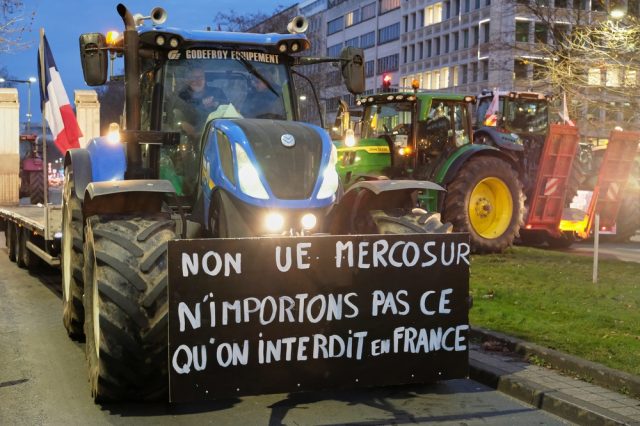
The desperate cries of European farmers, protesting what they consider to be one of the most unfair and dangerous trade agreements in history, continue to fall on deaf ears in Brussels.
The controversial agreement between the European Union and the Mercosur bloc (Argentina, Brazil, Paraguay, and Uruguay), which will cover a market of approximately 720 million consumers in Europe and South America, will be implemented—on a provisional basis—starting May 1.
This will happen despite the fact that in January, the European Parliament decided to refer the matter to the European Court of Justice so that the CJEU could rule on the legality and compliance of the Agreement with European treaties. Following this vote, the full entry into force of the Agreement’s provisions has been suspended for a period of time.
Neither the long-awaited opinion from the European Court of Justice nor the numerous protests by farmers across Europe that took place over several months prevented the European Commission from proceeding with its provisional application. This was made possible by a clause allowing the Trade Agreement to enter into force—albeit on a provisional basis—as soon as a single Mercosur country ratifies it. Meanwhile, all four countries in the South American bloc have ratified the long-negotiated Agreement, which its supporters view as driven solely by noble intentions, while its opponents believe it is meant to bring an apocalypse to European agriculture and food.
In the meantime, all signs indicate that, starting May 1, the rift between European agricultural producers and the globalist and bureaucratic elites will deepen.
While the European Commission praises the EU-Mercosur Agreement as a historic strategic deal that will boost the Union’s economy and competitiveness, create new markets for the automotive and chemical industries, protect farmers and food standards, and counterbalance China’s growing influence in Latin America, farmers in several European countries are drawing attention to the disastrous consequences it will have on agriculture and the food independence of member states.
Among the most serious criticisms raised by farmers is the fact that this will facilitate the flooding of European markets with cheaper products of questionable standards, which will not only endanger the health of European citizens but also drive entire businesses into bankruptcy. While European farmers are forced to comply with very strict regulations regarding energy and the so-called green transition and bear high production costs, for raw materials and food to be imported from Mercosur countries—from sugar and rice to soybeans and beef—health and environmental standards are significantly more relaxed, and overall production costs are far lower. Local products will no longer find buyers, because other imported products, at considerably cheaper prices, will flood the member states’ markets. This is therefore both a flagrant inequity and a fundamental issue of loss of food sovereignty.
Is the agreement with the Mercosur countries in the interest of local European producers and national agricultural sectors? Farmers are convinced that it is not. Not only is it unfair and not mutually beneficial, but it also risks having a destructive impact on a key sector.
Even though the European Parliament will only be able to vote on the Agreement after the European Court of Justice issues its ruling—which will not happen anytime soon—its provisional entry into force reignites one of the most fierce controversies of recent times.
Just a few days before the temporary application was due to take effect, Poland, through Deputy Prime Minister Wladyslaw Kosiniak-Kamysz—who is also the leader of a pro-farmer party in the governing coalition—announced that it would file its own appeal with the Court of Justice of the European Union, in a gesture with political and symbolic significance. According to the initiators of this new complaint to the CJEU, the local market will fully suffer the effects of the Agreement with the Mercosur states, which jeopardizes food security and the health of Polish consumers.
These two opposing views—those of the supporters and opponents of this agreement, which targets a massive market—seem utterly irreconcilable.