





 Subscribe


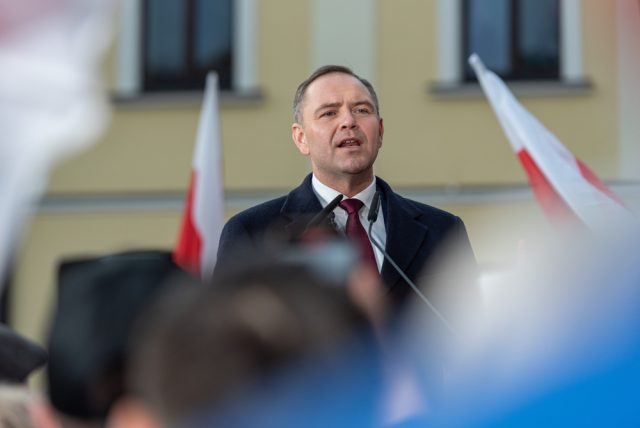
The seemingly endless conflict between Poland’s conservative president and the centrist-liberal prime minister has entered a new phase: the adoption of a new constitution by 2030. The current constitution no longer reflects the new challenges facing Polish society—and beyond—according to President Nawrocki.
The relentless rivalry between Karol Nawrocki and Donald Tusk has been a constant for the past nine months, dating back to the very first moments of the new head of state’s term. Given that the president initiated the move for a new constitution, his political opponent’s reaction was negative, which comes as no surprise. It’s yet another episode in a saga that doesn’t seem likely to end before the fall of 2027—when the parliamentary elections take place.
Karol Nawrocki hopes that his – first – term in office will be marked by the enactment of a new constitution. He stated this on the very day of his inauguration as President of the Republic of Poland, on August 6, 2025, when he spoke firmly in favor of amending the fundamental law, a necessity in the context of this increasingly complex battle for sovereignty.
A few days ago, Nawrocki raised this issue again, but in a much more concrete form, announcing the formal appointment of a council of experts to whom he has entrusted the task of drafting a new fundamental law, to be completed by 2030. The announcement of the establishment of this working committee on the future constitution was made, by no coincidence, on the 235th anniversary of one of the first constitutions of the modern era, the one adopted by Polish-Lithuanian Commonwealth on May 3, 1791. The Constitution of 1791 was a defining moment in history and should serve as a lesson also for today’s generation.
Next year, Poland will celebrate three decades since the adoption of its current constitution. Its fundamental law has been in force since October 1997, having been adopted during the first term of Aleksander Kwaśniewski, regarded as one of the great achievements of the third president of post-communist Poland. Forty-five years after the Soviet-style supreme law of the Polish People’s Republic, adopted in 1952, Poland finally had a new Constitution. Today, nearly three decades after Kwaśniewski’s constitution, Karol Nawrocki aims to bring the fundamental law in line with new realities that demand a fiercer fight to defend Poland’s sovereign national interests. A new era—a new Constitution.
The president’s arguments concern not only alignment with political and social transformations, but also clarifying the role of state institutions, which must be “enduring” and “strong,” since the current establishment is the source of chaos and increasing conflict within society.
For Poland’s conservative president, this situation cannot continue indefinitely, “with power in Poland split between two centers.” The current constitution, “a necessary compromise” in a transitional period is the source of a division that must be ended, for the good of society and the Polish people.
While for Nawrocki the adoption of a new Constitution is a quintessential project, for Donald Tusk this issue is nothing more than a political maneuver made by his rival, one that serves only to create even more confusion at a time when Polish society needs “stability.” More than that, Tusk was eager to point out that the president does not currently have the two-thirds majority required in the Sejm for this initiative to succeed. Even if the prime minister is right about the lack of the parliamentary majority, Nawrocki’s initiative is not a short-term one, and forming a new majority in the Sejm is by no means a fantasy, especially since new general elections will be held in a year and a half.
By setting 2030 as the target deadline for the new constitution to be adopted by referendum, the president has put forward a plan that could fulfill his mandate—and help him secure a second term.