





 Subscribe


For years, Europe discussed migration as if the only possible answer were redistribution: moving irregular migrants from one Member State to another, managing emergencies after they had already exploded, and asking border countries to absorb the pressure while the rest of the continent debated principles. On 17 June, in Strasbourg, that season suffered a decisive political defeat. The European Parliament approved the new EU Regulation on returns, a measure that marks one of the clearest shifts in European migration policy in recent years.
The vote in the chamber was politically significant: 418 votes in favour, 218 against and 30 abstentions. It was not a marginal adjustment, nor a technical file hidden in the machinery of Brussels. It was a vote that openly redefined the balance between the right to asylum, the duty to respect international law and the need to make expulsion orders actually enforceable. For the first time in a long while, Europe has admitted a simple fact: a migration system that cannot return those who have no right to stay is not a serious system.
The new Regulation aims to simplify and accelerate procedures for the return of third-country nationals staying irregularly in the European Union. Its most important provisions go in a clear direction. Those who receive a return decision will have to cooperate with national authorities and leave the territory of the Member State concerned, either immediately or within a fixed deadline. Detention will be possible, on the basis of an individual assessment, when there is a risk of absconding, lack of cooperation or a security threat. The maximum duration will be 24 months, with the possibility of an additional extension in specific circumstances.
The text also introduces a European return order, designed to facilitate cooperation between Member States and make national decisions more effective across the Schengen area. This is a crucial point. Until now, one of the structural weaknesses of EU migration policy has been fragmentation: a decision taken in one country could lose much of its practical force once the person concerned moved elsewhere. The new framework tries to close that gap by giving Member States stronger tools to recognise and act on return decisions.
But the most politically important element is the opening to return hubs in third countries. Under the Regulation, Member States will be able to conclude agreements with non-EU countries willing to host people subject to return decisions, with the exclusion of unaccompanied minors. These arrangements must respect human rights, international law and the principle of non-refoulement. Even so, the political message is unmistakable: Europe is no longer limiting itself to managing irregular migration inside its borders. It is beginning to build an external dimension of returns.
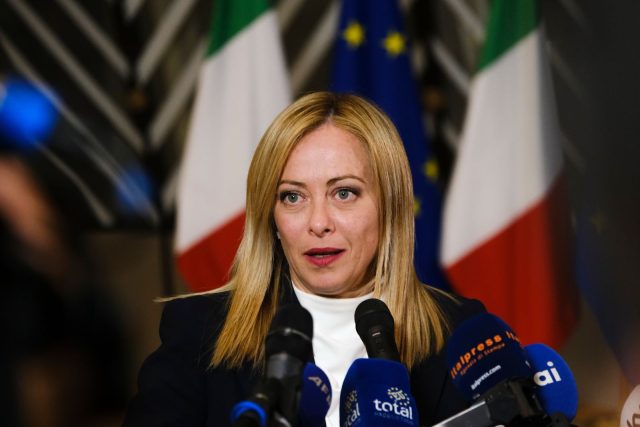
This is precisely the point on which the Italian government, led by Giorgia Meloni, has insisted since the beginning of the legislature. Rome has argued that migration can only be governed through three pillars: defence of external borders, cooperation with countries of origin and transit, and credible returns for those who have no legal title to remain. The agreement with Albania, fiercely attacked by the left in Italy and abroad, was part of this strategy. Yesterday’s vote in Strasbourg shows that what was dismissed as an Italian exception is now becoming a European instrument.
Giorgia Meloni immediately claimed the result as a political victory for Italy. The Prime Minister described the approval of the Regulation as a major success in Europe and underlined that the possibility of opening return centres in third countries follows the path opened by the Italian government with the Albania protocol. Her message was clear: Italy had promised to change Europe’s approach to migration, and now that change is visible in law.
Fratelli d’Italia framed the vote in the same way. Galeazzo Bignami, group leader of FdI in the Chamber of Deputies, argued that the European Union is finally moving toward the principles that the Italian government has put at the centre of the debate: stronger tools for returns, faster procedures, cooperation with third countries and action against abuses. Lucio Malan, president of the FdI senators, also described the outcome as confirmation that the path chosen by the Meloni government on returns is the right one.
In Strasbourg, Carlo Fidanza, head of the Fratelli d’Italia delegation in the European Parliament, gave the most explicitly political reading of the vote. He stressed that the result comes from the work of FdI in the European Parliament and from the action of the Italian government in the Council. According to Fidanza, Italy has shown that it can set the agenda in Europe. His phrase “the Meloni model can win in Europe” captures the broader significance of the vote: this is not only a legislative success, but a cultural and political shift.
Nicola Procaccini, co-chairman of the European Conservatives and Reformists group and MEP for Fratelli d’Italia, had already anticipated the meaning of the reform during the debate in Strasbourg. He described the Regulation on returns as one of the most important stages in the wider reform of Europe’s migration approach. For Procaccini, the change is striking: only a few years ago, it seemed almost impossible to move the EU away from an approach centred mainly on relocation and emergency management. Now, the Union is discussing stronger instruments, return hubs and practical enforcement.
The division in the European Parliament confirms the nature of the change. The Regulation was supported by the centre-right and right-wing groups, including the European People’s Party and the European Conservatives and Reformists. On the other side, much of the left opposed the measure, presenting it as a threat to rights and a step toward excessive externalisation. But this criticism misses the essential point. A rules-based migration policy cannot be reduced to the right to enter; it must also include the duty to leave when a legal claim has been rejected.
For too long, Europe has lived with a contradiction. It proclaimed that not everyone had the right to remain, but it lacked the will and instruments to enforce that principle. The result was predictable: low return rates, pressure on border countries, growth of illegal networks, loss of confidence among citizens and political space for radicalisation. A humanitarian system without enforcement becomes unsustainable. A legal system without consequences becomes symbolic. A border without control stops being a border.
The new Regulation does not solve every problem. Returns will still depend on cooperation with countries of origin and transit. Agreements with third countries will have to be negotiated, monitored and implemented. National administrations will have to use the tools effectively. Courts will continue to play their role, and fundamental rights will remain a binding framework. But the political direction has changed. The European Union is finally acknowledging that legality must be restored not only at the moment of entry, but also at the moment of removal.
This is why the vote matters beyond the technicalities. It shows that the centre of gravity in Europe has shifted. The language of control, responsibility and realism is no longer confined to national capitals accused of being too strict. It is entering the European legislative framework. What the Italian left and much of the European progressive establishment once denounced as impossible, inhumane or un-European is now being adopted by the Union itself.
For Italy, this is also a matter of national credibility. The Meloni government has turned migration from a domestic emergency into a European political question. It has insisted that the Mediterranean cannot be left alone, that the business model of traffickers must be broken and that those who do not qualify for protection cannot simply disappear into the shadows of the continent. Yesterday’s vote does not merely vindicate an Italian position; it strengthens it.
The real test will come with implementation. The Council must formally adopt the text, and the Regulation will then be published in the Official Journal. Some provisions, including those concerning return hubs and the external dimension of returns, are expected to apply immediately, while others will require a transitional period. But the legislative direction is now set.
Europe has spent years trying to square the circle: open rhetoric, weak controls, uneven solidarity and limited returns. The result was dissatisfaction on all sides. The new Regulation is an attempt to restore order, credibility and deterrence. It says that asylum must be protected, but abuse must not be rewarded. It says that borders must be managed, not merely described. Above all, it says that European law must be enforceable.
In Strasbourg, the Meloni line did not simply win an argument. It entered the architecture of European migration policy. For a continent that has too often confused compassion with powerlessness, that is a turning point.