





 Subscribe


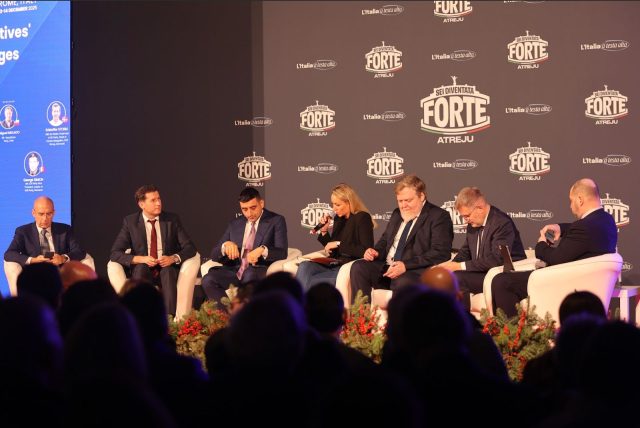
Rome, 12 December 2025. On Friday evening at Atreju, the panel “Conservative’s challenges” took place—an international conversation that, without equivocation, laid out the major fault lines running through Europe today: sovereignty versus standardisation, roots versus amnesia, popular democracy versus technocracy, geopolitical realism versus ideological utopia. Steering the discussion as moderator was Antonio Giordano, Secretary General of the ECR Party and a Member of Parliament for Fratelli d’Italia, who noted that this year Atreju is hosting 20 delegations from around the world.
The opening remarks were delivered by Elisabetta Gardini (FdI), President of the Italian delegation to the Parliamentary Assembly of the Council of Europe, who highlighted the political and cultural work orbiting the conservative family, mentioning—among the highlights of this edition—the study days and the presentation of the prize dedicated to Margaret Thatcher.
Nicola Procaccini (FdI/ECR) also offered greetings, in a synthesis that sounded like the ideal overture to the entire panel: conservatives, he stressed, feel “more than anyone else” the importance of national identity; and they stand apart from those in Brussels who cultivate the illusion that everything can be “reset” and that the answer lies in a vast super‑state.
Who was at the table: an ECR looking beyond borders
The make‑up of the panel provided a clear snapshot of the trajectory Europe’s conservatives are pursuing: consolidating their presence in institutions and, at the same time, building an international political field capable of speaking the language of sovereignty and responsibility.
Among the main speakers were: Adam Bielan, International Secretary of PiS (Poland) and head of the Polish delegation within the ECR Group; Sigmundur Gunnlaugsson, leader of Iceland’s Centre Party; Marion Maréchal, Vice President of the ECR Party, leader of IDL and head of the French delegation in the ECR Group; George Simion, ECR Vice President and leader of AUR (Romania); Kristoffer Storm, EU affairs officer for the Danish party (DD) and head of the Danish delegation in ECR; and Miguel Mellado, a member of the Chilean Republican Party, connected via a video greeting ahead of the upcoming electoral milestones in his country.
Carlo Fidanza (FdI/ECR), Member of the European Parliament and head of Fratelli d’Italia’s delegation in the European Parliament, also took part in the discussion, linking the Italian experience to the broader design of a European right that refuses to be subordinate.
Giordano’s questions: “What would Europe be without conservatives?”
Giordano set the panel with a series of key questions—almost a challenge thrown to the audience and, indirectly, to the continental mainstream: “What would the world be without conservatives? What would Europe be without conservatives? What would your country be without conservatives?”
The political meaning of those questions is clear: conservatives do not see themselves as a “testimonial” currently, nor as a marginal “correction” of the system. They claim, rather, a constituent role: without conservatism—in their reading—there is no order, no continuity, no concrete freedom, because the cultural and institutional ground on which freedoms can stand is missing.
Maréchal: against cultural and economic “colonisation”
The toughest line against the current EU set‑up came from Marion Maréchal, with a frontal attack on the “Europe built by the Left”, described as a project that has renounced its historical roots and turned into a “cultural and economic colony”.
The point, however, was not merely polemical: Maréchal placed the conservative battle squarely within the institutional arena, claiming that for the first time in the European Parliament a “Giorgia majority” would have taken shape as an alternative to the “Ursula majority”. On that contrast she built her central message: change course, and challenge a vision of Europe that—she argued—tends to reshape anthropology, law and the market in the name of an unbounded progressivism.
Her closing line, with a reference to Camus and the task of preventing the world from “falling apart”, became the emblem of a posture Atreju has staged repeatedly: not to destroy Europe, but to save it from being hollowed out.
Simion: “The future belongs to patriots”
George Simion struck a more mobilising tone: “The future belongs to us, the future belongs to patriots.” He tied the European trajectory to the Romanian diaspora in Italy, evoking a song learned precisely from young Romanians living in our country: “Tomorrow belongs to us.” In his remarks, Fratelli d’Italia was held up as an “authentic political model”: a reference that, beyond courtesy, signals a dynamic now firmly established in Europe’s conservative field. Meloni’s Italy is perceived—by more than one delegation—as a laboratory of an identity‑driven yet institutional government, capable of combining political firmness with practical management.
Fidanza: Europe and the European Union are not the same thing
Carlo Fidanza’s intervention focused on a distinction destined to remain at the centre of the conservative argument: “When we talk about Europe, we are not talking about the European Union.” For Fidanza the difference is “substantial”: Europe is history and civilisation; the EU is a political structure that requires “a deep and radical change”.
Here the overall vision emerging from the panel takes shape. The critique is not aimed at the very idea of cooperation among European states, but at an architecture that tends to replace peoples and nations with a centralised governance often unable to account democratically for its choices. Fidanza put it plainly: the mission of conservatives is not to “uniform” peoples; there is no single model “from Iceland to Sicily”. The task is the opposite: to value identities, territorial specificities and the “pride of peoples”, defending differences from flattening and global homogenisation.
In this framework comes his thrust at Italian politics over recent years: Fidanza argued that Atreju has confirmed the role of conservatism in a country that has been governed “for three years”, presenting Italian stability as the result of giving the word back to the people after a season of “technocrats” without a popular mandate.
Bielan: faith, family, sovereignty, courage
From the Polish side, Adam Bielan insisted on the value‑based dimension: “A Europe without conservatives would be a Europe without values,” and therefore—he argued—unable to defend the family. In his framework, the core values of the conservative West can be summed up in four words: faith, family, sovereignty, courage. And the Italy‑Poland axis is offered as proof that conservatives do not represent “the past”, but “the foundation for the future”. This is a significant passage because it points to an attempt to rebuild a shared lexicon across different political cultures: Mediterranean and Central‑Eastern, Catholic and Protestant, EU and non‑EU. The goal is to hold identity and modernity together, without handing innovation over exclusively to the progressive narrative.
Gunnlaugsson: roots as a prerequisite for progress
The Icelander Sigmundur Gunnlaugsson developed a complementary argument: without conservatives there would be no “civilisation”, and without conservatives there would not even be “progress”. A deliberately counter‑intuitive thesis compared with the common cliché that associates conservatism with immobility. Here conservatism is defined as the condition for sustainable change: building a “new world”, yes—but different from the current one because more solid—and to do so, “keeping one’s roots” becomes fundamental.
Storm: a right that no longer accepts labels
The Dane Kristoffer Storm instead raised the issue of political legitimacy: “They must stop calling us far‑right; we are the right, and we are European conservatives.” His remarks introduced an element that has become crucial in recent months: the relationship with the EPP and with conservatives “in the centre”, who are urged to recognise that cooperation with the conservative area is not a taboo, but a necessity to prevent ideological drift and decision‑making paralysis.
Mellado and the bridge to Latin America
Miguel Mellado’s video greeting from Chile served a strategic purpose: to remind everyone that the conservative challenge is not only European, and that the political horizon is now global. The reference to Chile’s upcoming elections added an important detail: the internationalisation of conservatism is not a permanent conference, but a network seeking to influence electoral appointments and governing cycles.
What idea of Europe emerges from the panel
Taken together, the interventions deliver a coherent—and politically ambitious—picture of what conservatives mean by Europe.
Europe as civilisation, not bureaucracy.
The Fidanza distinction “Europe/European Union” is the pivot: Europe is a historical and cultural heritage; the EU is a political construction that can be improved and, in many respects, must be reformed radically.
National sovereignty as a democratic keystone.
Procaccini and Fidanza converge: national identity is not nostalgia—it is the level at which the people can truly exercise sovereignty and hold decision‑makers to account. The super‑state, by contrast, tends to dilute responsibility and representation.
Non‑negotiable values and a critique of anthropological progressivism.
Maréchal and Bielan, in different registers, insist on one point: Europe cannot survive if it severs the link with its roots and turns everything—even anthropological fundamentals—into material available for ideological social engineering.
A governing right, not a polemical enclosure.
Simion points to FdI as a model; Fidanza claims stability and international centrality; Storm calls for an end to labels. It is the same trajectory: the normalisation of conservatism as a force of government, not an exception.
Building alternative majorities in Europe.
The idea of a “Giorgia majority” opposed to an “Ursula majority” signals the final objective: shifting the balance in the European Parliament, shaping dossiers, and changing the Union’s political direction from within.
Atreju as a political platform
In short, the panel “Conservative’s challenges” served to turn an identity theme into a project. Not nostalgia for closed borders, but a call for Europe to return to being a continent of free nations, able to cooperate without erasing themselves; a Europe that defends its civilisation without shame; a Europe that takes on the challenge of the future without handing it over to a progressive monoculture.
If Atreju, as often happens, is also a laboratory for languages and alliances, the impression is that the conservative constellation is attempting a further leap: from protesting against Brussels’ “autopilot” to building an alternative course. With a precise idea: there can be no strong Europe if, to become “one”, it must first forget who it is.