





 Subscribe


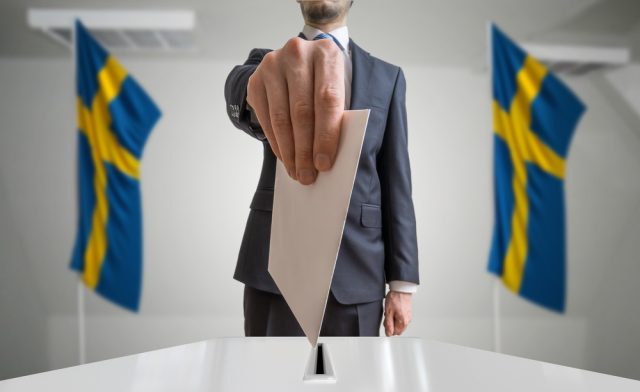
I have written regularly about the Swedish political situation regarding the centre-right government’s current polling, its future prospects, and what has been done so far to correct the many wrongs done by previous governments in Stockholm. This has always been done from the purview of there being two blocks in Swedish politics; the left-wing “red-greens” and the centre-right “bourgeois” parties supported by the nationalist Sweden Democrats (in the arrangement known as the Tidö agreement).
The certainty of the orientation towards two more or less cohesive blocks of politics is standard in most democratic political systems, but there exists exceptions. In France, politics is seemingly divided between three blocks, even if the liberal “centre” under president Emmanuel Macron is surely nearing its end of the line soon.
Recently, there have been indications that the more or less dual nature of Swedish politics may not be a given anymore. The cracks are visible on both aisles, though it is very clear on the left that there is little to no common baseline with which to challenge the ruling ‘Tidö parties’. This is not entirely new as far as Swedish parties are concerned, but it could amount to a significant break with more or less half a century of unwritten rules in party politics.
Two-block politics might be an exception
The idea of there being three party blocks goes far back in Swedish parliamentary history, and it took a long time for a cohesive centre-right block to actually form. During much of the 20th century, the ‘bourgeois’ parties were individually dwarfed by the Social Democrats, who engaged in what one might call a strategy of divide and conquer. The main allies of the Social Democrats were at this time the agrarian Centre Party, who very much constituted a well-defined third pillar in Swedish politics that was neither socialistically inclined, nor urban middle and upper class. It took until the 1970s for the Centre Party to definitely “switch sides”, and ally with the right-wing parties of the time to depose the Social Democrats from power for the first time in over 40 years in 1976.
With the entry of the Sweden Democrats into the riksdag in 2010, the tripartite parliament was again revived, at least until the Moderates, the Christian Democrats and the Liberals pragmatically decided to gradually abolish the cordon sanitaire against the party between 2019 and 2022. By the 2022 election, the alternatives in Swedish politics were clearer than they had been for 16 years.
But a mere four years later, it is not at all obvious that the new two-block landscape will survive the next election. But what may set this fracture diagnosis apart from similar breakdowns in other European countries, is that the nationalist party, the Sweden Democrats, do not figure in the foreground.
The crisis of the Liberals
The Sweden Democrats are admittedly key to understanding the failing vitality of the Tidö government. The conflict that may evaporate the right’s hold of government is between the Sweden Democrats and the Liberals – or more specifically, certain parts of the Liberals.
The Liberals, once the leading ‘bourgeois’ party in Sweden but since the 1970s eclipsed by the Moderates, has been in a permanent state of crisis since the mid-2010s, recently hovering not even in proximity to the parliamentary threshold in the polls, but far, far below it – at 1,4 percent of the vote share in a poll published in the last week of January. This is a party suffering a massive membership and competence haemorrhage due to the increasingly likely risk that they are going to be voted out in September. The downward spiral was evident already in 2022, when the party only barely managed to cling onto the four percent of the voters they needed to retain their seats.
It was arguably only by accident that the Liberals even agreed to the terms of the Tidö agreement with the Sweden Democrats, the Moderates and the Christian Democrats. The newly acceded leader at the time, Johan Pehrson, utilised his grace period to push through something that turned out to be viciously unpopular among many of his fellow party members and voters. Unsurprisingly, Pehrson was replaced in 2025, after failing to show any polling or popularity recovery since the election. Under the new leader Simona Mohamsson, the Liberals have however, counter to what its few sympathisers had hoped for, only accelerated the downward spiral.
But what is the source of the voter flight from the Liberals? Is it that they are collaborating with the Sweden Democrats, a party that represents nearly everything the Liberals are in opposition to, such as Euroscepticism, sovereignty, family values, and nationalism? Or is it that they have counter-signalled the Sweden Democrats too much, and are throwing a wrench into the future of the Tidö government by refusing the Sweden Democrats cabinet positions?
A party that has had a low-key internal civil war for the past 30 years understandably has vastly differing views on why exactly they are bleeding voters. It usually comes down to the relationship to the Sweden Democrats, but other issues are also raised, such as confusing messaging, lack of self-confidence, and organisational problems.
The band-aid solution to the Sweden Democrat issue was applied at a party conference at the end of last year. The Liberals’ official position is that the Tidö alliance must continue under the current arrangement – namely, that the Sweden Democrats are supplying support and confidence, but that they must not be allowed into government. This compromise, fundamentally fairly reasonable at the face of it, is not to the liking of the Liberals’ more left-leaning factions. Factions that are based out of the well-performing party districts in Stockholm and Uppsala, that likely feel that they have the upper hand against their mother organisation.
The eternal bickering inside the Liberals is likely to destroy the government’s chances of re-election. Yet, this conflict is minimal compared to what is playing out on the left side of politics.
The impossible red-green government
The red-green parties, the Social Democrats, the Left Party, the Green Party, and (as circumstances would have it) the Centre Party, are in the most notoriously unsustainable position against each other, which makes the Tidö parties’ quibble look enviable.
The left-wing planets are all circling around the Social Democratic sun, but are deeply distrustful between one another. In recent weeks, the launch of campaigning has also seen these small parties, ranging in size from four to eight percent in the polls, proposing bolder and bolder ultimatums in order to raise the stakes. Even with eight months left until the election, the hypothetical red-green shadow government has yet to even leave the runway.
The Centre Party rules out supporting a government that includes the Left Party, the Green Party rules out supporting a government that contributes to expanding nuclear power, and all three of the minor parties are in favour of opening Sweden’s borders to asylum seekers, while the Social Democrats are investing all of their political credibility in following the Tidö parties suite in having a strict immigration policy.
The socialist and historically communist Left Party’s demands to be a part of a future Social Democratic-led government have been public for a long time. Traditionally derided as a “doormat” to social democracy, the Left Party has under its leader Nooshi Dadgostar attempted to assert itself, and demonstrated its boldness when it started a vote of no confidence against the Social Democratic government in 2021, when then-Prime Minister leader Stefan Löfven agreed to deregulate rents after negotiations with the Centre Party. As a result of this defeat, which saw the resignation of Löfven as party leader, the succeeding Social Democratic leader Magdalena Andersson has been cautious to openly comment on the Left’s cabinet demands in order to minimise the conflict.
As can be implied from the 2021 affair, the conflict between the economically liberal and ‘entrepreneurial’ Centre Party and the deep-red Left Party runs along traditional lines; taxation, the private sector contra the public sector, centralisation, NATO and the European Union. Nationalists who are worried that the Centre and the Left, both radical in their own distinct ways, would set aside the conflicts of the Cold War and unite in the name of increasing immigration to Sweden are relieved, but this Gordian Knot is a major headache for the Social Democrats.
For the Green Party, the reversal of the previously uncontroversial anti-nuclear streak across the political spectrum in Sweden is a major concern. The Social Democrats have implicitly agreed to build new reactors and not close existing reactors, not wanting to trail too far after the Tidö parties’ popular energy policies. The Green Party is the only party to have explicitly ruled out cross-block conversations about how to secure Sweden’s future energy supply – not only including “renewable” energy. Can the Social Democrats maintain credibility on topics like energy and the economy if they say a definite no to nuclear power? Will they resist approaches from the bourgeois parties to expand nuclear power in Sweden, in order to satiate the anti-nuclear extremists in the Green Party? It appears unlikely.
Finally, how will the Social Democrats be tough on crime and immigration if they depend on the support of leftist idealists who believe that borders and cell doors should be open? The pitfalls that a red-green government could fall into makes the entire operation highly unrealistic. There are indications that the Social Democrats have also realised this.
The birth of a new centre?
To return to the topic introduced at the start about the construction of a new political centre in Sweden, the situations described above show that there may be voter demand as well as political demand for a centre block of politics that frees itself from ‘extremities’, and focuses on compromise and common understanding in the middle.
The Social Democrats have recently made occasional appeals to the bourgeois parties to do away with the “two-party system” and “polarisation”, evidently to introduce a third alternative. The Christian Democrats have at times strayed from the Tidö ‘script’ and criticised their co-ruling party the Moderates, as well as the Sweden Democrats, for their uncompromising positions when it comes to nuclear.
The gradual shift in mainstream politics from unsustainably progressive views on migration and crime to a significantly more punitive and conservative order has also lessened the gap between the Social Democrats and the bourgeois parties in these important issues. Secretly, many in the Moderates and the Christian Democrats may also see their collaboration with the nationalist Sweden Democrats as a moral failing. In the Liberals, views like this are already very outspoken.
If one does not want to draw conclusions from all these clues that have been dropped, perhaps an overview of the de facto state of Swedish politics is enough to foresee the rise of a new centrism; there are two political blocks, neither of which have any conceivable way of forming a government.
Conservatives should be prepared to hold on tight, because 2026 might bear a lot of surprises.