





 Subscribe


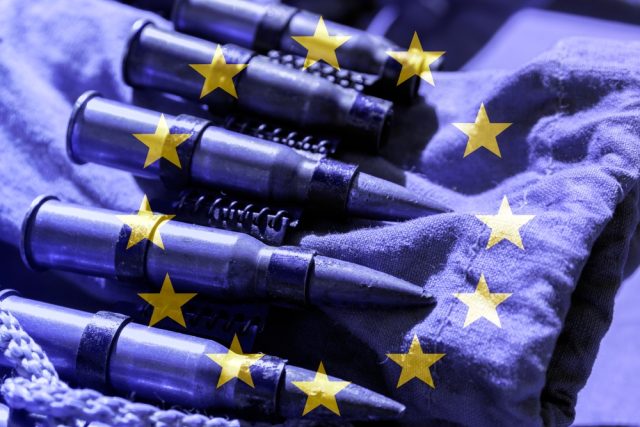
American weapons today, cooperation among European nations tomorrow, and manufacturing in Ukraine as well: the continent’s security will be built on the ability to act, not on slogans about self-sufficiency.
“Developing our own capabilities takes time. Right now, we do not have time.” The words spoken by the Luftwaffe chief, Lieutenant General Holger Neumann, in an interview published by POLITICO on 13 July, capture the strategic dilemma facing Europe as a whole. The continent must rebuild a broader, more innovative and more resilient defence-industrial base. Yet it must also close, now, the operational gaps accumulated over decades in which security was treated as something that came virtually free of charge.
Neumann’s warning is not an admission of surrender in the face of American technological superiority. On the contrary, it is a call for seriousness. Deterrence is not measured in communiqués, but in available systems, stockpiles, trained crews, maintenance and the ability to replace losses. A platform promised for 2035 will not intercept a missile in 2027. An ambitious industrial programme cannot replace a proven weapon when the need is immediate.
Military Time and Industrial Time
In 2022, Germany approved the purchase of 35 American F-35A aircraft for approximately €8.3 billion. The jets are intended to replace the Tornado fleet, including in the role assigned to Berlin under NATO’s nuclear-sharing arrangements. It is an instructive case: buying an American platform does not necessarily reflect a desire to abandon European industry. It can instead reflect the need for a capability that already exists and is interoperable with allied forces.
The point is not to choose, once and for all, between “American” and “European”. The point is to distinguish urgency from long-term strategy. In the immediate future, European states must be able to buy what works and what can be delivered within a timeframe compatible with the threat. At the same time, they must invest in their own research, production, skills and supply chains. Confusing these two horizons means turning strategic autonomy into a form of voluntary disarmament.
The European Union has created the SAFE instrument, making up to €150 billion in loans available to support investment and joint procurement. Its rules are intended to strengthen Europe’s industrial base and provide, as a general rule, that the cost of components originating outside the EU, the European Economic Area and Ukraine must not exceed 35 per cent of the estimated component cost of the final product.
This is an understandable policy: without orders and aggregated demand, European industry cannot expand production. Yet a percentage of European content is not, by itself, a military capability. Brussels can finance and incentivise; it cannot, by decree, shorten the development time of a fighter aircraft, an interceptor or a cruise missile.
Europe Is Bigger Than the European Union
The new Anglo-German programme for deep-strike weapons shows what the most effective method could look like. Launched under the Trinity House Agreement signed by London and Berlin in 2024, the project envisages a capability with a range of more than 2,000 kilometres.
In March 2026, the British government described it as a future family of stealth cruise missiles and hypersonic weapons, initially ground-launched but with possible air and maritime applications, expected to enter service in the 2030s. The cooperation has also been declared open to other partners.
The Telegraph framed the initiative as a rupture of the Franco-German axis and a blow to the French arms industry. It is an effective journalistic frame, but official documents point to a more complex reality. The rise of cooperation between London and Berlin does not necessarily mean that Paris is being excluded. Rather, it suggests that European defence is becoming more polycentric and more flexible in its geometry.
In July 2026, twelve allies — including the United Kingdom, Germany and France — announced their intention to invest a combined $50.66 billion in deep precision-strike capabilities over ten years. London also maintains the Stratus programme with France and Italy. Europe is therefore not witnessing the simple replacement of one axis with another, but the emergence of a network of overlapping partnerships, built around capabilities that are genuinely available.
The political lesson is important. The security of Europe does not coincide with the institutional borders of the European Union. The United Kingdom may be outside the EU, but it remains a nuclear-armed NATO power and one of the continent’s leading military and industrial actors. Excluding it from any serious concept of European defence would amount to strategic self-harm.
Nor is there a need for a single “European champion” imposed from above, or for a federal army built before a common political will and a credible chain of command exist. What is needed are coalitions among nations able to define shared requirements, finance programmes, allocate industrial work and take responsibility for results.
Anglo-German cooperation does not contradict Europe. It reminds us that the real Europe is a community of states, not a bureaucratic synonym for the European Union.
From Assistance to Production
The third element of the new architecture is Ukraine. The Wall Street Journal reported on 21 July that a Ukrainian company will begin licensed production of the BAE Systems-designed L119 light howitzer, starting with a test model.
This does not mean that Kyiv is already ready to produce highly complex systems such as Patriot interceptors. It does mean, however, that the relationship between Ukraine and Western industry is beginning to change: from the simple transfer of weapons to the construction of local manufacturing capacity.
The shift is already visible in parallel programmes. On 15 July, BAE Systems and the British government announced the delivery of the first elements of an order for 150 artillery barrels in 105mm and 155mm calibres, forged in the United Kingdom and intended for finishing and integration in Ukraine. The first four forgings were sent as development items so that Ukrainian partners could validate their industrial processes.
A few days earlier, a joint French-Ukrainian declaration had formalised French authorisation for the licensed production in Ukraine of AASM munitions and SCALP missiles. France and Italy have also authorised licensed production of Aster 30 interceptors, with the stated aim of beginning it as soon as possible. The picture is therefore more advanced than the still uncertain prospect of an American licence to produce Patriot interceptors.
None of this justifies triumphalism. Building a howitzer is very different from producing a high-technology interceptor. The Wall Street Journal noted the obstacles encountered by previous Western efforts: plant security, insufficient investment and orders, protection of intellectual property, difficulty obtaining materials and machinery, and vulnerability to Russian attacks.
Genuine industrialisation requires multi-year contracts, predictable funding, physical protection, technical training and a credible division of risk.
And yet the direction is right. Ukraine possesses something that much of Western Europe lacks: an extremely rapid cycle between operational experience, technical adaptation and feedback from the battlefield. It has developed recognised expertise in drones and electronic warfare, and has acquired direct knowledge of high-intensity combat.
Integrating Ukraine into the Euro-Atlantic industrial base would not be an act of charity. It would be an investment in collective security.
Sovereignty Does Not Mean Autarky
A multi-layered strategy emerges from these three cases. At the first level, Europeans must buy from the United States and other allies the capabilities that cannot wait. At the second, they must develop their own systems through practical intergovernmental cooperation, open to countries that possess technology, capital and political will. At the third, they must integrate Ukraine as a manufacturing, experimental and industrial hub for the future security of the continent.
This approach is more realistic than either autarky or permanent dependence. Buying American today must not become an excuse for indefinitely postponing the reconstruction of Europe’s defence industry. Yet “buy European” cannot become a dogma that forces armed forces to wait for systems that are not yet available.
Sovereignty does not mean manufacturing every screw within one’s own borders. It means being able to choose, maintain, replenish and deploy the capabilities required without being paralysed by a single supplier or by a single external political decision.
It is also a vision consistent with the conservative principle of a Europe of independent nations, cooperating for mutual benefit while preserving their identity, democratic legitimacy and responsibility. NATO must remain the strategic and operational framework. The European Union can mobilise capital, facilitate joint procurement and support research. States must define the threat, make the decisions and answer to their citizens. Industry, finally, must turn budget allocations into real capabilities.
The real mistake would be to continue discussing “strategic autonomy” as though it were a country-of-origin label. Europe will be autonomous not when it has stopped buying American weapons, but when it is no longer compelled to do so for lack of alternatives.
It will be stronger when London, Berlin, Paris, Rome, Warsaw and the other allies can build together without waiting for a single institutional template; and when Kyiv is not merely the place where Western weapons are used, but also one of the places where they are designed, produced and improved.
American weapons can fill today’s gap. Coalitions among European nations can build tomorrow’s capabilities. Ukrainian industry can give the continent depth, experience and speed.
This is not a surrender of European sovereignty. It is the only concrete way to begin exercising it.