





 Subscribe


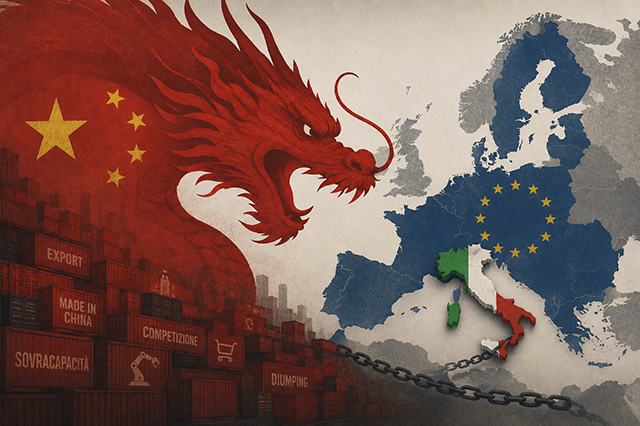
Rome joins France, Spain, the Netherlands and Lithuania in calling for stronger protections against unfair competition, positioning Italy as one of the leading voices in Europe’s industrial revival debate
The European Union is entering a new phase in its economic relationship with China, and Italy is emerging as one of the key advocates for a more assertive European industrial strategy. Alongside France, Spain, Lithuania and the Netherlands, the Italian government has formally called on Brussels to strengthen the instruments used to protect the EU’s single market from unfair competition, economic coercion and aggressive trade practices.
The initiative reflects a broader shift taking place across Europe. For years, many EU member states approached trade with China cautiously, seeking to balance economic cooperation with growing concerns over industrial dependency. Today, however, rising trade deficits, factory closures and fears of deindustrialization are pushing several European capitals toward a tougher and more strategic approach.
According to the seven-page proposal circulated in Brussels, some of the EU’s major trading partners are increasingly abandoning the principles of multilateral trade by introducing new barriers or creating structural industrial overcapacity. The document highlights how European industry lost roughly one million jobs between 2019 and 2025, a trend that has deeply alarmed policymakers.
Italy’s role in this debate is particularly significant. As Europe’s second-largest manufacturing power after Germany, the country has a direct interest in protecting strategic industrial sectors ranging from automotive components and machinery to steel, chemicals and advanced manufacturing. Rome has long defended the importance of maintaining a strong industrial base, arguing that Europe cannot afford to become excessively dependent on external production chains, especially in strategically sensitive sectors.
The Italian government’s support for stronger EU trade defences also reflects growing concerns about the impact of low-cost Chinese exports on European producers. Chinese industrial overcapacity — especially in sectors such as electric vehicles, solar panels, batteries and steel — has generated intense pressure on European companies already struggling with high energy prices and stricter environmental regulations.
The five countries are therefore asking the European Commission to reinforce its ability to investigate unfair trade practices more rapidly and effectively. One proposal involves expanding the staff dedicated to monitoring cases of protectionism and market distortions. Another would allow the EU to launch more sector-specific investigations during industrial crises.
The document also advocates wider use of safeguard measures alongside traditional anti-dumping tariffs. These safeguards could be applied temporarily but for extended periods, giving European industries more time to adapt and compete fairly.
For Italy, this approach is not merely defensive protectionism. Rather, supporters argue that it is an attempt to restore fair competition within a global trading system that has become increasingly unbalanced. Italian officials and industrial groups maintain that European companies are often required to comply with stricter labour, environmental and regulatory standards while competing against imports produced under very different conditions.
One of the most technical yet important aspects of the proposal concerns rules designed to prevent companies from circumventing EU tariffs. According to the document, some third countries are using increasingly sophisticated methods to avoid European duties by slightly modifying assembly processes or rerouting components through third-party markets.
To counter this, the five countries propose raising the threshold for local value-added requirements from 25% to 40% and lowering the acceptable proportion of components originating from targeted countries from 60% to 50%. These adjustments may appear highly technical, but they could significantly strengthen the EU’s ability to prevent tariff evasion.
Italy’s support for these measures demonstrates a growing belief in Rome that Europe must combine openness with strategic realism. The current government has repeatedly emphasized the importance of economic sovereignty, particularly after recent geopolitical crises exposed vulnerabilities in global supply chains.
The initiative is also politically important because it includes the Netherlands, traditionally one of Europe’s most liberal and free-trade-oriented economies. Dutch participation signals that concerns about unfair competition and industrial decline are no longer limited to southern European countries or France’s historically interventionist model.
Attention is now turning toward Germany, whose economy maintains extensive ties with China and has often adopted a more cautious approach toward trade tensions with Beijing. Berlin’s reaction could prove decisive in determining whether the EU ultimately embraces a more robust industrial defence strategy.
Meanwhile, the economic data reinforces the urgency of the debate. The EU’s trade deficit in goods with China reached nearly €360 billion in 2025, marking another annual increase. In volume terms, the imbalance rose dramatically from 44.8 million tons in 2024 to 58.1 million tons in 2025, underlining the scale of Europe’s growing dependence on Chinese imports.
For Italy, the challenge is therefore not only economic but strategic. Protecting European industry is increasingly viewed as essential for safeguarding jobs, innovation and technological independence. Rome’s decision to stand at the forefront of this debate suggests that Italy intends to play a central role in shaping a more resilient and competitive European economic model in the years ahead. 2015-2025, il deficit commerciale della Ue nei confronti della Cina è aumentato di oltre cinque volte (5,2 volte) in volume, mentre è più che raddoppiato in valore (2,4 volte).
Alessandro Fiorentino