





 Subscribe


“Polish independence has no price.” – Jarosław Kaczyński
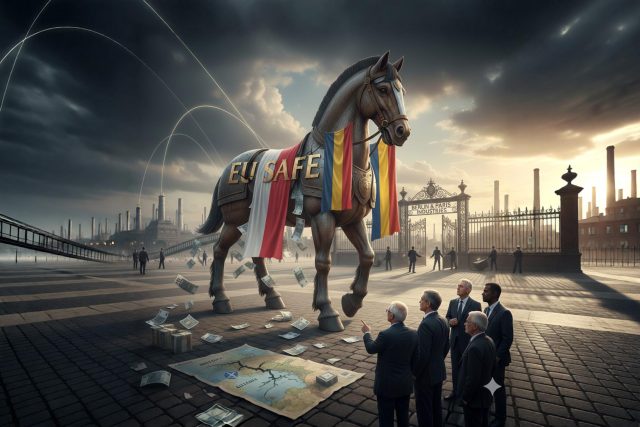
He’s not talking about tanks or borders. He’s talking about the EU’s new SAFE program. €150 billion in low-interest loans meant to supercharge defense spending across the bloc. For PiS, this isn’t just money. It’s a Trojan horse.
On paper, SAFE looks like a no-brainer. Launched in 2025 as part of the EU’s bigger “Readiness 2030” push, it offers member states long-term loans, up to 45 years to repay, with a decade of grace and interest rates around 3%, to buy weapons, build factories, and strengthen borders. Poland grabbed the biggest slice: €43.7 billion for 139 projects. Romania came second with €16.68 billion. Other eastern flank countries like Lithuania, Latvia, and Estonia scooped up billions too. The pitch? Get cheap cash now to protect yourselves later. But PiS isn’t buying the sales talk. Kaczyński and his allies voted against the enabling law in parliament. They’re urging President Karol Nawrocki to veto it.
Their complaints boil down to four big worries: political strings, who actually gets the cash, crushing future debt, and drifting away from America. And when you dig into the details, especially for weaker economies like Romania’s, the picture gets messy fast.
Start with the strings. SAFE money isn’t free-flowing. It comes with “conditionality”. Meaning that Brussels can pause or cut payments if a country slips on rule-of-law benchmarks. PiS remembers all too well how EU funds were frozen during their time in power over judicial reforms. “This is blackmail dressed up as solidarity,” Kaczyński argues. Even if the current government swears the safeguards are ironclad, opponents see a future lever that any Brussels bureaucrat could pull.
Then there’s the “Buy European” rule. To qualify, at least 65% of a weapon system’s components must come from the EU, EEA, or Ukraine. No more than 35% from outsiders like the US or South Korea. Poland’s government insists over 80% of its €43.7 billion will stay home, flowing to local firms in the Polish Armaments Group and beyond. They point to drone projects, artillery upgrades, and border tech as proof. Sounds great until you remember Europe’s defense giants are concentrated in the west. Independent analysts and industry watchers estimate that, across the program, 40-60% of the money spent by eastern buyers could ultimately land with French and German contractors. Why? France dominates high-end systems: missiles from MBDA, radars from Thales, fighters from Dassault. Germany’s Rheinmetall has exploded in recent years, churning out everything from ammunition to armored vehicles. Joint procurement projects often put western primes in the lead. Subcontracts trickle down, but the fat margins and intellectual property stay in Paris and Berlin. For Poland, with its more developed defense sector, some leakage is manageable. Local assembly lines can capture value. But critics like PiS say even “Polish” contracts will quietly funnel billions westward for key tech that domestic firms can’t yet produce at scale. The result? Eastern taxpayers borrow the money, western shareholders pocket the profits.
Now zoom in on Romania. Its situation is even starker. Bucharest’s €16.68 billion plan splits like this: €9.6 billion for the defense ministry (21 projects, including air defense, vehicles, drones), €2.8 billion for interior ministry gear, and €4.2 billion for dual-use roads like stretches of the A7 and A8 motorways linking toward Ukraine and Moldova. Romania’s defense industry is tiny compared to Poland’s. Basically legacy Soviet-era plants with limited modern output. Recent moves include a new gunpowder factory with Germany’s Rheinmetall and talks for Lynx infantry fighting vehicles (again, Rheinmetall). Piranha armored carriers are on the list too. In short, Romania’s homegrown capacity is even thinner than Poland’s. That means a bigger share of its SAFE billions will flow straight out the door to foreign suppliers: likely 60-70% or more to German, French, and other western firms. Local content rules help a bit (some assembly in Romania), but the engines, electronics, and know-how come from the west. Romania gets shiny new kit and a few hundred jobs per factory. The real industrial muscle builds elsewhere.
So who wins? Not the average citizen, at least not right away. Sure, there’s talk of thousands of defense jobs and safer borders. But these are loans, not grants. Repayments start around 2035 and stretch decades. Future Polish and Romanian taxpayers, your kids, their kids, will foot the bill. Meanwhile, social spending, healthcare, or schools compete for the same budget room. If much of the cash buys imported systems rather than supercharging local factories, the economic multiplier stays modest.
Countries on the EU’s eastern edge face genuine security worries, the “fear of Russian invasion” narrative that has dominated headlines. Those fears justify bigger allocations: Poland and Romania together take nearly 40% of the pot. Brussels frames SAFE as solidarity. Skeptics see something else: a clever way to hook frontline states on EU debt while steering procurement away from American suppliers. And that brings us to the transatlantic strain. Poland and Romania have long been Washington’s closest allies in the region. They host US troops, buy F-35 jets, Patriot missiles, HIMARS rockets, stuff proven in real conflicts. American gear comes with interoperability that NATO was built on. But SAFE’s 65% European rule caps US content at 35%. Kaczyński calls it “pushing Poland under the German boot and away from the United States.” Even milder voices worry it complicates the special relationship.
For Romania, which also hosts major US facilities on the Black Sea, the math feels similar: borrow from Brussels to buy more from Berlin and Paris, while Washington watches its market share shrink. Is any of this worth it? Independent economists note the irony: eastern states, already running deficits, take on more debt to fund a program that may do less for their own factories than advertised. For ordinary Poles and Romanians staring at future tax bills and gleaming but imported hardware, the answer might not feel quite so SAFE.