





 Subscribe


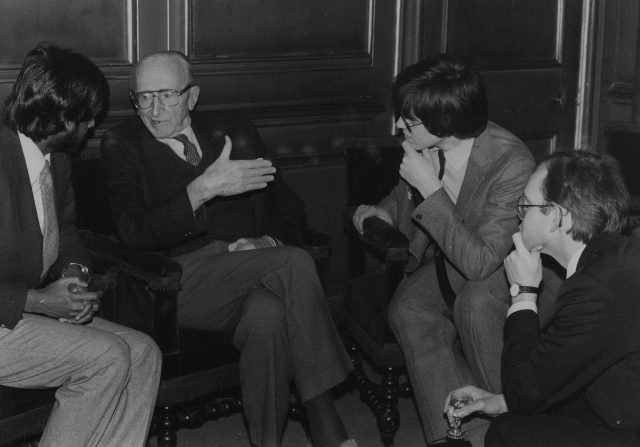
When I first read Friedrich A. von Hayek’s The Road to Serfdom, I was fascinated. The author expressed my views far better than I could: that national socialism and communism were two branches of the same tree; that central planning would gradually eliminate individual liberty; that the Christian civilisation of the West was threatened by totalitarianism; and that most human beings could only flourish in a free society (with the exception, of course, of the court jester and a few servile artists). After completing my studies in history and philosophy at the University of Iceland, I went to Oxford University in 1981 to write a doctoral dissertation on Hayek, supervised by John N. Gray, who was at the time writing about Hayek’s work.
‘Do Not Become Hayekians’
In the spring of 1983, Gray arranged for Hayek to visit Oxford. He hosted a reception for his guest at Jesus College, where he was a Fellow (see the photograph above), and then he, I, and two other students interested in classical liberalism, Chandran Kukathas and Andrew Melnyk, took Hayek to a Chinese restaurant. Hayek was in a good mood and spoke at length about philosophical and methodological problems. The three of us told Hayek we wanted to launch a student club at Oxford and asked whether he would let us call it the Hayek Society. ‘I am, of course, happy that young people are interested in my works, and I shall with pleasure give you permission to use my name, with just one condition,’ Hayek replied with a mischievous glint in his eyes. ‘It is that you promise not to become Hayekians. Because I have noticed that the Marxists are much worse than Marx, and that the Keynesians are much worse than Keynes.’
French Liberalism in the Nineteenth Century
I was not quite able to keep this promise, as I still regard Hayek as one of the twentieth century’s most profound thinkers. But I disagree with him on at least three issues, so I have not broken my word entirely. The first concerns French liberalism, which Hayek did not appreciate. Certainly, John Locke, David Hume, Adam Smith, and Edmund Burke had aptly articulated the British tradition of limited government, private property, and free trade. But I find nineteenth-century French liberalism, particularly the thought of Benjamin Constant and Alexis de Tocqueville, much more impressive than its British counterpart. The reason was undoubtedly that Constant and Tocqueville were confronted with the failure of the French Revolution. Their response was that France lacked the well-developed intermediate institutions and associations that Great Britain enjoyed (Burke’s ‘little platoons’), so that in 1789 intellectuals with no experience of self-governance could seize power and make a futile attempt to reconstruct society.
The Great Depression
The second issue concerns the Great Depression of the 1930s. I find Hayek’s explanation implausible: that it was the necessary correction of a preceding boom artificially created by easy money. This implied that government should do little, just let the correction take place, or, as unkind critics said, the bigger the bankruptcies, the better. I find the explanations of Gustav Cassel and Milton Friedman more plausible: misguided central-bank policies brought about a sharp contraction of the money supply, which then caused deflation and a recession, subsequently aggravated by protectionism.
Nationalism
The third issue is nationalism, which Hayek rejected, possibly because he witnessed in 1918 the collapse of the multinational Habsburg Empire, replaced by several bellicose, illiberal small states. But nationalism need not be aggressive. It can be the recognition of a national identity, a sense of belonging, the product of spontaneous development over centuries, and the will to establish a state to express and protect shared values. The Norwegians seceded from Sweden in 1905 because they were Norwegians, not Swedes. The Finns seceded from Russia in 1917 because they were Finns, not Russians. Similar considerations apply to many other European nations, such as the Poles, Estonians, Slovaks, and Slovenians. These nations were not motivated by hostility to others: they simply wanted to assert their identity.