





 Subscribe


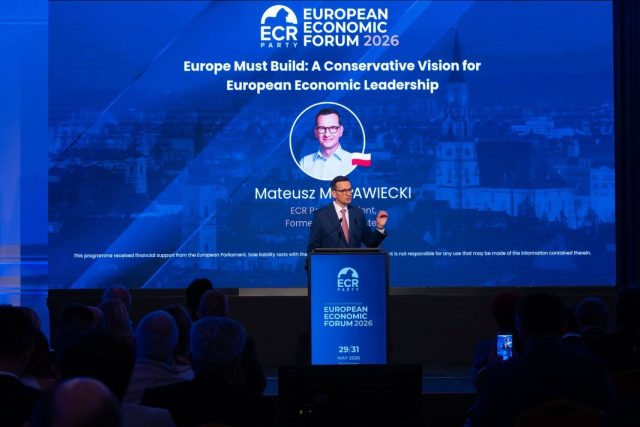
Between the 28th and 31st of May, Cluj-Napoca, a city in the heart of Transylvania, became one of the main hubs of European political and economic debate, hosting the European Awareness Days – European Economic Forum 2026, an event organised by the European Conservatives and Reformists Party (ECR Party). For four days, political leaders, MEPs, entrepreneurs, economic experts, and representatives of the academic community from Europe and the United States analysed and debated the major challenges currently facing the Old Continent. We must acknowledge that European countries are facing a loss of economic competitiveness relative to China and the U.S., rising energy costs, economic sovereignty, and the future of European industry and the transatlantic relationship—issues that should be on the agenda of all European leaders. Held in one of Romania’s most important academic and economic centers, the event brought together prominent political figures from the European conservative family, including ECR President Mateusz Morawiecki, former Prime Minister of Poland; ECR Executive Vice President and AUR leader George Simion; former British Prime Minister Liz Truss; ECR Secretary General Antonio Giordano; as well as parliamentarians and business representatives from several European countries. The dominant message of the meeting was clear: Europe is undergoing a period of economic and strategic decline, and if the European Union wishes to remain a relevant player in global competition, the current policies promoted at the Brussels level must be rethought.
George Simion: “Europe must once again become a continent that builds”
In opening the debates on Saturday, the 30th of May, George Simion delivered one of the strongest messages of the event, criticising the economic direction taken by the European Union in recent decades and warning of the consequences these have had on national economies. The leader of the AUR party and executive vice president of the ECR Party argued that numerous political decisions adopted at the European level have contributed to the decline of member states’ industrial capacities and the emergence of external dependencies that affect the European Union’s economic security.
“Romanians and other nations in the European Union were told to give up certain values, and this was called progress. We were told that our model is outdated, and now Europe depends on production from China, on others for defense, and on unstable regions for essential energy resources,” George Simion told the participants.
According to the Romanian conservative leader, the European economic model must return to stimulating production, investment, and entrepreneurship. In his view, prosperity cannot be built solely through regulations and bureaucratic mechanisms, but by supporting those who create economic value.
“Europe must once again become a continent that builds. We must invest in infrastructure, energy, industrial capacity, and technological innovation. These represent the foundation of our civilisation,” stated George Simion.
The ECR Party Vice President warned that the loss of production capacity and the weakening of strategic sectors pose a major risk to the continent’s future.
“A continent that cannot defend its borders, economy, and identity will not remain a global power,” emphasised the ECR Party Vice-President.
His speech opened a series of debates dedicated to the relationship between Europe and the United States, economic sovereignty, and how European states can regain the competitive advantages lost in recent years. Forum participants also discussed the need to strengthen transatlantic economic relations, energy security, and the opportunities offered by new technologies in an increasingly competitive global context.
Mateusz Morawiecki: “Europe is losing competitiveness in almost all key areas”
The highlight of the European Awareness Days – European Economic Forum 2026 was the speech by Mateusz Morawiecki, president of the ECR Party and former prime minister of Poland, who presented a comprehensive analysis of the European Union’s economic and geopolitical situation. Speaking to a packed hall, the Polish conservative leader argued that the European Union is at a critical juncture and that the gap with the world’s major economic powers has widened significantly.
“There was a time when Europe was nearly as strong as the United States in terms of technological advancement and economic potential. But that is no longer the case,” Morawiecki stated.
The former Polish prime minister explained that economic stagnation and the inability to implement structural reforms have severely affected the continent’s productivity and capacity for innovation.
“Europe is losing competitiveness in almost all key areas,” the ECR Party leader warned.
To illustrate this decline, Morawiecki offered concrete examples from the European steel industry, noting that steel production has fallen significantly across Europe in recent decades, including in Romania. In his speech, the ECR president used the famous metaphor from the Game of Thrones series to describe the challenges looming on the horizon.
“You probably remember the phrase ‘Winter is coming.’ Why am I talking about this here in Cluj-Napoca? Because this warning is constantly being whispered in our ears,” stated Mateusz Morawiecki.
According to him, Europe is simultaneously facing external pressures and problems generated by its own policies. Instead of responding to these challenges with measures to strengthen economic competitiveness, European institutions are said to be focusing too much on ideological goals and excessive regulations. One of the harshest criticisms leveled by the ECR leader targeted European climate policies and their impact on industry.
Mateusz Morawiecki argued that many industrial sectors have been pushed out of Europe, which has indirectly contributed to the rise of global competitors, particularly China, on which the European Union is currently dependent.
“The automotive industry, heavy industry, the chemical industry, and many other sectors have been relocated. With European money and European taxpayers’ money, we have helped build major industries in China almost from scratch. If that isn’t stupid, then I don’t know what is,” he said.
In his view, Europe must protect its strategic sectors more effectively and reduce the economic dependencies that undermine its autonomy.
Energy, security, and economic sovereignty—the themes that dominated the forum
Throughout the debates, participants consistently addressed the issue of economic sovereignty and the European Union’s ability to defend its interests in an increasingly complex international context. Several panels were dedicated to the relationship between technology, industry, and competitiveness, and the experts participating in the debates pointed out that Europe risks falling behind the United States, China, and India if it does not take swift measures to stimulate investment and reduce bureaucracy.
During the sessions on the innovation economy, representatives from the business community and European institutions discussed the need for investment in research, technology, and infrastructure, as well as the challenges posed by high energy costs. Mateusz Morawiecki revisited this topic, stating that energy prices represent one of the European economy’s greatest vulnerabilities. According to him, European companies are at a disadvantage in global competition because they pay significantly more for energy than their rivals in the United States or Asia.
The ECR Party president also criticised the high level of bureaucracy within the European Union, arguing that numerous administrative barriers effectively function as trade barriers that reduce the competitiveness of the single market. The Polish leader also called for a more flexible approach at the European level, arguing that member states should be able to set their own priorities in areas such as energy, the environment, or migration.
“A ‘one size fits all’ policy doesn’t work. We are 27 different countries with different priorities,” stated the ECR Party president.
The topic of security was also raised in several speeches. Mateusz Morawiecki drew attention to the challenges on the eastern flank of NATO and the European Union and noted that countries such as Poland and Romania are directly feeling the geopolitical pressure exerted by Russia.
“On the eastern flank of the European Union, our friends in the Scandinavian countries, as well as we in Poland, the Czech Republic, and Romania, feel Russia’s hot breath on our necks,” declared the ECR leader.
With “Russia’s hot breath on our necks,” Morawiecki argued that defense investments must be accompanied by the maintenance and development of a European industry capable of supporting the continent’s security efforts.
The Cluj-Napoca forum concluded with repeated calls to regain economic competitiveness, strengthen energy independence, and defend the sovereignty of member states. Beyond the differences of opinion within the European political landscape, the event highlighted a shared concern for the continent’s economic future and for the European Union’s ability to cope with new geopolitical and economic realities. With the presence of leading political figures from Europe and the United States, the European Economic Forum 2026 transformed Cluj-Napoca into a platform for dialogue on the direction in which Europe is heading. And the messages conveyed by Mateusz Morawiecki and George Simion outlined one of the main themes of the meeting: the need for a Europe that is more competitive, less bureaucratic, and better able to defend its economic and strategic interests in a world where changes can occur from one day to the next.
Photo: ECR Party