





 Subscribe


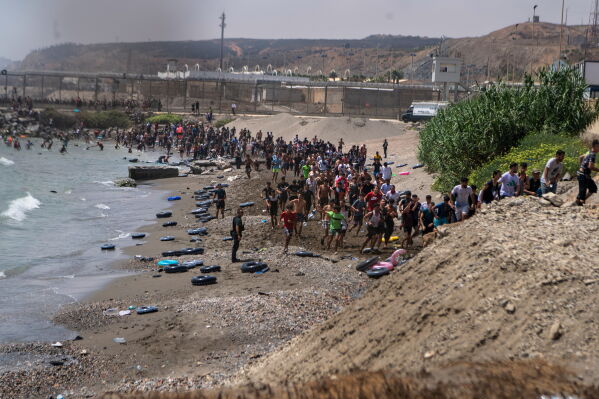
On the morning of Thursday 30 July, people began entering the Spanish city of Ceuta from Moroccan territory in numbers no European frontier has absorbed in a comparable window: twenty thousand within hours, close to sixty thousand by Friday evening, and at least ninety drowned in the Strait.
What happened in Ceuta was not so much a migration surge but a hybrid attack on the territory of an EU member state. Migration was the instrument, not the object. And Spanish migration policy is why the instrument was cheap, which is an aggravating factor and not a cause. The Ceuta border is a double fence ten metres high and eight kilometres long, normally guarded in force on the Moroccan side. That sixty thousand people crossed it in thirty-six hours without a decision to stand the deployment down is not a proposition about migration. Non-enforcement on that scale is itself an act—and the reversal duly arrived, forty-eight thousand returns in two days being equally impossible without Moroccan cooperation.
A judgment read as intelligence
On 29 June, Spain’s Supreme Court held that migrants reaching Ceuta and Melilla by sea cannot be summarily returned without due process, removing the shortcut that had quietly sustained both perimeters for two decades. Thirty-one days later the perimeter was tested on a scale never previously attempted. The Interior Ministry says smuggling networks exploited the ruling; that explains the supply of people willing to enter, not the absence of policing on the other side. A published judicial constraint is, to a government contemplating pressure, an intelligence product delivered free of charge. Every European interior ministry should be asking which of its own published limitations would function, in hostile hands, as a timetable.
The stake nobody names
Ceuta and Melilla give Spain, and therefore the Union, decisive weight over the territorial waters of the Strait of Gibraltar. The proximate object of 30 July is the bilateral file—Western Sahara, fisheries, the status of the cities—but the structural stake is the Strait, and with Hormuz and Bab el-Mandeb also under pressure, all three great passages of Eurasian trade are now contested at once. None of it is intelligible without Western Sahara, where the Spanish claim to pure victimhood cracks. For twenty years the relationship rested on an implicit bargain: Moroccan cooperation on migration control in exchange for Spanish accommodation on the Sahara and silence about the cities. In March 2022 Pedro Sánchez made it explicit, endorsing the autonomy plan in a letter to Mohammed VI without troubling the Cortes. Calm at the border followed and was read in Madrid as vindication. But a concession extracted under coercion is not a settlement. It is a demonstration, entered into the file, that the instrument works.
A look at the immediate timeline
Coercion has a price, and whatever lowers the expected consequence makes the act more likely. In March, Michael Rubin of the American Enterprise Institute urged Washington to recognise the cities as occupied Moroccan territory, then called on Mohammed VI to revive the spirit of the 1975 Green March and send unarmed civilians into them: Spain could hardly escalate, and the Alliance would not intervene.
Rubin’s case rested on a technical point that is substantially correct. Article 5 of the North Atlantic Treaty makes an armed attack on one ally an attack on all; Article 6 confines the clause to the territory of the parties in Europe or North America. Ceuta and Melilla are in Africa, have never been unambiguously covered, and Spain has never sought clarification, preferring ambiguity to an answer it feared would come back negative. They are therefore the softest sovereign target in the alliance, and an act pitched below the threshold of armed attack falls outside Article 5 by nature as well as geography.
By late April the position had institutional form. House Report 119-631, signed by Mario Díaz-Balart and passed by the House on 15 July, records that the Spanish-administered cities are located in Moroccan territory and subject to Morocco’s long-standing claim, backs the Secretary of State in promoting dialogue on their future status, directs forty million dollars in assistance to Rabat, and rebukes Spain over defence spending and base access.
The Committee notes that the Spanish-administered cities of Ceuta and Melilla are located in Moroccan territory and remain the subject of Morocco’s longstanding claim. The Committee supports efforts by the Secretary of State to encourage diplomatic engagement between Morocco and Spain on the future status of Ceuta and Melilla (House Report 119-631)
A committee report is not law—but the absence of legal force is not the absence of political force, and its author chairs the subcommittee that funds American diplomacy. Not to mention the signal of encouragement such statements may give to attentive ears.
Moreover, on 30 July itself, the State Department’s Throne Day statement reaffirmed recognition of Moroccan sovereignty over the Sahara and declared that the dispute must end now. The following day it stood with Spain against a flagrant violation of Spanish sovereignty yet it attributed that violation, in the same message, to Spain’s own immigration policy alone.
Israel moved into the same opening on 30 July, when its ambassador to the United Nations invited Spain—critical about the current Israel government’s position on the West Bank and southern Lebanon—to account for its own “colonial enclaves” in North Africa.
The solidarity that broke in a day
The most consequential development of 31 July occurred not at the border but inside the Union, and it occurred fast. Deterrence lives in the first hours, because those are the hours the next aggressor studies. Italy requested the suspension of Schengen free movement with Spain and closed its air and sea borders; Finland and Denmark signalled willingness to follow. The Commission proposed reinforcing Frontex and declined to speculate as to why sixty thousand people had crossed a militarised frontier in thirty-six hours. Nothing was suspended or reviewed in respect of the state that opened it.
On 1 August, twenty-two heads of state and government requested an emergency meeting of interior ministers. Their letter uses the correct vocabulary, speaking expressly of the instrumentalisation of migration and of hybrid threats—yet its operative request is aimed not at the actor who opened the border but at preventing illegal entry from becoming legal residence. The declaratory half identifies a hybrid attack; the dispositive half regulates the victim. When Minsk channelled arrivals towards Poland and the Baltics, nobody proposed suspending Schengen with Warsaw. And Copenhagen, which drove this initiative, has subscribed to the rule by which it will be measured the next time Washington returns to Greenland.
Accelerant, not ignition
One reading has circulated widely in Washington: that Ceuta is what happens when a government regularises more than a million irregular migrants, and that Spain brought this on itself. Concede the substantial part—I have criticised that policy at length, and Spain absorbed the shock badly as a result. But if regularisation were the cause, the reproach would fall on every equivalent policy, Italy’s hundreds of thousands of work permits included, and it does not. Exposure is not a function of what Madrid does with people once they are inside. It is a function of a neighbour’s capacity to move sixty thousand of them across a militarised frontier, and of five months of signalling that the act would go unanswered.
Europe has lived through several major episodes of coercive migration and still has no doctrine. The Migration Pact, the instrumentalisation provisions, Frontex, emergency reception funding: all are calibrated to manage arrivals, none to impose a cost on the government that causes them. Closing that gap requires routine attribution rather than a judgement weighed each time against fishing quotas; a pre-published schedule of consequences, since a penalty invented afterwards deters nobody while a known one is priced into the decision to open the tap; burden-sharing during the event rather than at the summit afterwards; and an answer, at last, to the Article 6 question.
I am not optimistic: attribution is cheap when the actor is Belarus, a pariah with nothing to risk, and expensive when it is a partner on whom the Union depends for fishing access and containment of the Atlantic route. But cheap, deniable, effective instruments do not fall into disuse. They are studied, and adopted by others. The United States has a southern border abutting states with their own leverage calculations and their own grievances, and it is not obvious why a precedent set in Ceuta should stay in Ceuta. The question is not whether this happens again, but where, and whether the target will have thought about it beforehand.