





 Subscribe


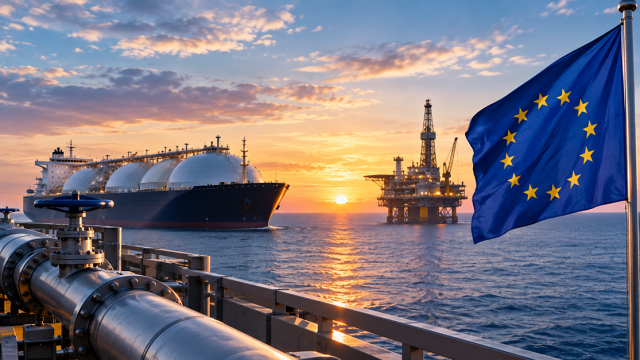
Wood Mackenzie warns that without new investment EU output could almost disappear, while faster permitting and exploration in the Black Sea and Eastern Mediterranean could dramatically reduce reliance on LNG
The European Union could become dependent on imports for more than 98% of its natural gas by 2050 if investment in domestic production dries up, highlighting a long-term energy-security challenge that could leave the bloc increasingly exposed to the global liquefied natural gas market.
The warning comes from Wood Mackenzie’s new report, What could domestic gas do for EU energy security?, which models three production scenarios through 2050. The difference between the least and most ambitious cases approaches 1,000 billion cubic metres (bcm) of cumulative production — roughly equivalent to three years of current EU gas demand.
Europe is already heavily dependent on foreign supplies. Around 85% of the gas consumed in the EU is imported, according to Wood Mackenzie. That proportion is expected to remain relatively stable until the early 2030s before rising as several important sources come under pressure.
Norwegian production is expected eventually to decline from its current plateau, while growing domestic energy demand could limit North African exports. At the same time, Europe is progressively eliminating the Russian pipeline supplies that once formed a central pillar of its energy system.
LNG would increasingly fill the resulting gap. Wood Mackenzie estimates that LNG’s share of European gas supply could rise from approximately 40% today to 63% by 2050. More strikingly, the United States could provide 77% of those LNG volumes, replacing one form of concentrated external dependence with another.
The consultancy’s three scenarios illustrate how policy decisions could change that trajectory.
Under the low-investment scenario, in which no new gas fields receive investment, EU production falls from 43 bcm in 2028 to only 2 bcm in 2050, effectively eliminating indigenous supply.
A middle scenario based on current policies and investment would keep production close to 40 bcm annually until 2038. Even this would require considerable investment simply to replace declining fields, and domestic production would never meet more than 17% of EU demand.
Only Wood Mackenzie’s high case substantially changes Europe’s strategic position. Stable fiscal conditions, faster permitting, fewer corporate constraints and successful exploration could push EU production to 77 bcm in 2042, covering as much as 38% of demand. Cumulative output under this scenario would reach approximately 1,400 bcm.
The geological opportunity is concentrated heavily in southeastern Europe.
Exploration accounts for around 680 bcm of the additional production separating the low and high cases, with roughly 70% of the yet-to-be-discovered resources located in the Black Sea and Eastern Mediterranean. Greece alone represents around one-third of the estimated exploration potential. Energean and ExxonMobil are preparing to drill Greece’s first deepwater exploration well in 2027.
Cyprus represents an additional possibility. Wood Mackenzie models separately a maximum potential of 340 bcm that could be routed through Egypt, although it cautions that not all this gas would necessarily reach European consumers.
Romania provides a more immediate example. The Neptun Deep project in the Black Sea, operated by OMV Petrom alongside Romgaz, is expected to reach production of around 8 bcm annually from the late 2020s.
Economics may strengthen the case for European production. Wood Mackenzie calculates that US LNG delivered to northwestern Europe has a breakeven cost 68% higher than gas from Neptun Deep and 96% higher than new Norwegian supply. Domestic or nearby pipeline gas can also avoid some of the energy-intensive liquefaction and transportation processes associated with LNG.
Yet the issue creates an uncomfortable policy dilemma for Europe. Expanding gas production could improve security of supply while the EU is simultaneously pursuing deep decarbonisation and attempting to reduce fossil-fuel consumption.
Member states are consequently moving in different directions. Black Sea and Eastern Mediterranean countries are seeking investment in exploration, while Denmark, France and Spain have restricted new licences or established pathways towards ending hydrocarbon production.
Domestic gas therefore cannot make Europe energy-independent, nor does Wood Mackenzie suggest that it can. Instead, the report presents production as a way of reducing exposure during an energy transition in which gas is expected to remain part of the European system for years.
The crucial variable is time. Exploration, permitting and offshore development can take many years before producing the first cubic metre. Decisions taken during the next five years could therefore determine whether Europe enters the 2040s with a meaningful domestic gas industry — or increasingly reliant on LNG arriving from across the Atlantic.
Alessandro Fiorentino