





 Subscribe


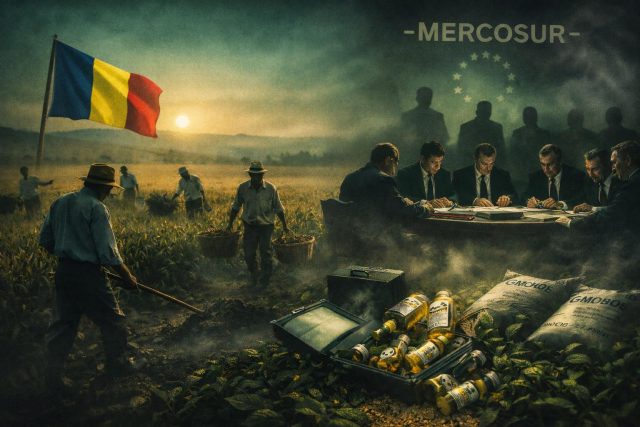
Romania’s unclear support for the EU–Mercosur deal could hurt its own farmers and let in cheaper, more chemically intensive goods from South America. The way Bucharest handled the vote could also give the European Court of Justice a reason to throw out the Council decision.
Romania’s Ministry of Agriculture led by Florin Barbu stated in December that it will not support the Mercosur agreement and refused to sign the Economy Ministry’s memo allowing Romania to support the Mercosur agreement. This was a clear sign of opposition from the ministry that should protect farmers. Still, President Nicușor Dan later said that Romania had voted for the EU–Mercosur free trade agreement. He said that the country’s initial concerns had been “overcome” and that Romania would benefit from having access to a large South American market.
This split between a non signing agriculture ministry and a Council vote cast in favour creates a legal grey zone: the internal administrative chain that should authorise Romania’s position appears incomplete. Such an inconsistency is precisely the type of procedural defect that other member states, particularly Poland, could invoke before the Court of Justice of the EU to challenge the validity of the Council decision approving the agreement. EU law allows member states, EU institutions or even, under certain conditions, private actors to bring actions for annulment before the CJEU when a Council decision suffers from procedural or competence defects. An internal Romanian decision making process where the competent line ministry explicitly refused to sign the memorandum, yet the state still cast a yes vote in Council, offers a plausible angle of attack: the argument that Romania’s consent was not properly formed under its own constitutional and administrative rules.
France’s Emmanuel Macron has repeatedly presented himself at home as a sceptic of the Mercosur accord, citing environmental and agricultural concerns to calm furious French farmers. Yet France also stands to gain heavily from the deal through expanded export markets for its industry and better access to cheap agricultural and mineral inputs from Mercosur countries.
In this context, Romania’s pro Mercosur vote under President Nicușor Dan effectively helped clear a crucial hurdle in the Council while allowing Paris to keep its hands formally “clean” domestically. The political reading in Bucharest is that Dan and his USR allies delivered the decisive support needed by Macron’s government and by the major Western economies, even though Romania’s own agriculture ministry refused to endorse the underlying memorandum.
The core fear around Mercosur is not just competition on price, but competition built on a far more aggressive chemical model of agriculture than the one permitted within the EU and Romania. Brazil alone has more than 3,000 commercial pesticide products registered for use, and as of early 2023 roughly 63% of the active ingredients approved in Brazil did not have a corresponding authorisation in the EU.
Greenpeace and other analyses show that Brazilian produce exported to the EU already contains residues of multiple pesticides, including substances that are banned or not approved in Europe, with many samples showing a “toxic cocktail” of up to seven different chemicals. By contrast, EU and Romanian farmers operate under far stricter rules on pesticide authorisation, maximum residue limits, antibiotic use in livestock, and the ban on practices such as cloning cattle for the human food chain and widespread cultivation of certain genetically modified crops for feed.
Romania’s exports to South America are negligible, so any tariff cuts on manufactured or processed goods bring only marginal gains for the Romanian economy. Meanwhile, opening the EU market wider to South American beef, poultry, sugar, soy and other commodities produced on an industrial scale with cheaper land, looser labour standards and lighter environmental and chemical constraints, undercuts Romanian producers who already struggle with imports from Ukraine and Russia.
For Romanian farmers, the combination of Ukrainian/Black Sea dumping and a new wave of low cost Mercosur imports risks turning an already fragile sector into one built on survival rather than development. If local agriculture collapses and supply chains from Ukraine or Mercosur are disrupted by geopolitical shocks, the country is left dangerously exposed, with food production pushed back to subsistence level in household yards instead of modern, resilient farms.