





 Subscribe


Tags:
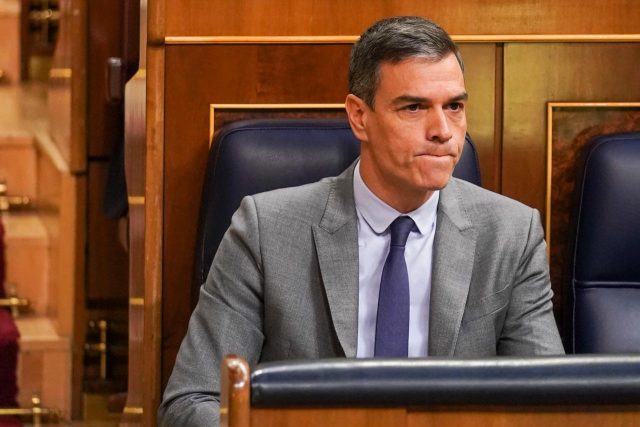
Spain’s political crisis has entered a new and more dangerous phase for Prime Minister Pedro Sánchez. In the space of a few days, the Socialist leader has faced mass street protests, a formal act of political condemnation in the Senate and a police operation inside the national headquarters of his own party, the PSOE.
Taken separately, each episode would be serious. Together, they suggest something deeper: the erosion of trust around a government that has long presented itself as the guardian of democracy, transparency and institutional decency.
The first image came from the streets of Madrid. On Saturday, 23 May, tens of thousands of people marched through the Spanish capital demanding Sánchez’s resignation and early elections. The protest, called by Sociedad Civil Española and backed by the conservative Partido Popular and Vox, was held under the slogan of dignity and against corruption. Organisers claimed around 120,000 people attended, while the central government’s delegation put the number at around 40,000. Whatever the exact figure, the political meaning was unmistakable: a large part of Spanish public opinion no longer sees Sánchez merely as a controversial prime minister, but as the symbol of a political system perceived as exhausted, opaque and increasingly arrogant.
The demonstration was largely peaceful, but tensions emerged near the Moncloa Palace, the prime minister’s official residence. According to Reuters reporting carried by Internazionale, a small group of protesters tried to break through police barriers, three people were arrested and several officers were injured. The scenes added a further layer of pressure to an already fragile government: the anger is no longer confined to parliamentary debate or media confrontation. It has moved visibly into the streets.
The crisis then shifted to the institutional arena. In the Senado, where the Partido Popular holds a majority, the opposition promoted a political act of censure against Sánchez. The distinction is crucial. This was not a constitutional motion of no confidence capable of bringing down the government. Under Spain’s constitutional order, the moción de censura belongs to the Congreso de los Diputados, not to the Senate. Article 113 of the Spanish Constitution states that the Congress of Deputies may demand the political responsibility of the government through a motion of censure, adopted by an absolute majority.
This means the Senate vote does not remove Sánchez from office, nor does it automatically trigger early elections. Its value is political rather than executive. But that does not make it irrelevant. On the contrary, it shows that the crisis has now passed through several levels at once: public mobilisation, parliamentary condemnation and judicial scrutiny. The Senate cannot dismiss the government, but it can register formally that a significant part of Spain’s institutional architecture considers the prime minister politically compromised. For Sánchez, it is one more front to dismiss as an offensive by the right. For the opposition, it is proof that the prime minister’s authority is no longer merely contested, but openly denounced inside the state’s own institutions.
Then came the most damaging development of all. On 27 May, Spanish police went to the national headquarters of the PSOE in Madrid as part of a judicial investigation into alleged attempts to interfere with legal proceedings involving the party or the government. Reuters reported that Spain’s High Court clarified the operation was the retrieval of specific documents and electronic files ordered by Judge Santiago Pedraz, rather than a general search raid. Still, the political image was devastating: police officers entering the headquarters of the ruling party while the prime minister is already under intense pressure over corruption allegations surrounding his political environment.
The investigation focuses on figures linked to the Socialist orbit, including Santos Cerdán, the former PSOE organisation secretary, and Leire Díez, a former party member. The alleged offences under investigation include bribery, misconduct, inducement to give false testimony and participation in a criminal organisation. The legal process is ongoing, and those under investigation are entitled to the presumption of innocence. But politically, the damage is immediate. For any governing party, the sight of police collecting material from its headquarters is not a procedural footnote. It is a public symbol of institutional decay.
Associated Press has described the operation as part of a wider investigation into alleged financial wrongdoing and possible attempts to influence judicial and police processes. It also noted that Sánchez himself is not directly implicated. That point matters legally. But politics is not only about criminal liability. It is also about responsibility, judgment and the culture of power that develops around a leader. Sánchez may not be personally accused, but his government is being dragged deeper into a network of scandals involving former officials, party figures and members of his wider circle.
Sánchez has tried to hold the institutional line. He has said that the PSOE will cooperate with justice and that any wrongdoing will be addressed firmly. Yet his response is increasingly met with scepticism. For months, the Spanish prime minister has portrayed investigations and allegations surrounding his party and entourage as part of a campaign against him. That strategy may still help him mobilise his base, but it becomes less convincing every time a new judicial file, police operation or corruption allegation emerges.
The opposition has seized the moment. Alberto Núñez Feijóo, leader of the Partido Popular, has demanded early elections, arguing that Spain cannot continue under a government consumed by scandal. Vox has gone further, using harsher language and presenting the Sánchez era as a moral and institutional emergency. The two forces differ in tone and strategy, but their central message is converging: the prime minister has lost the authority to govern.
Sánchez’s problem is that his political brand was built precisely on the opposite claim. He presented himself as the responsible European progressive, the defender of democratic norms, the leader who would protect Spain from the right, from populism and from instability. Yet his own survival has depended on fragile parliamentary bargains, controversial alliances with separatist forces and an increasingly aggressive narrative against critics. Now, with corruption allegations surrounding the Socialist ecosystem, that claim to moral superiority is collapsing under the weight of events.
The PSOE is not facing a simple communications crisis. It is facing a crisis of credibility. When citizens fill the streets demanding resignation, when the Senate issues a political condemnation, when police enter the headquarters of the ruling party, the issue is no longer whether the government can technically survive another week or another month. The question is whether it still has the moral and political authority to govern Spain.
Sánchez may try to endure, as he has done many times before. His career has been built on tactical resilience, parliamentary manoeuvring and the ability to turn weakness into survival. But survival is not legitimacy. A prime minister can cling to office long after his authority has been emptied of substance. He can still count votes, negotiate deals and accuse his opponents of conspiracy. What he cannot do is ask a country to trust a government that appears unable to keep its own house clean.
Spain is now watching the slow collapse of a political narrative. The left that claimed to defend institutional purity is surrounded by investigations. The leader who promised stability has become the centre of instability. The party that preached democratic responsibility is now forced to explain why police are collecting documents from its headquarters.
This is no longer just a difficult week for Pedro Sánchez. It is a warning about what happens when power mistakes endurance for legitimacy. Governments do not fall only when they lose a vote. They also fall when citizens stop believing them, when institutions turn against their credibility and when every new headline confirms the suspicion that the system around them has become rotten. Spain has not yet reached the final act of the Sánchez era. But the curtain is visibly moving.
Tags: