





 Subscribe


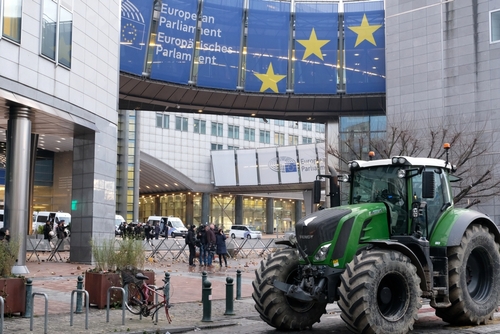
Thus far, 2026 has been marked by two major developments. Namely, Greenland and the EU–Mercosur Trade Agreement. Greenland will be addressed in the next article, so let us devote this one to Mercosur.
The EU-Mercosur trade deal is a treatly long in the making. After 25 years of negotiations, these concluded in 2019 and a political deal was reached in December 2024, with the final agreement signed in Paraguay on January 17 this year. However, right after its signing, disagreement and fracture took over the European Parliament and, last week, during a critical vote, it was refered to the European Court of Justice (ECJ), effectively freezing its ratification.
The epicentre of this new political earthquake took over Brussels and national parliaments, as fault lines appeared both across parties —at the national level— and within groups at the European Parliament. That was also the case within the European Conservatives and Reformists (ECR) Group itself. During the vote for the trade deal to be refered to the ECJ, the group came close to splitting down the middle. Roughly 46 per cent voted in favour, 49 per cent against, revealing a profound internal divide between those instinctively drawn towards free trade and those prioritising the protection of domestic agricultural interests.
This division is understandable, and it showcases the overall sentiment across the entire EU, as the ECR might be the termometre of common sense politics; preocupied not with ideologically-charged worldviews but with solving real problems of real people. Many ECR members represent rural constituencies and farming communities that feel increasingly exposed by globalisation, regulatory asymmetries, and rising production costs imposed by Brussels itself. Others, however, remain rightly reluctant to block one of the most significant free trade agreements ever negotiated by the European Union. All understand the importance of free markets and free trade for nations to prosper so the question facing the ECR was therefore not merely tactical, but strategic: should European conservatives align themselves with free trade or with defensive protectionism? This crossroads, though again understandable in a “yes” or “no” vote, should however become a different one going forward. One that explores how can economic realism rooted in competition also protect sovereignty, and long-term prosperity.
The EU-Mercosur agreement is not a technocratic exercise in tariff reduction. It is a test of whether Europe remains committed to the principles that underpin a functioning market economy. At its core, the treaty reflects the logic of comparative advantage and the international division of labour—concepts long understood by conservative economic thinkers as drivers of productivity, efficiency, and rising living standards. Opposition to the agreement, whether dressed up as economic nationalism, often masks sectoral interests or ideological reflexes rather than a serious engagement with economic reality.
Nowhere is this clearer than in the European agricultural lobby’s argument that Mercosur imports constitute “unfair competition”. This claim ignores a basic fact: efficiency differences are not evidence of cheating. The productivity of agriculture in Argentina, Brazil, or Uruguay stems from economies of scale, technological innovation, and bioclimatic conditions that simply do not exist in Europe. Demanding that foreign producers replicate the EU’s cost structure is tantamount to denying the rationale for trade altogether. If all production were identical, trade would be redundant.
Moreover, European protectionism imposes real and measurable costs on ordinary citizens—costs that are paid three times. First, through taxation: the Common Agricultural Policy continues to absorb close to one third of the EU budget, transferring hundreds of billions of euros to a highly protected sector. Second, through higher consumer prices, which disproportionately harm lower-income households that spend a larger share of their income on food. Third, by locking European agriculture into structural uncompetitiveness, raising supply-chain costs and generating persistent negative externalities. In practice, trade barriers function as a regressive transfer of wealth from consumers to subsidised producers.
Concerns about food safety and regulatory standards are equally overstated. The EU-Mercosur agreement does not weaken European sanitary or phytosanitary rules, as every product entering the Single Market must comply fully with EU standards and the requirements of the European Food Safety Authority. Claims that the agreement would “poison” European consumers are not serious arguments; they are fear-based narratives designed to mobilise opposition without evidence, and often led by major lobbies and corporations who despise a competitive market that is to their disadvantage.
Environmental objections deserve more careful consideration, but here too the case against the agreement collapses under scrutiny. Paradoxically, rejecting the treaty would weaken—not strengthen—Europe’s environmental leverage. The agreement provides the EU with its only credible institutional mechanism to link access to the Single Market to environmental and climate commitments. Without it, Mercosur economies will simply redirect exports towards Asian markets that impose few, if any, sustainability requirements. From an institutional economics perspective, the treaty creates incentives that raise the cost of practices such as deforestation. Blocking it in the name of environmentalism risks accelerating the very degradation critics claim to oppose.
On the South American side, resistance to the agreement reflects a familiar but failed model: protectionism under the banner of “industrial sovereignty”. Decades of import substitution policies delivered inflation, technological stagnation, and weak productivity. The EU–Mercosur agreement would eliminate tariffs on capital goods, enabling access to European technology and integration into global value chains. Real industrialisation does not emerge from subsidies and walls, but from competition, investment, and openness. Denying this pathway condemns workers to lower productivity and lower real wages.
There is also a broader strategic dimension that conservatives should not ignore. By obstructing the agreement, the EU risks surrendering its role as a global standard-setter at a time when economic gravity is shifting decisively towards the Indo-Pacific. Mercosur countries, for their part, risk remaining trapped in the “middle-income trap” if they retreat into defensive nationalism. The agreement offers a framework for institutional modernisation—covering services, public procurement, and intellectual property—that domestic political systems often lack the will to implement independently.
For true conservatives, this debate should not be reduced to a binary choice between farmers and free trade. A conservative approach should recognise that many of the pressures facing European agriculture are the result of EU regulatory overreach, not international competition. Shielding inefficient structures through permanent protection only postpones adjustment while deepening dependency on subsidies. A reformist conservative agenda would focus on reducing regulatory burdens, improving competitiveness, and supporting transition—rather than freezing Europe into economic immobility.
At a time when the US calls into question the transatlantic alliance, Europe must seek to both repaire it —to the extent it can do so unilaterally— and to seek new alliances and partnerships, so that it ensures it geopolitical and geoeconomic independence. As a result, this is the worst time possible to show strategic ambiguity. Conservatism, properly understood, is not about preserving every existing structure at any cost; nor to sacrifice national interest in the altar of ideological postulates such as free trade. It is about sustaining prosperity, national strength, and social cohesion in a changing world. There is no ethical or economic justification for trade barriers that impoverish millions to protect narrow interests. Supporting the EU–Mercosur agreement is not an act of ideological globalism; it is an expression of economic realism, institutional leverage, and strategic foresight.
Therefore, conservatives must resist the temptation to mimic the reflexes of the populist extremes—whether of the left or the “alternative” right. The real choice is not between sovereignty and trade, but between managed openness and managed decline. Openness, however, must be accompanied by stronger competition: removing barriers to entry within the European economy, enforcing antitrust rules, and curbing anti-competitive cartels and quasi-monopolistic behaviour. In other words, Europe should open its markets while equipping its farmers and producers with the tools needed to compete. Ceteris paribus, they will prevail.