





 Subscribe


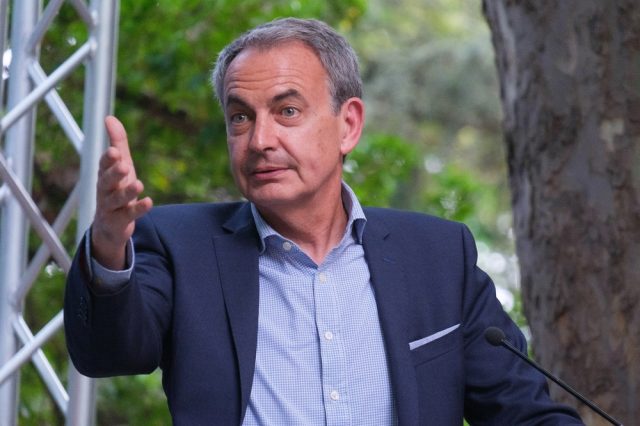
When Spanish National Court judge José Luis Calama formally indicted former two weeks ago Prime Minister José Luis Rodríguez Zapatero on charges of leading a criminal organisation, money laundering, influence peddling, and document forgery, he didn’t just make history. He detonated a bomb beneath the foundations of the Spanish Socialist left —and the blast radius may yet consume PM Pedro Sánchez’s entire government.
The case, known as Caso Plus Ultra, began as a controversy over a €53 million public bailout granted in 2021 to Plus Ultra Líneas Aéreas —a minor carrier with Venezuelan shareholders and a mere 19% share of traffic on the Madrid-Caracas route. It has since grown into something far larger: a sprawling judicial investigation linking a former head of government to Nicolás Maduro’s kleptocratic regime, to Venezuelan state oil money funnelled through Swiss accounts, and to what Judge Calama describes as a sophisticated “organised and stable structure” dedicated to trading political access for cash.
The alleged scheme
At the centre of the indictment sits a consulting firm called Análisis Relevante, run by businessman Julio Martínez Martínez —described by investigators as Zapatero’s frontman. Between 2020 and 2025, the firm channelled nearly half a million euros directly to Zapatero, with additional funds flowing to What The Fav, a marketing company owned by his two daughters. Spain’s Economic and Financial Crime Unit concluded that Zapatero’s office was “the operational hub” of the alleged influence-peddling network.
Martínez’s role went well beyond paperwork. When officers raided his home they found €286,070 in undeclared cash: hidden in a tartan travel bag, a golf bag, a bathroom, and a radiator. He had also moved more than €500,000 from a Miami bank account upon learning of the investigation. In total, police traced 40 companies, 110 money transfers, and 60 individuals. The alleged logic was elegant in its cynicism: Venezuelan-linked interests needed a European political guarantor to unlock Spanish pandemic rescue funds, soften EU pressure on the Maduro regime, and lend legitimacy to its international operations. Zapatero, with unique access to both Sánchez’s government and the palaces of Caracas, was the ideal asset.
The Venezuelan thread
What transforms this from a domestic corruption scandal into a matter of international consequence is the Venezuelan dimension. The shareholders who controlled Plus Ultra were not random entrepreneurs. They operated at the highest levels in Caracas, with direct contacts including Maduro’s wife Cilia Flores, then-Vice-President Delcy Rodríguez, and Alex Saab —the Colombian-born businessman who served as Maduro’s primary financial operator before being arrested and extradited to the United States.
US Treasury Department documents referenced in Spanish prosecutorial files trace a Plus Ultra transfer of $519,000 to a Swiss account used to pay financial intermediaries facilitating operations tied to PDVSA funds. That account is believed to be what first connected the Audiencia Nacional’s inquiry to the broader American-led investigation into Venezuelan corruption. Maduro is alleged to have granted six million barrels of crude oil in 2021 to two former Plus Ultra shareholders despite their having no experience in the sector. The oil moved through a parallel accounting system outside PDVSA, managed by military figures with criminal records, designed to evade US sanctions.
What Zapatero articulated for two decades as progressive diplomacy —first from inside the Moncloa, as Prime Minister, then from outside it— had, from the outset, the hallmarks of a lucrative exchange. He flew to Venezuela over a hundred times after leaving office, positioning himself as an indispensable mediator between Maduro and the opposition. He was not merely a useful idiot for the regime; he was, prosecutors allege, a paid one.
With Maduro now in US custody since January and Saab extradited and facing narco-terrorism charges, Zapatero stands as the critical European node whose testimony could map the full architecture of international complicity. The Trump administration, which has made dismantling Maduro’s financial networks a strategic priority, is described in Spanish judicial filings as cooperating actively and fully with the investigation. This is no longer a bilateral judicial request. It is a coordinated international unravelling — and Zapatero sits at the European end of it.
What Sánchez knew (or should have)
Pedro Sánchez insists the Plus Ultra bailout —in the midst of the Covid19 pandemic— met all legal requirements. His government approved the rescue in March 2021, over the objections of opposition parties who flagged the airline’s thin market presence and murky shareholder structure. The case was initially archived after prosecutors found insufficient evidence —only to be spectacularly reopened following judicial cooperation requests from France and Switzerland.
PP spokesman Borja Sémper framed the political reality bluntly: “The alleged crimes attributed to Zapatero are not only those of a former prime minister —they are those of a former prime minister who allegedly needed the current Cabinet to commit them, because the ministers who approved the €53 million bailout were members of the current government.” That framing is proving difficult to rebut.
There is also the small matter of the morning the indictment was served. When police arrived at Zapatero’s door, he had a ticket booked on the 16:10 Air Europa flight from Barajas to Santo Domingo —from where, according to sources cited by El Confidencial, he planned to board a private aircraft onward to Caracas. He never made it to that flight.
The Government coalition fractures
Perhaps most damaging for Sánchez is the fracture within his own camp. Más Madrid’s spokeswoman Manuela Bergerot declared that while presumption of innocence applies, “it is not normal for a former prime minister to receive hundreds of thousands of euros for advising companies. It is unacceptable and incompatible with the values of the left.” Sumar is calling for a broad left-wing conference after the summer that would operate independently of the PSOE. Even Podemos’ Pablo Fernández admitted: “It can now be asserted that this is not a case of lawfare. There are behaviours in the left that cannot be tolerated.”
The PNV —whose support has been essential to the government’s survival— has broken with its habitual caution. PNV president Aitor Esteban declared it would be “irresponsible” to continue the legislature beyond 2026 “without direction, without budgets, without a stable majority.” Former Prime Minister Felipe González —the most respected figure in the Socialist camp— said the case “affects us as a country, as a party, and as people,” and called for elections “this year.”
Why this matters beyond Spain
The Caso Plus Ultra raises a question every European democracy should be asking: how did Maduro’s regime — under comprehensive international sanctions, its assets frozen, its legitimacy contested — manage to exercise political influence at the highest levels of a founding EU member state? The answer, if the judge’s findings are borne out, is that it found its European intermediary in a former prime minister who used the language of dialogue and solidarity as cover for what the Audiencia Nacional now calls organised crime.
The damage to Spain’s international standing is particularly acute because it strikes at the very role the country has long claimed for itself. Madrid has historically positioned itself as the natural bridge between Europe and Latin America —a relationship built on shared language, deep cultural ties, and decades of diplomatic investment. That bridge function carries real weight: Spain has the standing, the relationships, and the institutional leverage to shape how Europe engages with a region that is strategically vital and frequently turbulent. But a bridge only works if both sides trust the builder. If a former Spanish prime minister was not facilitating dialogue with Venezuela’s regime in the interests of democracy and human rights, but allegedly monetising that access for personal enrichment while the regime consolidated its authoritarian grip, then Spain was not acting as a bridge at all — it was acting as a backdoor. That betrayal is not merely a domestic political embarrassment. It is a reputational wound that will take years to heal, and one that hands ammunition to every Latin American democrat who ever suspected that Europe’s engagement with their region was more about business than about principles.
Zapatero will stand before Judge Calama on June 2nd. The architecture of complicity is being dismantled from both ends simultaneously —in Madrid and in Washington. What remains to be seen is how many names still standing in between will survive the full picture emerging.