





 Subscribe


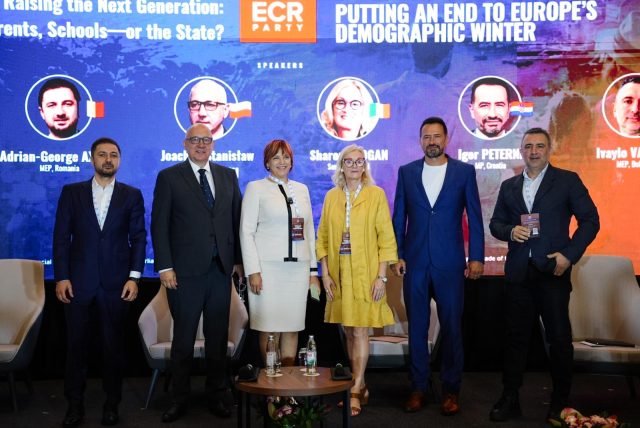
This year’s European Congress on Family focused on “Putting an End to Europe’s Demographic Winter”. Organised by the ECR Party, this third edition was hosted from September 11 to 13, in Dubrovnik, Croatia. The first session on Saturday, September 12, debated a fundamental yet increasingly sensitive topic: “Raising the Next Generation: Parents, Schools – or the State?” Which authority is best entitled to decide, or who should have the final say, when it comes to educating the next generation, in an era when artificial intelligence seems to influence more and more our lives and daily decisions.
Moderated by Romanian MP Cristina-Emanuela Dascălu, vice chair of the Chamber of Deputies’ Education Committee, the panel brought together three members of the European Parliament and two members of the parliaments of Ireland and Croatia.
In her opening remarks, Cristina Dascălu, who is also a university professor, highlighted a key paradox: we want our young people to start families and raise children, but society does not provide the proper conditions to do so. Children are a blessing, not a burden.
What should the state’s specific role be? What about schools? Who should provide the primary influence on the younger generation: parents, schools, the government, or even the all-too-advanced technology?
Modern technology, and more specifically Artificial Intelligence, is no longer a topic that can be addressed with superficiality. How should young people be educated so that new technologies play a benign role and strengthen their intelligence and judgement? This is a question of the utmost relevance today. Adrian Axinia, the leader of the AUR party delegation in the European Parliament, used the typical example of a young schoolgirl who, to finish her homework faster, asks a mobile app that gives her the correct answer almost instantly. What did she learn? Absolutely nothing. According to the Romanian MEP, artificial intelligence offers our children “an ocean of information,” while also leading them to believe that information obtained so quickly is equivalent to knowledge. Nothing could be further from the truth. Whoever thinks that a machine that provides seemingly accurate answers to any problem can replace traditional learning is mistaken.
Adrian Axinia believes that our children should continue to read. Whole books. Even though we have far more tools today than ten years ago, the proper learning process should remain unchanged. The belief held by some that AI should be a substitute for a teacher is a growing danger, and we must oppose this scenario with all our might, according to Axinia. True educators have always been – and will always be – parents, teachers, and friends, not a machine, even if it seems to offer the perfect answers. The Romanian MEP was firm: children should use artificial intelligence “only when they are emotionally and intellectually ready” and only under the constant supervision of parents and teachers.
Polish MEP Joachim Brudziński was asked where the role of the state and public education ends, and where parental authority begins. Brudziński admitted he feels “fortunate” that his daughters completed their studies before the era of artificial intelligence. The Polish MEP has no doubt about who should play the most important role in a child’s life – his mother and father. Parents are the ones who must shape “children’s consciences, sensibilities, and knowledge,” a right that must be defended at all costs. However, the Church should also exert significant influence, including by preserving our fundamental values.
Joachim Brudziński referred to “ideological charlatans” who, through social engineering methods, are attempting to infiltrate and corrupt the education system. Resisting this dangerous nonsense caused by left-wing activists is difficult, but not impossible, and parents need to set certain key boundaries.
In a harsher tone, Irish Senator Sharon Keogan stated that parents who “fell asleep at the wheel” are responsible for this situation, which is by no means easy. The Irish senator clearly stated that parents have not been active enough within our own communities, thereby allowing leftists to take their place. Sharon Keogan cited the community – the neighbourhood or the street where our children grew up, that “organic environment” in which children developed authentic communication and social skills, as well as an early stage of independence – as one of the main pillars that should not be missing from this debate. While today’s government has regulated even children’s playgrounds, its response to the real dangers within our society is virtually nonexistent. What the state must do is enforce the law and ensure peace in the communities where we live – by no means should it over-regulate needlessly or allow destructive ideologies to penetrate the education system. On the other hand, when parents fail, the state has a duty to intervene, stated Senator Sharon Keogan.
Igor Peternel, a member of the Croatian Parliament, said that the family is undoubtedly the foundation of society, but the reality – of which we must be aware – is a very harsh one. Digitalization has brought about transformations that seemed almost unimaginable just a few years ago. The struggle we face today is not against an oppressive state, as it was during the communist era, but against a different kind of threat – technology that seeks to control everyone’s lives and dictate certain behaviours.
According to Bulgarian MEP Ivaylo Valchev, in a healthy society, the family, the school, and the state should all be moving in the same direction. Even though parents bear the primary responsibility, this does not mean they can take the place of educators. Valchev’s concern is that the study of national history is viewed as “primitive, suspect, or an obstacle to becoming European.” But you won’t become more European by becoming less Bulgarian, less Italian or less Polish. Denying your own roots does not automatically make you a modern citizen. This view was also shared by Adrian Axinia, who stated that the contemporary system “educates” young people to lose their national identity, and that parents should have the right to withdraw their children from classes they consider inappropriate.
MEP Joachim Brudziski also spoke about his party’s attempt, while in power, to promote national identity and history through a subject they introduced in schools. It sparked outrage among leftists and “centrists”, who, once they came to power, allowed the education system to be ideologically infiltrated. Today’s battle is one for “the souls of our children,” fought against extremely powerful and dangerous adversaries.
For Sharon Keogan, one of the greatest dangers of our time is demographic change and the impact that mass migration has on the education system, while Igor Peternel believes that schools must under no circumstances become “indoctrination factories.”
When it comes to artificial intelligence, parents need to know what kind of information these technologies provide to their children and decide accordingly. Sharon Keogan drew attention to the “monster” we have created – a monster that annihilates critical thinking. According to Joachim Brudziński, AI can be very dangerous if it falls into the wrong hands, and common sense must always prevail, no matter what.
Parents, school, the community, the Church – each has its own specific role in raising and educating children. A child needs his mother and father and strong values, but does not need to be raised by algorithms or to constantly stare at screens, as moderator Cristina Dascălu, a member of the Romanian Chamber of Deputies, so rightly pointed out in her concluding remarks. To build the future, we need more natural intelligence and less artificial one.