





 Subscribe


I taught several interesting courses at the University of Iceland, but my favourite was American Politics. Each student had to deliver three presentations: on an American president of their choice, for example, Jefferson, Lincoln, Franklin D. Roosevelt, and Reagan (I always had to persuade students to choose the unjustly neglected Cleveland or Coolidge); on a film that illustrated aspects of American life, for example, All the President’s Men, Citizen Kane, The Grapes of Wrath, and Mr Smith Goes to Washington; and on a theme in American politics, such as civil rights, gender equality, and big business. My friend Davíd Oddsson, Prime Minister of Iceland from 1991 to 2004, gave a guest lecture on the four presidents he had met. First, as Mayor of Reykjavik in 1986, he welcomed Reagan to a summit with Mikhail Gorbachev, General Secretary of the Soviet Communist Party. Their talks started the process of ending the Cold War. Then, as a long-serving leader of a NATO country, he met George H. W. Bush, Bill Clinton, and George W. Bush on several occasions and became friendly with all of them.
Snow White was Icelandic
I told the students that when the Icelanders discovered America in 1000, they attempted to establish settlements there but retreated when hostile indigenous tribes confronted them. I recalled that in 1867, the American Secretary of State, William H. Seward, considered buying Greenland and Iceland from Denmark, just as he had recently bought Alaska from Russia. I added anecdotes, such as the fact that Walt Disney’s Snow White was Icelandic: her designer at the Disney Studios, the Icelandic-Canadian Charles Thorson, drew her from the image of an Icelandic girl he loved, Kristín Sölvadóttir, later a housewife in Iceland. Another American icon, the log cabin, comes from Sweden. I recommended, as complementary readings, the lively History of the American People by British polymath Paul Johnson and the intriguing novel Atlas Shrugged by Russian-American philosopher Ayn Rand, each book more than one thousand pages long.
The US Defends Iceland
Of course, I devoted much of the course to the relationship between Iceland and the United States. The British had occupied Iceland in May 1940, not least to prevent its occupation by Nazi Germany. But after the fall of France, they fought alone against Hitler and desperately needed their forces elsewhere. US President Roosevelt wanted to help, but had to move cautiously. An ideal first step was to defend Iceland through an agreement with the Icelandic government. This happened in the summer of 1941, when the American military replaced the British. Hitler was furious, but his generals advised him that occupying Iceland would be too costly. The US, however, only entered the War in December 1941, after the Japanese attack on Pearl Harbour. After the War, the US wanted a military base in Iceland, but accepted Iceland’s request to leave in 1946. When the Cold War began, Iceland became a founding member of the North Atlantic Treaty Organisation, NATO. As the Cold War intensified, in 1951 she made a new Defence Treaty: the US undertook again to defend Iceland and to keep a military base in the country.
New Challenges in the North Atlantic
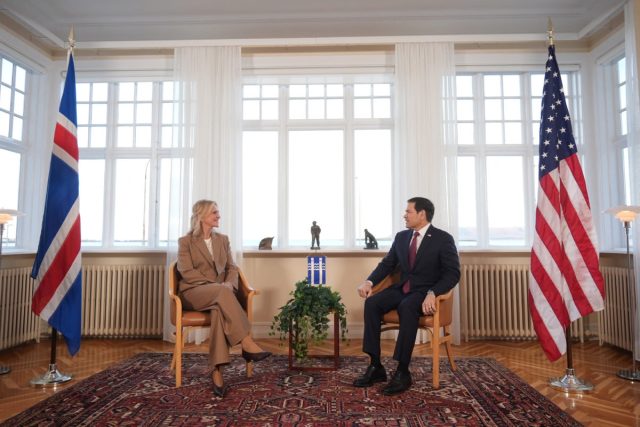
The American military base in Iceland was important during the Cold War. Already in 1920, Lenin highlighted Iceland’s strategic relevance in the era of aeroplanes and submarines. Later, Winston Churchill quoted a German geopolitical expert who said that whoever controlled Iceland held a pistol aimed at Great Britain, Canada and the US. Churchill also called Iceland ‘an unsinkable aircraft carrier’. But with the end of the Cold War, American interest in Iceland dwindled, and in 2006 the military base was closed. Now, however, tensions in the North Atlantic seem to have increased again, amid Russian and Chinese challenges. It was therefore no surprise that Secretary of State Marco Rubio visited Iceland on 5 October 2026, emphasising the close ties between the two countries and suggesting even closer cooperation in the future. Even the usually anti-American Foreign Minister Thorgerdur Katrín Gunnarsdóttir welcomed the charismatic American politician and showed him the house where Reagan and Gorbachev met (photo above). She had sought to bring Iceland into the European Union, but was roundly defeated in a referendum on 29 August 2026.